Try it on your own data
Every report in this article is in the free plan. One snippet for web and apps, up to 10 sites.
Start freeOpen source analytics saves licence fees, but you take over deployment, upgrades and data protection. It also does not mean private or compliant. In the sample below, self-hosting cost $11,100 over three years against $5,400 for a hosted plan, and the break-even is about 1.3 maintenance hours a month. Here is how to price it.
What you will learn
- Open source is not free, private or compliant; those are separate properties
- Self-hosting pays only if maintenance takes less time than the hosting fee saves
- Read the licence name, the network clause and the paid tier before you install
What does "open source analytics" actually mean?
Open source analytics is analytics software whose source code you can read, run and, within the terms of its licence, change and redistribute. It does not mean free, and it does not mean private or compliant. Those are separate properties, and mixing them up is the most common mistake in the decision.
The label covers four different arrangements, and they carry different obligations:
| Arrangement | Is the source open? | Who hosts it | The catch |
|---|---|---|---|
| Self-hosted, permissive licence | Yes, with few conditions | You | You run everything |
| Self-hosted, network copyleft licence | Yes, with sharing duties | You | Modifying and offering it over a network can require publishing your changes |
| Open core | Core is open, some features are not | You or the vendor | Features you expect may sit in a paid tier |
| Vendor-hosted open source | Yes | The vendor | You pay for hosting, not for the code |
A licence counts as open source in the formal sense when it meets the Open Source Initiative's definition: free redistribution, source code available, derived works allowed, no discrimination against people or fields of use. A "source available" licence that restricts commercial use may let you read the code without meeting that definition, so check the licence name before you assume anything. How this fits the wider tool landscape is in web analytics tools; if the goal is a privacy-first setup, GDPR-compliant analytics covers what configuration matters more than licence.
The claim of this article is narrow: open source saves licence fees, but you take over deployment, upgrades and data protection. The rest shows how to price that.
| Arrangement | Is the source open? | The catch |
|---|---|---|
| Self-hosted, permissive licence | Yes | You run everything |
| Self-hosted, network copyleft | Yes, with sharing duties | Modifying and offering it over a network may require publishing changes |
| Open core | Core only | Expected features may sit in a paid tier |
| Vendor-hosted open source | Yes | You pay for hosting, not for the code |
Check the licence name before you assume which row applies.
What are the real costs of self-hosting analytics?
Four jobs move from the vendor to you the day you self-host:
| Job | What it involves | Who does it |
|---|---|---|
| Deployment | Server, database, reverse proxy, TLS, backups | You |
| Upgrades and patches | Applying releases, running migrations, fixing breaks | You |
| Scale and storage | Growing the database as events accumulate, tuning queries | You |
| Data protection | Retention, deletion, access control, breach readiness | You, as the operator |
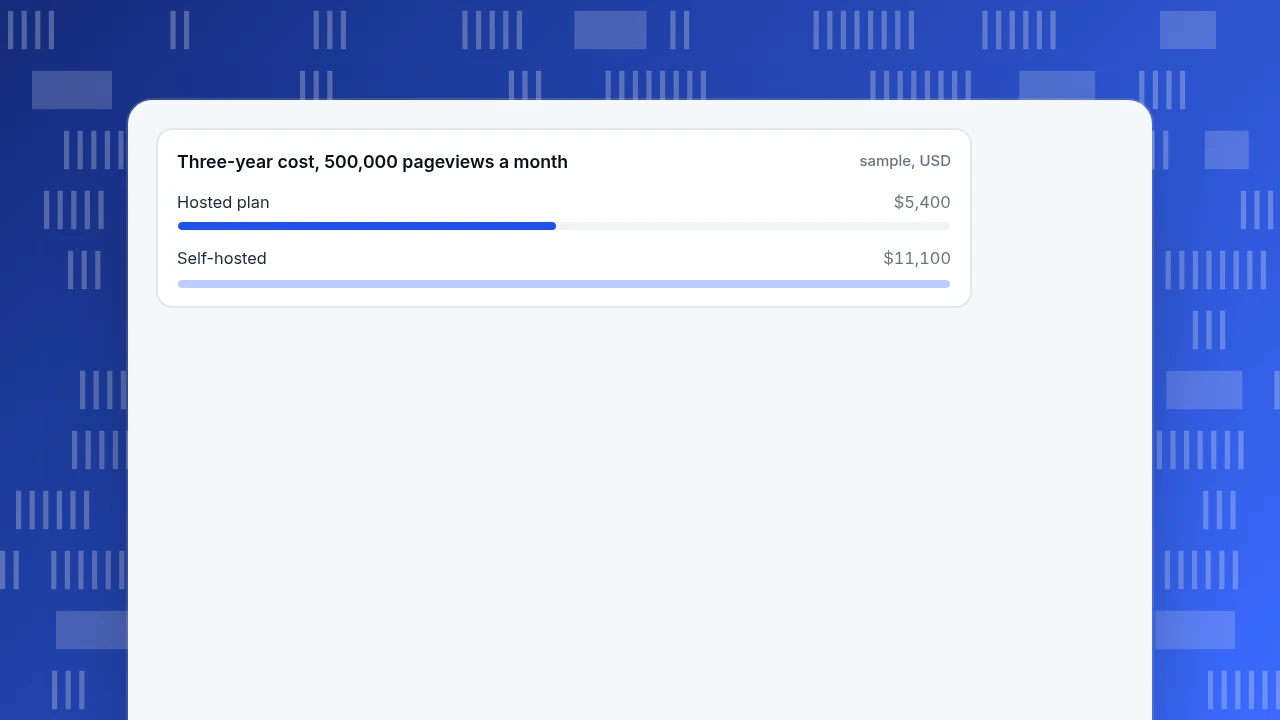
Sample data: a site with 500,000 pageviews a month compares a self-hosted instance with a hosted plan at $150 a month, with labour at $75 an hour.
| Item | Self-hosted | Hosted plan |
|---|---|---|
| Server | $40 × 12 = $480 a year | included |
| Backups and storage | $10 × 12 = $120 a year | included |
| Setup (once) | 16 h × $75 = $1,200 | 0 |
| Maintenance | 3 h a month × 12 × $75 = $2,700 a year | 0 |
| First year | $4,500 | $1,800 |
| Three years | $1,200 + 3 × $3,300 = $11,100 | $5,400 |
Recomputed: 480 + 120 + 1,200 + 2,700 = 4,500 for year one; 480 + 120 + 2,700 = 3,300 for each later year; 1,200 + 3 × 3,300 = 11,100 over three years; 150 × 36 = 5,400 for the hosted plan.
The break-even is the rule worth keeping. Self-hosting saves $150 − $50 = $100 a month in fees, which pays for 100 ÷ 75 = 1.3 hours of work a month. If maintenance takes longer than that, hosting is cheaper. Even at one hour a month, the setup keeps the self-hosted total above the hosted one over three years (1,200 + 3 × 1,500 = $5,700 against $5,400). The numbers change if your time is free or your site is much larger, but the formula does not.
Three-year cost, 500,000 pageviews a month
sample, USDWhat should you check in a licence before adopting a tool?
A licence is a contract with obligations. Before you commit data to a tool, read the licence name and answer these questions:
| Question | Why it matters |
|---|---|
| Is the licence on the Open Source Initiative's approved list? | Confirms the freedoms you expect |
| Is it permissive or copyleft? | Copyleft can oblige you to share changes |
| Does it have a network clause? | The AGPL, for example, applies to software offered over a network, which is how analytics runs |
| Which features are in the paid tier? | Open core can gate what you assumed was included |
| Can you export your data in a documented format? | Determines whether you can leave later |
The network clause deserves one extra sentence. Under the GNU AGPL, if you modify the program and let users interact with it over a network, you must offer them the source of your modified version. If you only run the unmodified program, there is nothing extra to publish. If you plan to patch it, ask the person who understands the licence before you do.
What do you take on for data protection when you host it yourself?
Open source does not make an analytics tool compliant; what you do with it does. When you host it yourself you are the party that decides why and how personal data is processed, which makes you the controller under the GDPR, and you also operate the system that processes it. That brings concrete duties:
- Security of processing. Article 32 requires measures appropriate to the risk. For a self-hosted database, that means patches, access control and backups are yours.
- Storage limitation. Article 5(1)(e) says personal data should be kept no longer than needed, so you need a retention job, not just a database.
- Erasure and access requests. Article 17 gives people the right to ask for deletion, so you need a way to find and delete one person's events.
- Choice of location and recipients. Where the server sits and who administers it are your decisions.
None of this is a reason to avoid self-hosting; it is the work that sits next to the licence saving. Configuration also matters: whether a tool sets cookies, truncates addresses or needs consent depends on how it is set up and on local law. For a fuller treatment, see GDPR-compliant analytics and data protection strategy. This is general information, not legal advice.
When does open source analytics fit, and when does a hosted service?
Use the facts about your team rather than the label:
| If this is true | Lean towards |
|---|---|
| You need code-level control or must run inside your own network | Self-hosted open source |
| Someone already operates servers and databases for you | Self-hosted open source |
| Maintenance would take more than about 1.3 hours a month at your rates | A hosted service |
| Nobody owns patching and backups | A hosted service |
| You need a feature that is in an open-core paid tier | Check the tier, then decide |
| You want the data in a place you control but not the operations | Vendor-hosted open source |
The honest middle path is vendor-hosted open source: you keep the option to leave and run it yourself, and you pay for someone else to keep it patched.
How do you evaluate an open source analytics project in five steps?
- Read the licence name and check it against the table above.
- Check project health: the date of the last release, how many maintainers commit, and how fast security issues get fixed.
- Read the upgrade notes from the last two versions. Frequent breaking migrations mean frequent maintenance hours.
- Test the data export and a deletion of one person's events on a trial instance.
- Price the maintenance with the break-even formula and decide before you install, not after.
If the project has not released in a year and security issues sit unanswered, do not put production data in it, whatever the licence says.
Common mistakes when choosing open source analytics
- Equating open source with free. In the sample, the "free" option cost $11,100 over three years against $5,400 hosted.
- Equating open source with private. A self-hosted tool that logs full addresses and keeps data indefinitely is less private than a configured hosted one.
- Ignoring the network clause. Patching a copyleft tool and running it publicly can create a duty to publish.
- Forgetting the upgrade treadmill. The first install is cheap; the twentieth upgrade is the cost.
- No exit plan. If you cannot export a clean copy of your events, you are locked in whether or not the code is open.
- No owner. Unpatched analytics servers collecting personal data are a liability.
How does TapCub compare on these costs?
TapCub is a hosted service, not software you install; its client SDKs are published in public repositories, but the service itself is not self-hosted. Here is how the four jobs from the cost table look for a team that chooses it.
- Deployment and upgrades. There is no server to run: you add one script to the website, or an SDK to an app, and the service is operated for you. The maintenance hours in the sample cost table do not apply, but you also do not get the source to run yourself. If code-level control is a requirement, self-hosting is the right path.
- Exit. Raw detail leaves by asynchronous export in All-platform analytics › Data › Data export; the console shows summary data, and the export is the way to get events out. Details older than the retention period have already been deleted, while the daily summaries contain no personal data.
- Data protection settings. In Configuration › Privacy center you choose a collection tier, address truncation, retention, and handle data subject requests (export and delete). Tracking is cookie-free by default and IP addresses are not stored; whether consent is required depends on your configuration and local law.
- Sharing. Configuration › Settings › Public sharing creates read-only links with an optional password and a limit on how many days the viewer can see.
TapCub does not make you compliant by itself, and it does not replace legal advice. It removes the hosting and patching work and gives you the privacy controls above.
FAQ
What is open source analytics?
Open source analytics is analytics software whose source code you can read, run and, under its licence, modify. It does not by itself mean free to run, private or compliant. Check the licence, the hosting model and the tier a feature sits in.
Is open source analytics free?
The licence usually costs nothing, but running it does not. In the sample, self-hosting cost $11,100 over three years against $5,400 for a hosted plan, because setup and maintenance hours were the larger part. Count your time before you call it free.
Is self-hosted analytics GDPR compliant?
Not automatically. If you host it yourself you are responsible for security, retention, deletion and the configuration of cookies and addresses. The tool can help, but compliance depends on how you run it and on local law. This is not legal advice.
What is the catch with the AGPL licence?
If you modify AGPL software and let people interact with it over a network, you must offer them the source of your modified version. Running it unmodified does not trigger the extra duty. Ask someone who understands the licence before you patch it.
When is self-hosting analytics worth it?
When you need code-level control, must keep data inside your own network, or already operate servers, so that maintenance takes less than the hosting fee saves, about 1.3 hours a month in the sample. If nobody owns patching, use a hosted service.
Sources
- Open Source Initiative. The Open Source Definition — the ten criteria a licence must meet to be called open source. Verified 2026-11-19.
- Free Software Foundation. GNU Affero General Public License, version 3 — section 13 on remote network interaction. Verified 2026-11-19.
- European Union. Regulation (EU) 2016/679 (GDPR) — Article 5(1)(e) on storage limitation, Article 17 on erasure and Article 32 on security of processing. Verified 2026-11-19.
Was this article helpful?
We use your answers to fix and expand this page.
Couldn’t send. Please try again in a minute.
Thanks for the feedback. We’ll use it to improve this page.You’ve already sent feedback on this page. Thanks.

Data Analyst
Explores traffic sources, conversion funnels, and retention, using clear metric definitions and concrete examples to explain what the numbers mean.