Try it on your own data
Every report in this article is in the free plan. One snippet for web and apps, up to 10 sites.
Start freeTo identify your competitors, combine at least three sources of evidence: the domains that rank for your target queries, the alternatives customers mention in sales calls and chats, and the advertisers that overlap with you in auctions. Score each candidate on search share, customer mentions and fit, and keep the top three to five.
What you will learn
- No single source finds direct, indirect and search rivals; use at least three and score them together
- In the sample, Rival D appears in only 3 of 12 searches but 7 of 20 conversations, and still scores as a core competitor at 0.51
- Keep three to five core rivals, review the watch tier twice a year and rerun the exercise every quarter
Who counts as your competitor?
Your competitors are the businesses your customers compare you with, not only the ones that sell what you sell. The US Small Business Administration puts it this way: a competitive analysis should identify competition by product line or service and by market segment, and it should include indirect or secondary competitors that may affect your success. The difference between direct and indirect rivals is covered in direct vs indirect competitors; this guide is about finding them with evidence instead of memory.
Three kinds of rival show up in practice, and each leaves a different trace:
| Kind | Who they are | Where you will see them |
|---|---|---|
| Direct | Sell an interchangeable product to the same buyer | Customer comparisons, sales calls, review sites |
| Indirect or substitute | Solve the same problem another way, such as a spreadsheet or an agency | Customer answers to "what did you use before?" |
| Search rival | Rank for the same queries, even if they sell something different | Search results and ad auctions |
The claim of this guide is that no single source finds all three, so use at least three sources and score the candidates against each other. A rival who dominates search results but never comes up in sales calls is a different problem from one who never ranks and appears in half your lost deals.
Which four sources of evidence should you use?
| Source | What it finds | Weakness |
|---|---|---|
| Search results for your target queries | Search rivals and the direct rivals who invest in the same content | Misses rivals who win through sales or word of mouth |
| Customers: sales calls, lost deals and chats | Direct and indirect rivals as buyers actually see them | Small samples; people forget what they considered |
| Ad auctions | Who bids on the same searches, if you run search ads | Only shows paying advertisers |
| Referrals and traffic overlap | Sites that send you visitors, such as comparison and list pages | Shows who is mentioned, not who is chosen |
The next four sections take them in turn and then combine them into one score.
| Source | What it finds | Weakness |
|---|---|---|
| Search results | Search rivals and direct rivals who invest in content | Misses rivals that win through sales or word of mouth |
| Customers | Direct and indirect rivals as buyers see them | Small samples; people forget |
| Ad auctions | Who bids on the same searches | Only shows paying advertisers |
| Referrals | Sites that compare or list you | Shows who is mentioned, not who is chosen |
Use at least three of the four sources and score the candidates together.
How do you find rivals in search results?
Pick the queries a buyer would use, search each in a private window, and record which domains appear in the top 10. Count how many queries each domain appears in. Use 10 to 15 queries across three types: what you sell ("project management software for agencies"), the problem ("track client deadlines") and comparison searches ("alternatives to" or "vs"). Skip queries that are only about your own brand.
Sample data: 12 queries, top 10 results each. The domains are placeholders.
| Domain | Queries where it appears (of 12) | Share |
|---|---|---|
| Rival A | 11 | 91.7% |
| Rival B | 9 | 75.0% |
| Rival C | 8 | 66.7% |
| Rival E | 6 | 50.0% |
| Rival D | 3 | 25.0% |
| Rival F | 2 | 16.7% |
Treat the share as the search-overlap number. Exclude pages that are not competitors even though they rank, such as review sites, forums, encyclopedias and media; they matter in the referrals step, where they are sources of traffic rather than rivals. Repeat the search from the country you sell in, because results differ by location.
How do you find rivals from customer evidence?
Open your last 20 sales calls, lost deals or chat conversations and write down every alternative the buyer mentioned, whether by name or as "a spreadsheet" or "doing it ourselves". If you do not record calls, ask the question at the end of the next 20: "What else did you look at?" Count the mentions per rival.
Sample data: 20 conversations.
| Rival | Mentions (of 20) | Share |
|---|---|---|
| Rival A | 9 | 45.0% |
| Rival D | 7 | 35.0% |
| Rival B | 6 | 30.0% |
| Spreadsheets | 5 | 25.0% |
| Rival C | 1 | 5.0% |
| Rival E, Rival F | 0 | 0.0% |
Two things stand out. Rival D appears in 7 of 20 conversations but only 3 of 12 searches, so it wins customers by a route that search results do not show, perhaps a sales team or a partner network. And a spreadsheet, which no search or ad tool would ever list, is a rival in 5 of 20. Twenty conversations is a small sample; it is a direction, not a market share.
Can ad auctions show who else you compete with?
If you run Google search ads, the Auction Insights report shows how your ads perform against other advertisers in the same auctions. Its metrics include impression share, overlap rate (how often a competitor's ad showed in the same auctions as yours), outranking share (how often your ad ranked above theirs or showed when theirs did not) and, for search campaigns, position above rate and top of page rate. A competitor with a high overlap rate across several of your campaigns is bidding on the same buyers, whether or not they ever appear in your sales calls.
Use it as a third source, not the main one. It reports only advertisers, and a rival with no ad budget will not appear. If you do not run search ads, skip this step; the score below works without it.
How do you score the candidates?
Combine the evidence into one number per candidate so that you rank by data and not by who you fear most.
Score = 40% × search share + 30% × customer-mention share + 30% × fit
Here fit is a rating from 0 to 3 of how close the rival is to your product, price and buyer (0 is far, 3 is nearly the same), divided by 3. Search share is appearances ÷ 12 and customer-mention share is mentions ÷ 20, both from the tables above.
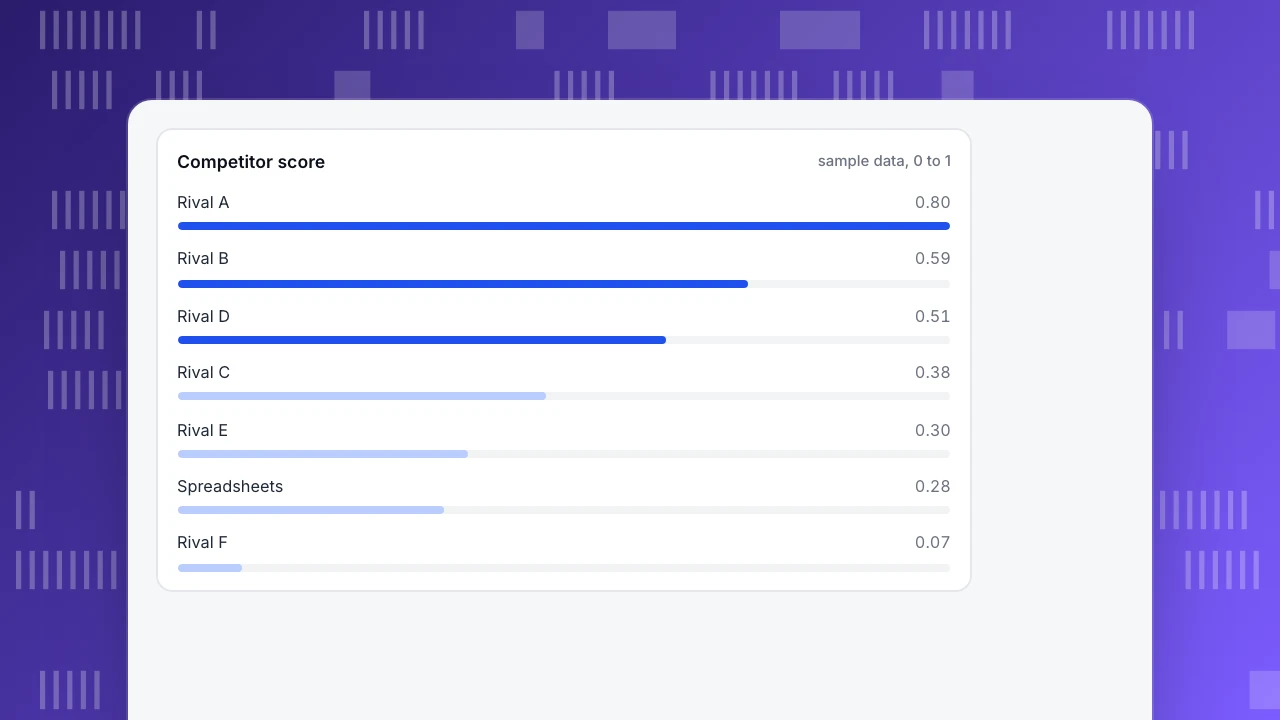
| Candidate | Search share | Mention share | Fit (0–3) | Score | Tier |
|---|---|---|---|---|---|
| Rival A | 91.7% | 45.0% | 3 | 0.80 | Core |
| Rival B | 75.0% | 30.0% | 2 | 0.59 | Core |
| Rival D | 25.0% | 35.0% | 3 | 0.51 | Core |
| Rival C | 66.7% | 5.0% | 1 | 0.38 | Watch |
| Rival E | 50.0% | 0.0% | 1 | 0.30 | Watch |
| Spreadsheets | 0.0% | 25.0% | 2 | 0.28 | Watch |
| Rival F | 16.7% | 0.0% | 0 | 0.07 | Ignore |
For example, Rival A scores 0.4 × 0.917 + 0.3 × 0.45 + 0.3 × (3 ÷ 3) = 0.367 + 0.135 + 0.300 = 0.80. Rival D scores 0.4 × 0.25 + 0.3 × 0.35 + 0.3 × 1 = 0.100 + 0.105 + 0.300 = 0.505, which makes it a core competitor despite being nearly invisible in search. That is exactly what a search-only method would have missed. The weights are a choice: if you sell mostly through search, raise the search weight, and change it once, not after you see the result.
Competitor score
sample data, 0 to 1What do you do with the list?
Use tiers so the list stays short enough to act on:
- Core (score 0.50 or more): 3 to 5 rivals. Review their pricing, positioning and the pages that rank against you every quarter. These are the ones to benchmark against, as described in competitor benchmarking.
- Watch (0.25 to 0.49): check twice a year. A rival here can move up: a watch-tier rival that gains search share should be re-scored.
- Ignore (below 0.25): drop them from regular tracking.
Rerun the whole exercise every quarter, because the search results and your buyers change. And note the limit: the list tells you whom you are compared with, not how big they are. For traffic estimates, see seeing competitors' website traffic, which covers the tools that estimate it.
Which mistakes make the competitor list wrong?
- Naming only the biggest brands. Large companies are easy to remember, but if none of them appears in your searches or conversations they are not your competitors. In the sample, Rival F never appeared in a conversation and scored 0.07.
- Forgetting the substitute. A spreadsheet, a manual process or an agency scored 0.28 in the sample and would not exist on a list built from search results alone.
- Using one set of queries. If every query includes your own category word, you only find rivals who use the same words. Include queries about the problem itself.
- Counting rivals the buyer never compared. A rival who ranks but is never mentioned and has a fit of 0 or 1 belongs in the watch tier at most.
- Never rerunning it. A list that is two years old describes a market that has moved.
How do you use TapCub in this?
TapCub does not show competitors' traffic or rankings; it shows how your own visitors arrive and what they ask. Both are evidence for the list above.
- Check who sends you visitors. In Web analytics › Sources, read the referring domains. Comparison pages, "alternatives" lists and review sites that send you visitors tell you which rivals your buyers are comparing you with, and the UTM view separates your own campaigns from organic referrals.
- Find the queries where you rank. If you connect Google Search Console or Bing Webmaster, Monitoring › Search performance lists clicks, impressions, click-through rate and average position by page, query and country. Take your top queries as the input to the search-results step, and search them yourself to see who else ranks. Data arrives 1 to 3 days late.
- Read the chat conversations. If live chat is on, each conversation arrives with the visitor's source and the page they are on, and the transcript shows what they compare. Add "what else did you look at?" to your agents' routine questions and tally the answers in your own sheet.
- Watch what changes after you act. When you change a page against a rival, mark it in Configuration › Annotations and compare the same pages' traffic and goal conversions before and after.
FAQ
How do you find out who your competitors are?
Combine at least three sources: the domains that rank for your target queries, the alternatives customers mention in sales calls and chats, and the advertisers that overlap with you in ad auctions. Score the candidates and keep the top three to five.
What is the difference between direct, indirect and search competitors?
Direct competitors sell an interchangeable product to the same buyer. Indirect competitors solve the same problem another way, such as a spreadsheet. Search competitors rank for your queries even if they sell something else. Each shows up in a different source.
How do you find competitors online?
Search your 10 to 15 target queries in a private window and count how often each domain appears in the top 10. Add the sites that send you referral traffic and, if you run search ads, the advertisers in your auction insights.
How many competitors should you track?
Three to five core rivals for regular review, and a short watch list reviewed twice a year. More than that and the review stops being read. Rerun the scoring every quarter, because search results and buyers change.
Sources
- U.S. Small Business Administration, Market research and competitive analysis — identify competition by product line or service and market segment, and include indirect or secondary competitors. Checked 2026-11-21.
- Google Ads Help, About Auction Insights — impression share, overlap rate, outranking share, position above rate and top of page rate. Checked 2026-11-21.
Was this article helpful?
We use your answers to fix and expand this page.
Couldn’t send. Please try again in a minute.
Thanks for the feedback. We’ll use it to improve this page.You’ve already sent feedback on this page. Thanks.

Product Analyst
Focuses on event analysis, conversion funnels, and retention, using clear metric definitions and structured analysis to explain product performance.