Try it on your own data
Every report in this article is in the free plan. One snippet for web and apps, up to 10 sites.
Start freeGrowth engineering is the practice of using software engineering to move a company's growth metrics through small, measurable experiments. Its unit of work is a testable change tied to a number, not a feature. This guide gives the seven-step loop, a worked sample-size example (a 5.0% to 6.0% lift needs 7,600 visitors per variant), a scored backlog and the groundwork a team needs before its first test.
What you will learn
- Growth engineering turns an idea into a testable change tied to one metric, with guardrails and a written result either way
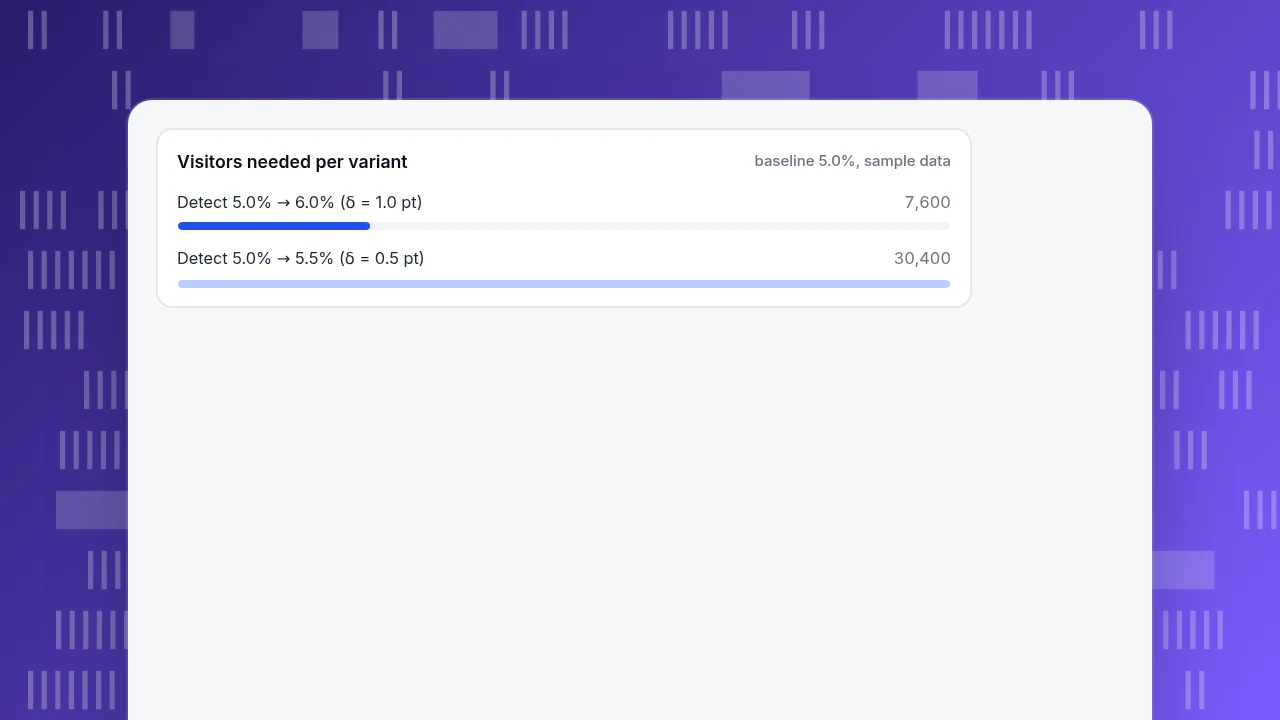
- Halving the lift you want to detect multiplies the sample by four: 7,600 per variant for 5.0% to 6.0%, 30,400 for 5.0% to 5.5%
- Decide the sample before you start; stopping on the first significant result inflated false positives to 26.1% in a published example
What is growth engineering?
Growth engineering is the practice of using software engineering to move a company's growth metrics through a steady stream of small, measurable experiments. A growth engineer writes the code that changes a signup flow, an onboarding step, a pricing page or a lifecycle message, instruments it, and ships it so the effect on a metric can be read. The unit of work is not a feature; it is a testable change tied to a number.
The discipline is young as a job title, and descriptions vary by company. Gergely Orosz's Pragmatic Engineer newsletter, in a deep dive with Alexey Komissarouk, a former head of growth engineering at MasterClass, organises it around what growth engineers work on and why they tend to move faster than product engineers. Read that for one practitioner's view; this guide gives a general model you can apply to your own funnel.
A working definition, in three parts:
- A target metric — signups, activation, repeat purchase, revenue per visitor.
- Code that changes how users meet the product — flows, copy, speed, messages, pricing display.
- A way to read the result — a controlled test where you can run one, or a before/after comparison with guardrails where you cannot.
How is growth engineering different from growth hacking, growth marketing and product engineering?
The boundaries are blurry in practice, but the centre of gravity differs:
| Role | Main tool | Typical output | Success measure |
|---|---|---|---|
| Growth engineering | Code and experiments | A shipped, measured change | Lift in a funnel metric |
| Growth marketing | Channels, creative, offers | Campaigns and content | Cost per acquisition, qualified traffic |
| Growth hacking | Quick tactics | One-off tricks | Short-term spike |
| Product engineering | Roadmap features | New capability | Delivery against a plan |
Growth marketing and growth engineering overlap at the landing page: marketing decides who arrives with which promise, engineering decides what the page does with them. For the team-level view, see growth team; for the channel side, growth marketing strategies. This article stays on the engineering loop.
| Role | Main tool | Typical output | Success measure |
|---|---|---|---|
| Growth engineering | Code and experiments | A shipped, measured change | Lift in a funnel metric |
| Growth marketing | Channels, creative, offers | Campaigns and content | Cost per acquisition |
| Growth hacking | Quick tactics | One-off tricks | Short-term spike |
| Product engineering | Roadmap features | New capability | Delivery against a plan |
Boundaries blur in practice; the centre of gravity is what differs.
What does the growth engineering loop look like?
Seven steps, repeated:
- Pick the metric. One funnel step, such as visitor → signup.
- Write the hypothesis. "Shortening the signup form from six fields to three will raise signup rate from 5.0% to 6.0%."
- Define the guardrails. Metrics that must not get worse: error rate, page speed, refund rate.
- Build the smallest change that tests the hypothesis.
- Instrument it before launch, and check the events arrive.
- Run it for a pre-set sample or time, without stopping early.
- Decide: ship, revert or iterate, and write the result down whichever way it went.
The loop's value is in step 7. A team that keeps a log of ideas, results and reversals learns which levers move its funnel; a team that only ships winners cannot tell luck from skill.
How long does an experiment need to run? A worked example
Many "failed" tests are underpowered ones. A common rule of thumb, from Evan Miller's guide to A/B testing, sets the sample per variant at n = 16σ² / δ², where δ is the smallest change you want to detect, in absolute percentage points, and σ² = p(1 − p) for a conversion rate p. The page offers it as a rule of thumb for fixing the sample size before the test starts.
Sample data: the signup page converts at p = 5.0% and you want to detect a lift to 6.0%, so δ = 1.0 point = 0.01.
- σ² = 0.05 × 0.95 = 0.0475
- n = 16 × 0.0475 ÷ 0.01² = 0.76 ÷ 0.0001 = 7,600 visitors per variant, or 15,200 in total.
- If 3,000 eligible visitors arrive per week, that is 15,200 ÷ 3,000 ≈ 5.1 weeks; round up to six so every weekday is covered equally.
Now ask for a smaller lift, 5.0% to 5.5% (δ = 0.005):
- n = 16 × 0.0475 ÷ 0.005² = 0.76 ÷ 0.000025 = 30,400 per variant, 60,800 in total, about 20.3 weeks at the same traffic.
Halving the effect you can detect multiplies the sample by four, which is why low-traffic sites should test bigger changes, not smaller ones.
Do not stop early when the number looks good. Miller's example: with a 50% baseline and a change that does nothing, stopping the first time the result reaches 5% significance, or at 150 observations, produced a false-positive rate of 26.1%, more than five times the nominal 5%. Decide the sample before you start.
If you cannot reach the sample in a reasonable time, say so and change the decision rule: ship the change on judgement, compare before and after with the guardrails watched, and record that the evidence is observational.
Visitors needed per variant
baseline 5.0%, sample dataWhat if you do not have enough traffic?
Low traffic limits the experiments you can read, not the ones you can ship. Four options, in order of preference:
- Test a bigger change. The sample falls with the square of the effect, so a redesign tests easier than a button colour.
- Move to an earlier step with a higher base rate. Sample data: if 30% of visitors start the signup form, a lift to 33% (δ = 0.03, σ² = 0.3 × 0.7 = 0.21) needs 16 × 0.21 ÷ 0.03² = 3,733 per variant, far fewer than the 7,600 for the 5.0% completion rate. The trade-off: starts are a proxy, and a change can raise starts while lowering completions, so watch both.
- Compare before and after with guardrails, annotate the date, and label the evidence observational.
- Skip the test for changes that are low-risk and obviously right, such as fixing a broken form, and spend the traffic where the answer is uncertain.
What do growth engineers actually build?
| Area | Example work | Metric it targets |
|---|---|---|
| Acquisition pages | Landing page speed, form length, personalised hero | Visitor → signup |
| Onboarding | Setup checklist, empty states, sample data | Signup → activated |
| Lifecycle | Triggered emails or in-app messages | Activated → returning |
| Monetisation | Pricing page layout, plan comparison, checkout steps | Active → paying |
| Referral | Invite flows, share links | Existing users → new signups |
| Platform | Experiment assignment, event pipeline, feature flags | Speed and reliability of testing itself |
The platform row is easy to miss: the fastest-moving teams build the tooling that makes the next experiment cheap, because every test shares the same assignment, logging and analysis steps.
How do you decide which experiment to run first?
Score ideas with a simple, explicit formula so the argument is about inputs and not about who spoke last. One workable score: users affected per month × expected relative lift × confidence (0 to 1) ÷ engineer-weeks. Sample backlog:
| Idea | Users/month | Expected lift | Confidence | Weeks | Score |
|---|---|---|---|---|---|
| Shorter signup form | 10,000 | 10% | 0.7 | 1 | 700 |
| Pricing page copy | 6,000 | 5% | 0.5 | 0.5 | 300 |
| Faster landing page | 20,000 | 3% | 0.8 | 2 | 240 |
| Onboarding checklist | 3,000 | 15% | 0.5 | 3 | 75 |
| Referral link | 2,000 | 20% | 0.3 | 4 | 30 |
The order is 700, 300, 240, 75, 30. The weights are guesses, so treat the ranking as a conversation starter and revisit it after each result; the useful output is that the cheap, wide change beats the exciting, narrow one.
What has to be in place before the first test?
- Event definitions agreed in writing. A test cannot be read if "signup" means different things in two places.
- Stable identity. Anonymous visitor to logged-in user, so a person is counted once across the test.
- Variant recorded on every relevant event, as a property, so you can split any report by it.
- Guardrail metrics watched. Error rate, page speed and refunds should have thresholds and an alert.
- Bots excluded. Automated visits distort both arms and the denominators.
Which mistakes slow growth engineering down?
- Testing a change too small for the traffic. See the sample-size table above.
- Peeking and stopping on the first win. It inflates false positives.
- No guardrails. A signup lift bought with a rise in errors is a loss.
- Running tests nobody logs. Without the log the team repeats ideas.
- Treating one win as a rule. Re-test on another page or season before generalising.
- Optimising a step that is not the bottleneck. Look at the whole funnel first; see AI conversion rate optimization for how automated suggestions fit in.
How to use TapCub in a growth engineering loop
TapCub does not assign users to variants, run experiments or manage feature flags; those stay in your own code or test tool. It is where you measure what happened. Using the signup test above:
- Plan the events. Record
signup_startedandsignup_completedin All-platform analytics › Data › Tracking plan with a status; switch on live verification to see arrivals and required-property completeness over the last 24 hours. - Send the variant. Add a
variantproperty to the events from your code, then read All-platform analytics › Behavior › Behavior analysis: a funnel from visit tosignup_completed, broken down byvariant(a funnel breakdown uses the first layer only). - Watch guardrails. In All-platform analytics › Operations › Monitors, add monitors on
error_rateandbounce_ratewith a dry run first, and use Monitoring › Performance for page speed. A monitor only notifies; it does not roll anything back. - Annotate the rollout. Add a date annotation under Configuration › Annotations so the launch is visible on every chart.
- Read after the sample is reached. Compare the two arms once, at the planned sample. Bots are counted separately, so crawlers do not sit in the denominators.
FAQ
What is growth engineering?
Growth engineering is using software engineering to move growth metrics through small, measurable experiments. Engineers change signup flows, onboarding, pricing displays and messages, instrument the change, and read the effect on a funnel metric.
What does a growth engineer do?
A growth engineer ships testable changes tied to a metric: shorter forms, faster pages, onboarding steps, triggered messages, referral flows, and often the experiment tooling itself. They also log results, including failures, so the team learns which levers move the funnel.
How is growth engineering different from growth marketing?
Growth marketing works through channels, creative and offers to bring the right people in; growth engineering works through code and experiments on what happens once they arrive. They overlap on landing pages and share the same funnel metrics.
How many users do I need to run an A/B test?
It depends on the baseline and the smallest lift you want to detect. For a 5.0% baseline and a target of 6.0%, the rule n = 16σ²/δ² gives 7,600 per variant; for a target of 5.5% it gives 30,400. Decide the sample before you start.
Do I need to write code to do growth work?
You can run copy and campaign tests without code, but growth engineering means changing the product itself: flows, speed, pricing display, event pipelines. Teams without engineers can still use the loop; the changes are just limited to what no-code tools can alter.
Sources
- Orosz, G. & Komissarouk, A. What is Growth Engineering?. The Pragmatic Engineer, March 2025 — what growth engineers work on and how they differ from product engineers. Read 2026-11-19.
- Miller, E. How Not To Run an A/B Test — the peeking problem (26.1% false-positive example) and the n = 16σ²/δ² rule of thumb. Read 2026-11-19.
Was this article helpful?
We use your answers to fix and expand this page.
Couldn’t send. Please try again in a minute.
Thanks for the feedback. We’ll use it to improve this page.You’ve already sent feedback on this page. Thanks.

Product Adoption Consultant
Explores customer onboarding, live conversations, and self-service, turning common usage questions into practical guidance and improvements.