Try it on your own data
Every report in this article is in the free plan. One snippet for web and apps, up to 10 sites.
Start freeAI visibility tracking is the repeated measurement of whether AI assistants mention or cite your site and how many visits they send back. Track both, because a mention that sends nobody is not worth much, and treat any single check as noise. Below: the metrics by where they come from, three methods, why 20 runs cannot show change, a recomputed traffic month and the limits.
What you will learn
- Track two things: whether you are cited, and how many visits the citations bring; keep mentions and traffic separate
- One run of a prompt is a single draw: 20 runs cannot tell 35% from 55%, 100 runs can
- Use first-party analytics as the base: AI crawls, AI-referred visits, cited pages and conversion
What is AI visibility tracking?
AI visibility tracking is the repeated measurement of two things: whether AI assistants mention or cite your site when people ask relevant questions, and how many visits those assistants send back. The first is measured from the outside, by asking assistants questions and recording the answers. The second is measured from the inside, in your own analytics. A tracker that only does the first tells you about reputation; one that only does the second tells you about traffic; you need both to know whether being mentioned is worth anything.
It differs from two pages already on this site. AI visibility explains what the term means and why it matters. An AI visibility audit is a one-off checklist: can crawlers fetch your pages, what do assistants cite, did visits convert. Tracking is what you do after the audit, on a schedule, so that you can see change. The core of this guide: track whether you are cited, and how many visits the citations bring, and treat any single check as noise.
Which metrics should you track?
Split the metrics by where they come from, because they fail in different ways.
| Metric | Formula | Measured from | What it tells you |
|---|---|---|---|
| Mention rate | Runs where your brand appears ÷ total runs of a prompt set | Prompt sampling | Whether assistants know you for these questions |
| Citation rate | Runs where your URL is cited ÷ total runs | Prompt sampling | Whether they send people to you or only name you |
| Share of voice | Your mentions ÷ mentions of all brands in the same runs | Prompt sampling | Your position among competitors, by set of prompts |
| Accuracy of the answer | Runs where the description of you is correct ÷ runs that mention you | Prompt sampling, read by a person | Whether what they say about you is true |
| AI crawls | Fetches by AI crawlers | Your logs or analytics | Whether your pages are being read at all |
| AI-referred visits | Human sessions whose source is an AI assistant | Your analytics | Whether answers produce traffic |
| Crawl-to-visit ratio | AI-referred visits ÷ AI crawls | Your analytics | Reads that turn into visits |
| Cited pages | Landing pages receiving AI-referred visits | Your analytics | Which content is being used |
| Conversion of AI visits | Goal completions ÷ AI-referred visits | Your analytics | Whether the visits are worth anything |
Mention and citation are different. An assistant can name your brand from memory and never send anyone to your site; a citation with a link is the one that can produce a visit. Track both and keep them separate.
What do different AI crawler visits mean?
A crawl is not a single thing. OpenAI, for example, documents three user agents with different jobs, and the difference changes what a count means.
| User agent | What OpenAI says it does | What a visit tells you |
|---|---|---|
| OAI-SearchBot | Surfaces sites in ChatGPT's search features | Your pages are candidates to appear in search answers |
| GPTBot | Crawls content that may be used to train its models | Training use; not a signal that you are cited in answers |
| ChatGPT-User | Visits a page when a user's question or an action requires it | A person's question caused this fetch, so your page was being used in a live answer |
Two consequences. First, a crawl count that mixes training crawlers with user-triggered fetches overstates how often you are used in answers; the user-triggered ones are the closest crawl signal to "this was read for a question". Second, OpenAI notes that robots.txt rules may not apply to user-initiated visits, so blocking in robots.txt will not stop them. Other assistants publish their own crawler lists; check each one's documentation. What a crawler is, in general, is explained in AI crawlers.
How can you track AI visibility? Three methods compared
| Method | What it shows | What it misses | Effort | Noise |
|---|---|---|---|---|
| Manual prompt checks | What a few assistants say about you, with the exact wording | Everything outside the prompts you typed; not repeatable | An hour a month | Very high |
| Prompt-sampling tools | Mention, citation and share of voice across many prompts and repeated runs | Whether anyone clicked; the prompts are chosen by the tool or by you | Setup and a subscription | High unless runs are repeated |
| First-party analytics | AI crawls, AI-referred visits, cited pages, conversions | Mentions that sent nobody to you | Setup once | Low; counts, not samples |
Use the third as the base because it counts real events on your own site; add the second if you need the competitive picture; use the first for spot checks and for reading what assistants actually say, which no dashboard replaces. One limit that applies to all three: Google reports AI Overviews and AI Mode traffic inside the ordinary Web search type in Search Console, so you cannot separate it there.
| Method | What it shows | What it misses | Noise |
|---|---|---|---|
| Manual prompt checks | The exact wording an assistant gives | Anything you did not type; not repeatable | Very high |
| Prompt-sampling tools | Mention, citation and share of voice over many runs | Whether anyone clicked | High unless runs repeat |
| First-party analytics | AI crawls, AI-referred visits, cited pages, conversion | Mentions that sent nobody | Low |
Google reports AI Overviews and AI Mode traffic inside the Web search type in Search Console.
Why does one check of an assistant tell you almost nothing?
Assistants do not give the same answer twice. A January 2026 study by SparkToro and Gumshoe.ai asked ChatGPT, Claude and Google's AI the same questions many times, using 600 volunteers and 2,961 runs. As reported by Search Engine Land, the chance of getting the same list of brands twice was under 1 in 100 for ChatGPT and Google AI. A single run shows you one draw from a wide distribution.
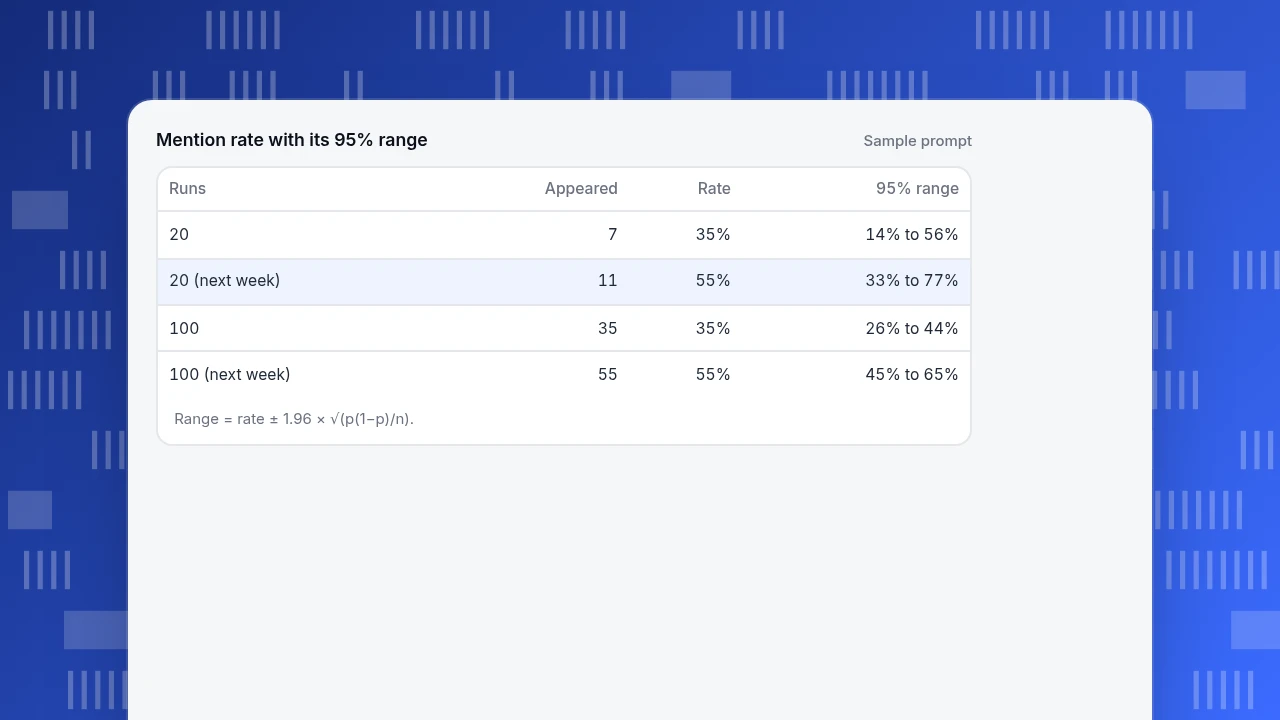
What helps is repeating the run and reporting a rate with its range. Sample data: you ask one prompt and record whether your brand appears.
| Runs | Appearances | Mention rate | 95% range (rate ± 1.96 × √(p(1−p)/n)) |
|---|---|---|---|
| 20 | 7 | 35% | 14% to 56% |
| 20 (next week) | 11 | 55% | 33% to 77% |
| 100 | 35 | 35% | 26% to 44% |
| 100 (next week) | 55 | 55% | 45% to 65% |
With 20 runs, 35% and 55% look like a 20-point jump, but their ranges overlap from 33% to 56%, so you cannot say anything changed. With 100 runs each, the ranges (26–44% and 45–65%) do not overlap, so the change is real. To pin a rate near 35% down to about ±5 percentage points you need roughly 350 runs. This is why a weekly screenshot of "are we in ChatGPT" is not tracking, and why prompt-sampling tools repeat each prompt.
Mention rate with its 95% range
Sample prompt| Runs | Appeared | Rate | 95% range |
|---|---|---|---|
| 20 | 7 | 35% | 14% to 56% |
| 20 (next week) | 11 | 55% | 33% to 77% |
| 100 | 35 | 35% | 26% to 44% |
| 100 (next week) | 55 | 55% | 45% to 65% |
Range = rate ± 1.96 × √(p(1−p)/n).
Worked example: a month of the traffic side
Sample data: a publisher's analytics for one month, with the previous month for comparison. All numbers are invented.
| Brand of assistant | AI crawls | AI-referred visits | Crawl-to-visit ratio |
|---|---|---|---|
| Assistant A | 7,200 | 96 | 96 ÷ 7,200 = 1.33% |
| Assistant B | 3,000 | 120 | 120 ÷ 3,000 = 4.00% |
| Assistant C | 1,800 | 24 | 24 ÷ 1,800 = 1.33% |
| Total | 12,000 | 240 | 240 ÷ 12,000 = 2.00% |
- Previous month: 9,000 crawls and 150 visits, a ratio of 150 ÷ 9,000 = 1.67%. Crawls grew by 33% (3,000 ÷ 9,000) and visits by 60% (90 ÷ 150).
- Assistant B accounts for 25% of crawls (3,000 ÷ 12,000) and 50% of visits (120 ÷ 240); the other two read a lot and send little. The question to ask is which pages Assistant A reads, and whether they are the ones worth citing.
- Conversion: 12 goal completions from the 240 AI visits is 5.0%, against a site-wide 2.8% (sample figure), so these visitors are worth more per visit than the average.
Three conclusions follow. The ratio rose from 1.67% to 2.00%, but 240 visits is a small number, so treat one month as a direction, not a result. The brand table shows where to look, not what to conclude. And the conversion row is what turns "AI sends traffic" into a decision about whether the content deserves effort. A visit that never converts does not justify a content investment, however good the ratio.
What are the limits of AI visibility tracking?
- No impression data. Search consoles tell you how often you appeared; assistants do not. A mention that nobody clicked leaves no trace in your analytics.
- Visits can hide in direct. If an assistant strips the referrer, the session looks like direct traffic. The AI-referred count is a lower bound.
- Crawl counts can be incomplete. With only a page script, crawlers that do not run JavaScript are invisible; server logs fill the gap.
- Answers vary with location, wording and history. A prompt set is a sample of what people ask, not what they ask.
- The ratio is not a click-through rate. It divides visits by crawl requests, not clicks by impressions, and crawls include training fetches.
- Nothing here shows why you are or are not cited. Tracking tells you what happened; improving it is a content question covered in the audit.
Which mistakes make AI visibility numbers misleading?
- Treating one run as a result. The table of 20 runs against 100 shows the problem.
- Reporting a blended score. A single number across assistants can hide that one engine names you far more than another; report assistants separately.
- Counting training crawls as usage. They tell you your content may be used for training, not that it is cited.
- Counting mentions as traffic. A brand named from memory may send no one.
- Changing the prompt set between months. Then the trend measures your prompts, not your visibility.
- Ignoring conversion. Visits are only worth tracking if they do something on your site.
How do you track AI visibility in TapCub?
TapCub covers the traffic side of the example. It does not ask AI assistants questions, and it does not record whether you are mentioned or your share of voice; for those, use a prompt-sampling tool or the manual checks above. What it does is the first-party counting.
- Open the AI visibility tab. In Web analytics › Bots, the AI visibility tab shows four cards: AI crawls, AI-referred visits (sessions whose source is an AI assistant), Crawl→visit, and Sitemap coverage when you have set a sitemap. A trend draws crawls and visits together.
- Read the brand table. The By AI brand table gives crawls, pages, visits and ratio per assistant, which is the table in the example; look for brands with many crawls and few visits. Read the AI content ledger on the AI & agents tab for who is reading and who sent people back.
- Find the cited pages. Cited pages lists landing pages that received AI-referred visits. Web analytics › Sources has an AI sources tab that counts the same people, not crawlers.
- Add the conversion. Set the goal that matters in Web analytics › Goals and compare the conversion rate of AI-referred visits with the rest of the site. Recognised bots are counted separately, so crawlers do not enter your visitor or conversion figures.
- Know the limits. With only the page script, crawl counts are incomplete; crawlers that do not run JavaScript need server events or a log import. With no sitemap, coverage is empty, not 0%. To see how this is read in practice, see the AI crawler ledger.
FAQ
What is AI visibility tracking?
It is the repeated measurement of whether AI assistants mention or cite your site and how many visits they send. The first part comes from sampling prompts; the second from your own analytics. Doing it on a schedule is what separates tracking from a one-off audit.
How do you track your brand visibility in AI answers?
Choose a fixed set of prompts that reflect real questions, run each many times on each assistant, and record the mention and citation rate with its range. Keep the prompt set unchanged between periods. Add your analytics to see whether the citations produced visits.
How do you check whether ChatGPT mentions your site?
Ask it relevant questions and read the answers and citations, but do not trust one run: answers vary, and the chance of the same brand list twice was under 1 in 100 in a 2026 study. Repeat the question many times, and look in your analytics for visits whose source is the assistant.
What is the difference between AI visibility and SEO rankings?
A search ranking is a position on a results page, and a search console reports impressions and clicks for it. AI visibility is whether an assistant names or cites you in an answer; it has no fixed position, varies between runs and gives no impression count.
Does blocking GPTBot remove you from ChatGPT answers?
Not by itself. OpenAI describes GPTBot as related to training, OAI-SearchBot as related to appearing in ChatGPT search, and ChatGPT-User as visiting when a user's request requires it, where robots.txt may not apply. Decide for each purpose separately.
Sources
- OpenAI. Overview of OpenAI crawlers — OAI-SearchBot, GPTBot and ChatGPT-User, and what each is used for. Verified 2026-11-19.
- Search Engine Land. AI recommendation lists rarely repeat: study — reporting on the SparkToro and Gumshoe.ai study (January 2026; 600 volunteers, 2,961 runs). Figures as reported by secondary coverage on 2026-11-19; the original post was not opened.
- Google. AI features and your website — traffic from AI Overviews and AI Mode is included in overall search traffic in Search Console. Verified 2026-11-19.
Was this article helpful?
We use your answers to fix and expand this page.
Couldn’t send. Please try again in a minute.
Thanks for the feedback. We’ll use it to improve this page.You’ve already sent feedback on this page. Thanks.

Product Experience Specialist
Writes about product experience, practical workflows, and growth, turning complex processes into clear steps for everyday decisions.