Try it on your own data
Every report in this article is in the free plan. One snippet for web and apps, up to 10 sites.
Start freeIdentity resolution providers link the identifiers of one person, using exact matches on a shared login (deterministic), scores from signals such as IP and device (probabilistic) or a network of sources (graph). Choose by what a wrong merge would cost you, then measure coverage and precision on your own known pairs.
What you will learn
- Choose the approach by the cost of merging two different people, then set the threshold
- Measure coverage and precision on a holdout of known pairs; quoted match rates do not check correctness
- In the sample, the hybrid linked 81.0% of devices with 49 wrong links; deterministic linked 38.0% with 2
What does an identity resolution provider actually do?
An identity resolution provider takes the scattered identifiers that belong to one person, such as a cookie on a laptop, a device ID on a phone, an email address and a customer ID, and decides which of them are the same person. You send it identifiers; it returns a person-level ID, a match, or a set of linked records. The identity resolution page defines the idea; this guide is about choosing between the methods providers use, because the method decides what you can safely do with the result.
Providers differ in three ways that matter more than the feature list:
- How they decide two identifiers match. From an exact shared login to a statistical guess.
- What data they match against. Only the data you send, or a large reference set they hold.
- How wrong they are allowed to be. Every method makes mistakes; the question is which kind and how many.
The core claim here is simple: choose a provider by the decision you will make with the match, then measure its coverage and its false merges on your own known pairs. A method that is perfect for counting audiences can be dangerous for showing someone their account page.
Deterministic, probabilistic and graph: how do the three approaches differ?
| Approach | How it links identifiers | Strength | Weakness |
|---|---|---|---|
| Deterministic | Exact match on an identifier both records share, such as a login ID or a hashed email | Very few wrong merges; easy to explain and audit | Only links people who gave you that identifier, so coverage is limited |
| Probabilistic | Scores how likely two records are one person from signals like IP address, device type, time and location, and links above a threshold | Wider coverage, including people who never logged in | Wrong merges are built in; the threshold trades coverage against errors |
| Graph (identity graph) | Builds a network of identifiers from many sources and links them through shared nodes, often mixing deterministic and probabilistic edges | Reaches across many devices and sources | Hard to audit; quality depends on the sources behind it |
Two clarifications save arguments later. First, many providers are hybrids: they anchor on deterministic links and add probabilistic ones for the rest. Ask which edges are which, and how each is labelled in the output. Second, the word "deterministic" is used loosely. An exact match on a hashed email is deterministic; an exact match on an IP address is not, because many people share an IP address. The identity graph page covers the data structure behind the third approach.
| Approach | Coverage in sample | Wrong links in sample | Fits |
|---|---|---|---|
| Deterministic (login ID) | 38.0% | 2 | Account data, prices, messages |
| Probabilistic | 72.0% | 65 | Reach and audience counts |
| Hybrid graph | 81.0% | 49 | Counts and cross-device attribution, with the guessed share reported |
Sample data: 1,000 devices belonging to 500 people; precision 99.5%, 91.0% and 94.0%.
How do you measure match quality?
Two numbers describe any resolution method, and you need both:
- Coverage: the share of devices that end up linked to at least one other device.
- Precision: of the links made, the share that join devices belonging to the same person.
The way to measure them is a holdout of pairs you already know are one person: for instance, devices that logged into the same account on your own product. Hide those links, run the method, and count how many it recovers (coverage) and how many wrong links it adds (precision). Vendor-quoted match rates measure something else, usually how many of your records found any match in their reference data, with no check on whether the match was right.
Sample data: 1,000 devices belonging to 500 people, two devices each, so the true answer is known.
| Method | Devices linked | Coverage | Precision | Correct links | Wrong links | Correct per wrong |
|---|---|---|---|---|---|---|
| Deterministic (login ID) | 380 | 38.0% | 99.5% | 378 | 2 | 189 |
| Probabilistic | 720 | 72.0% | 91.0% | 655 | 65 | 10 |
| Hybrid graph | 810 | 81.0% | 94.0% | 761 | 49 | 16 |
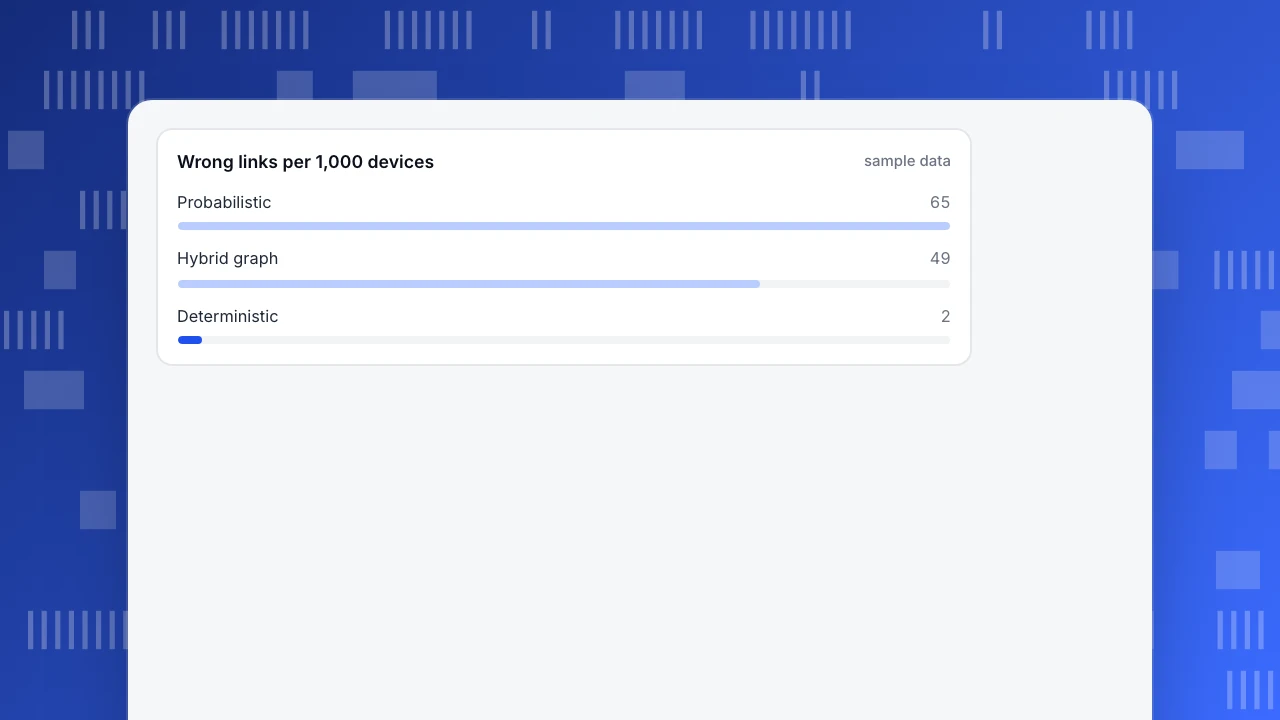
The arithmetic is linked × precision for correct links and linked × (1 − precision) for wrong ones, rounded to whole devices. The hybrid doubles the deterministic method's correct links (761 against 378), but it also adds 49 wrong ones, where the deterministic method adds 2. Whether that trade is good depends entirely on what a wrong link costs, which is the next section.
Wrong links per 1,000 devices
sample dataWhich approach fits which decision?
Write down what happens when two different people are merged into one, then pick the method by that cost.
- Showing account data, prices or messages to a person: deterministic only. A wrong merge shows one person another person's information. At 65 wrong links in 1,000 devices, the probabilistic method is not acceptable here; at 2, the deterministic one is close to it.
- Counting unique people and reach: hybrid or probabilistic is fine. A 5% to 9% error in who is the same person moves a count slightly, and the extra coverage reduces the double counting of people with several devices. Sanity-check it against your sign-ins: a people count far below the number of distinct login IDs deserves a look, because few people hold several accounts.
- Attributing conversions across devices: hybrid, with the probabilistic share reported separately. If 40% of your credited cross-device conversions rest on guessed links, say so, so that nobody reads the number as exact.
- Suppression, such as honoring an opt-out: err toward merging. Here a wrong merge only suppresses one extra person, while a missed merge keeps contacting someone who asked to stop. This is the one case where a false merge is cheaper than a miss.
The pattern is the same each time: first the cost of a wrong merge, then the method, then the threshold.
What should you ask a provider before you buy?
Use these questions as the selection criteria; each has an answer you can check.
- What exactly counts as a deterministic match? Ask for the identifier types. Email and login ID are fine; IP address is not.
- Can I run a holdout test on my own known pairs? If not, you cannot verify precision. Insist on measuring coverage and wrong links, not a quoted match rate.
- Where does the reference data come from, and what consent covers it? Under the GDPR, personal data is any information relating to an identified or identifiable natural person, and pseudonymised data is still personal data when it can be attributed to a person with additional information. A hashed email is pseudonymised, not anonymous, so your lawful basis and notices still apply.
- What do I get back? A person ID you can store, a list of linked records, or only an audience match inside their platform. The first two are portable; the last locks the value in.
- What are the pricing unit and the exit? Per record matched, per lookup, or per month; and whether you can export the links if you leave.
- How are errors reported? Look for a confidence level per link, so you can set a stricter threshold for the sensitive decisions above.
- How fast is the answer? Real-time lookups for on-page personalisation, or batch updates that are a day old.
Why do browser changes matter for the choice?
Probabilistic and graph methods lean on identifiers that browsers increasingly limit. Safari's Intelligent Tracking Prevention deletes script-written storage after 7 days without the user visiting, caps cookies set on landing pages with click IDs in the link at 24 hours, and blocks third-party cookies by default with no exceptions. A method that depends on a long-lived third-party identifier therefore sees more devices as new every week, which lowers its coverage over time.
A link built from a login does not age this way. When someone signs in on a new device, you learn the connection directly, from first-party data. That is why a deterministic base from your own sign-ins is worth building first, whichever provider you add on top: it is both the most accurate layer and the one browser policy does not erode.
How can you use your own login data in TapCub?
TapCub is not an identity resolution provider. It does not hold a third-party identity graph or match your visitors against outside data. What it does is the deterministic layer from your own sign-ins, which is also the ground truth you need for the holdout test above.
- Turn on identified mode and report the login. Identified mode is available from the Pro plan. After your own sign-in succeeds, call
tapcub.login(id, props); the ID can be your login ID, an email (lowercased and hashed), a mobile number, an OpenID or a UnionID. Placeholder IDs such asguestoranonymousare rejected so that a crowd does not collapse into one person. - Let the first login backfill the history. The first login on a device moves that device's earlier anonymous history onto the person, so the funnel from first visit to sign-up is complete. A later login with a different account on the same device does not move rows that already belong to someone.
- Read the people, not the devices. In All-platform analytics › Users › People, open a person to see their behavior over time across devices. Analyses can count by visitor, device or person; switching to person is what removes double counting.
- Use the pairs as your holdout. People with two or more devices bound to one login are your known pairs. Write down a sample of them before you test any outside method against it.
- Know the limits. Each person can have up to 50 devices by default; devices beyond that are still counted but not merged. Anonymous visitors who never log in stay separate, and TapCub does not guess that they are the same person.
FAQ
What is an identity resolution provider?
A company or platform that links the identifiers of one person, such as cookies, device IDs, emails and customer IDs, into a person-level record. Providers differ mainly in how they match (deterministic, probabilistic or graph), what data they match against and how they report errors.
What is the difference between deterministic and probabilistic identity resolution?
Deterministic matching links records that share an exact identifier, such as a login ID, so it makes very few wrong merges but covers only people who identified themselves. Probabilistic matching scores likelihood from signals such as IP and device and covers more people at the cost of built-in errors.
How do you test an identity resolution provider?
Run a holdout. Take pairs of devices you know belong to one person from your own logins, hide the links, run the provider and count the links recovered and the wrong ones added. Compare coverage and precision, not the quoted match rate.
Do I need an identity resolution provider at all?
Not always. If most of your valuable users sign in, a deterministic layer built from your own logins may be enough for account analytics. A provider helps when you must reach people who never log in or combine data from many sources, and when you accept the error trade-off.
Sources
- WebKit, Tracking Prevention — the 7-day cap on script-writable storage, the 24-hour cap with link decoration and default third-party cookie blocking. Checked 2026-11-21.
- GDPR, Article 4: definitions — personal data (4(1)) and pseudonymisation (4(5)). Checked 2026-11-21.
Was this article helpful?
We use your answers to fix and expand this page.
Couldn’t send. Please try again in a minute.
Thanks for the feedback. We’ll use it to improve this page.You’ve already sent feedback on this page. Thanks.

Product Experience Specialist
Writes about product experience, practical workflows, and growth, turning complex processes into clear steps for everyday decisions.