Try it on your own data
Every report in this article is in the free plan. One snippet for web and apps, up to 10 sites.
Start freeTo handle an irate customer in live chat, let them finish, name the specific problem and the feeling, take ownership of the next step, give a concrete action with a time and confirm it landed. In chat, speed and specifics do the work that tone of voice does by phone. Below: the five steps, phrases by situation, rules for transfers and the metrics that show it works.
What you will learn
- Order matters: let them finish, name the problem, own the next step, give an action with a time, confirm
- Never make an angry customer repeat themselves; read the history and context before the first reply
- Judge the approach on angry chats separately: resolved share, transfers, reopens and first response
How do you handle an irate customer in live chat?
Handle an irate customer in chat with five moves in order: let them finish, name the problem and the feeling, take ownership of the next step, give a concrete action with a time, and confirm it landed. In chat you cannot use tone of voice, so the words and the speed do all the work. A message that is accurate, specific and promises something checkable calms people faster than a long apology.
- Let them finish. Do not answer the first angry line with a template. Wait for the message to end, then send one short acknowledgement while you read their history.
- Name the problem and the feeling. "I can see you were charged twice for order 4471, and I understand why that is frustrating." Specific beats generic: "I understand your frustration" with no detail reads as a script.
- Take ownership of the next step. "I am going to check this now and I will stay with you until it is sorted." Say who does it. "Someone will look into it" tells the customer nobody owns it.
- Give a concrete action with a time. "The duplicate charge will be refunded today; you will get a confirmation email by 5 pm, and I will message you here either way." A time the customer can check is worth more than reassurance.
- Confirm and close the loop. "Does that cover what you needed?" Then follow up at the time you promised, even if the news is only "still working on it".
The same advice applies in tone to the situations in empathy statements and chat etiquette; this guide adds the order of steps, phrases for specific situations and the numbers to watch.
Why do customers get angry in chat?
Anger in chat usually has an identifiable cause, and most causes are about effort and being unheard, not about the underlying product problem:
- They already tried to fix it themselves. A Gartner survey of 5,728 customers (published August 2024) found that only 14% of customer service issues were fully resolved in self-service, and 45% of customers who started in self-service said the company did not understand what they were trying to do. A person arriving in chat after a failed self-service attempt is often already frustrated.
- They repeat themselves. Being asked for the same information twice, or being passed between agents, is the most reliable way to make a calm customer angry.
- They are waiting. A slow first reply reads as being ignored.
- A promise was missed. A refund that did not arrive or a callback that never came turns a problem into a grievance.
Research on service recovery adds a caution: McCollough, Berry and Yadav found in experiments that satisfaction after a failure followed by recovery stayed below satisfaction with error-free service, even when the recovery was good. A good response limits the damage; it does not erase it, so the cheapest fix is not to repeat the failure.
Which words work in which situation?
Phrases are templates to adapt, not scripts to paste. Each pairs something to say with something to avoid.
| Situation | Say | Avoid |
|---|---|---|
| Late order | "Your order is two days past the date we gave you, and that is on us. I am checking where it is now." | "Delays happen." |
| Double charge | "You were charged twice for order 4471. I am raising the refund now and will confirm the amount here." | "It may just be a pending authorisation." (before checking) |
| Repeated contact | "I can see you have contacted us three times about this. I will not ask you to repeat anything." | "Can you explain the problem again?" |
| Abusive language | "I want to help, and I can do that best if we keep this respectful. Let me sort out the refund." | Matching tone or sarcasm |
| Stuck in a bot loop | "Let me take over from here." (hand off at once) | Asking them to retry the bot |
| Outage or known bug | "The error you are seeing is a known problem on our side. We expect a fix by 3 pm and I will message you when it is live." | Guessing a fix time you cannot meet |
| Refund not possible | "I cannot refund this one under the policy, and here is what I can do instead: a credit of $20 or an exchange." | A bare "No" |
| Wrong earlier answer | "That answer was wrong, and I am sorry. Here is the correct one." | Defending the earlier agent |
Keep a few as canned replies so they are quick to send, but edit the order number, the amount and the time every time. A reply with a placeholder left in it makes things worse.
| Situation | Say | Avoid |
|---|---|---|
| Late order | "Your order is two days past the date we gave you, and that is on us. I am checking where it is now." | "Delays happen." |
| Double charge | "You were charged twice for order 4471. I am raising the refund now and will confirm the amount here." | "It may just be a pending authorisation." (before checking) |
| Repeated contact | "I can see you have contacted us three times about this. I will not ask you to repeat anything." | "Can you explain the problem again?" |
| Abusive language | "I want to help, and I can do that best if we keep this respectful. Let me sort out the refund." | Matching tone or sarcasm |
| Stuck in a bot loop | "Let me take over from here." (hand off at once) | Asking them to retry the bot |
| Outage or known bug | "The error you are seeing is a known problem on our side. We expect a fix by 3 pm and I will message you when it is live." | Guessing a fix time you cannot meet |
| Refund not possible | "I cannot refund this one under the policy, and here is what I can do instead: a credit of $20 or an exchange." | A bare "No" |
| Wrong earlier answer | "That answer was wrong, and I am sorry. Here is the correct one." | Defending the earlier agent |
Templates to adapt: change the order number, amount and time every time.
When should you transfer, pause or end the chat?
Set these rules before the angry chat arrives, so agents are not deciding under pressure:
- Transfer when the fix needs a permission you do not have (refunds above a limit, account changes) or when the customer asks for a manager. Tell the customer who they are being passed to and carry the context so they do not repeat it.
- Pause by telling the customer exactly when you will come back: "I need ten minutes to check with billing; I will write to you at 2:15."
- End only after a clear warning if the chat is abusive: one polite request to keep it respectful, then, if it continues, a final message and closure under your written policy. Never end because the customer is merely upset.
- Escalate urgently if the customer mentions safety, legal action or harm. Follow your own policy for those cases.
Which numbers show that de-escalation works?
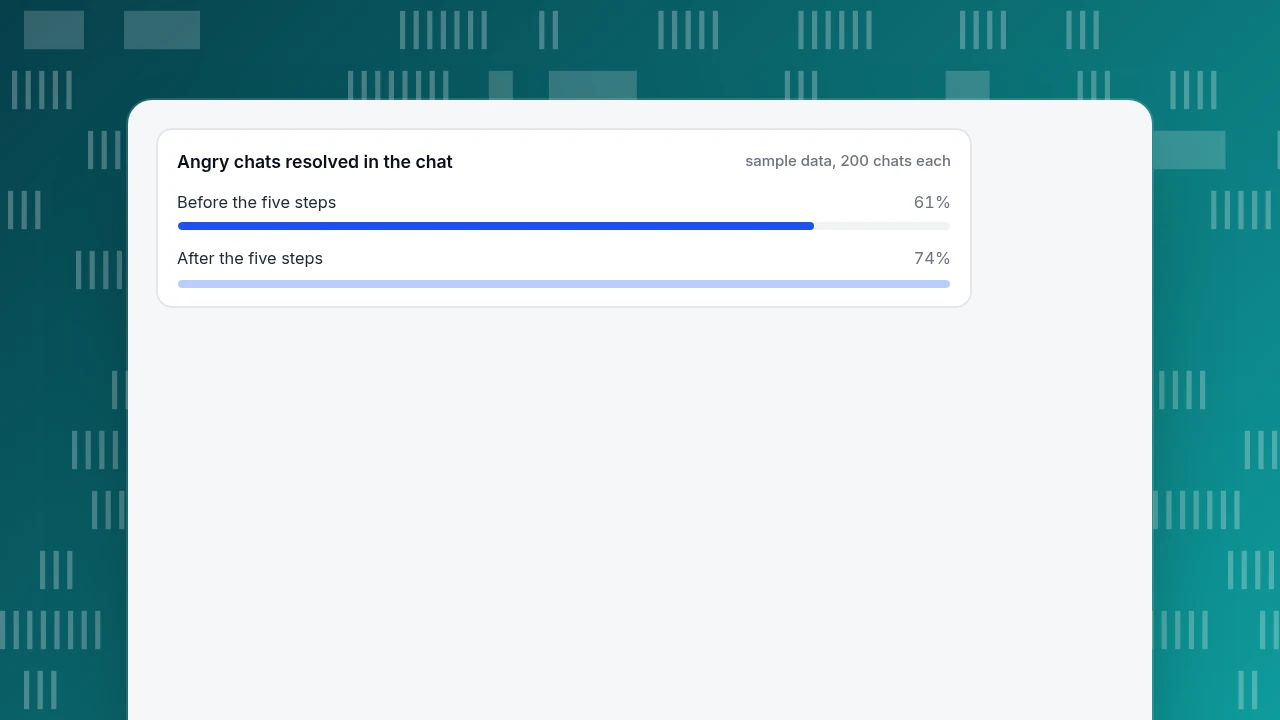
Track the same handful of numbers for the chats that start angry, and compare before and after you change the script or training. Sample data for 200 chats that started angry, before and after introducing the five steps; all rates were recomputed in Python.
| Metric | Before | After |
|---|---|---|
| Median first response | 95 seconds | 48 seconds |
| Resolved in the chat | 122 of 200 (61%) | 148 of 200 (74%) |
| Transferred to another agent | 46 (23%) | 30 (15%) |
| Reopened within 24 hours | 24 (12%) | 14 (7%) |
| Average satisfaction score, rated chats (1 to 5) | 2.6 | 3.4 |
Read the table as a set. Faster first replies and fewer transfers explain why the resolved share rose from 61% to 74%, and a lower reopen rate says the fix held. Satisfaction only counts customers who rated, so watch the number of ratings too. If first response improved but reopens rose, agents are answering quickly without solving the problem. If transfers fell but satisfaction did not rise, they may be refusing handoffs they should make. Do not set one target for all chats: the angry subset needs its own baseline.
Review a sample of the angry chats each week, ten is enough, and read them against the five steps. The pattern you find (missing time, repeated questions, a late first reply) tells you which step to coach next.
Angry chats resolved in the chat
sample data, 200 chats eachWhat mistakes make an irate customer angrier?
- Arguing about facts before acknowledging the feeling. Acknowledge first, then correct.
- Scripted empathy. The same sentence in every chat is noticed immediately.
- Promising what you cannot control. "It will be fixed today" without checking.
- Making them repeat themselves. Read the history and the context panel before replying.
- Going quiet. If the check takes time, say so and say when you will be back.
- Taking it personally. The anger is about the situation. Use a short rest between chats after a hard one.
How to handle this in TapCub
TapCub gives the agent the context that stops the "please repeat that" problem. Walk through an angry double-charge chat:
- Read before you reply. In Live chat › Inbox, the side panel shows the visitor's current page, landing page, referrer, region and device, the pages viewed in this conversation, the analytics trail from the last two days and earlier conversations with the same visitor. The first reply can already say "I can see you were on the payment page".
- Reply fast and precisely. Type
/to insert a canned reply from Live chat › Canned replies and edit it before sending; they can be personal or shared across the site. Guide: use canned replies. If the visitor writes in another language, two-way translation lets each side read their own language (Live chat › Chat settings › Greeting & translation). - Transfer cleanly. Use transfer in the inbox to pass the conversation, and the new agent sees the thread and the visitor context. Per-person transfers out and in appear in Live chat › Reports.
- Avoid bot loops. With AI replies on, the AI stops when an agent takes the chat, replies in person or the visitor asks for a person; the inbox labels why a handoff happened. The AI only writes a reply and cannot refund or change an order, so promise those only when a person can do them.
- Measure. Live chat › Reports shows resolution rate, average first response (a person's first reply only, with a median), satisfaction (1 to 5 within 24 hours of resolve) and agent workload. A visitor who writes again inside the reopen window reopens the same conversation.
TapCub does not detect anger or tag chats as irate by itself; you decide which chats to review.
FAQ
How do you deal with an irate customer?
Let them finish, name the specific problem and the feeling, take ownership of the next step, give a concrete action with a time and confirm it landed. In chat, speed and specifics matter more than a long apology.
What should you say to an angry customer in chat?
Say what happened and what you will do, with a time: "You were charged twice for order 4471. I am raising the refund now and you will have a confirmation by 5 pm." Avoid generic phrases and any question that makes them repeat themselves.
How do you de-escalate an angry customer online?
Acknowledge the feeling before the facts, keep sentences short, avoid arguing about blame and do not match their tone. Offer a clear next step quickly. Transfer to a colleague with the context if you lack the permission to fix it.
What metrics show that de-escalation works?
Median first response, resolved-in-chat rate, transfers, reopens within 24 hours and satisfaction among rated chats. In the sample, resolved chats rose from 61% to 74% while reopens fell from 12% to 7%.
Sources
- Gartner Survey Finds Only 14% of Customer Service Issues Are Fully Resolved in Self-Service, Gartner press release, 19 August 2024, survey of 5,728 customers.
- McCollough, Berry and Yadav, "An Empirical Investigation of Customer Satisfaction after Service Failure and Recovery", Journal of Service Research, 2000, satisfaction after failure and recovery compared with error-free service.
Was this article helpful?
We use your answers to fix and expand this page.
Couldn’t send. Please try again in a minute.
Thanks for the feedback. We’ll use it to improve this page.You’ve already sent feedback on this page. Thanks.

Product Analyst
Focuses on event analysis, conversion funnels, and retention, using clear metric definitions and structured analysis to explain product performance.