Try it on your own data
Every report in this article is in the free plan. One snippet for web and apps, up to 10 sites.
Start freeThe 7 principles of GDPR, set out in Article 5 of Regulation (EU) 2016/679, are lawfulness, fairness and transparency; purpose limitation; data minimisation; accuracy; storage limitation; integrity and confidentiality; and accountability. Below is each one in plain language, with an example and a check for the personal data a website collects through analytics and live chat, plus how to document it. This is a practical reading, not legal advice.
What you will learn
- Six principles are in Article 5(1); accountability, the seventh, is in Article 5(2) and means you must be able to prove the other six
- Keep a data inventory with a purpose and a retention period per item; items with no purpose should stop being collected
- Infringing the basic principles can reach €20 million or 4% of worldwide turnover, whichever is higher
What are the 7 principles of GDPR?
The seven principles are the rules in Article 5 of the General Data Protection Regulation that every use of personal data has to meet. Six are listed in Article 5(1); the seventh, accountability, is in Article 5(2). The UK regulator's guide lists them as follows (ICO); the legal text is in Regulation (EU) 2016/679.
| # | Principle | Article | In one line |
|---|---|---|---|
| 1 | Lawfulness, fairness and transparency | 5(1)(a) | Have a legal basis, do nothing people would not expect, and tell them |
| 2 | Purpose limitation | 5(1)(b) | Collect for stated purposes; do not reuse for incompatible ones |
| 3 | Data minimisation | 5(1)(c) | Only what is adequate, relevant and necessary |
| 4 | Accuracy | 5(1)(d) | Keep it correct; fix or erase wrong data without delay |
| 5 | Storage limitation | 5(1)(e) | Do not keep it in identifiable form longer than needed |
| 6 | Integrity and confidentiality | 5(1)(f) | Protect against unauthorised access, loss and damage |
| 7 | Accountability | 5(2) | Be able to show that you meet the other six |
This is a practical reading for people who run a website with analytics and live chat, not legal advice. For each principle the sections below give the plain meaning, one concrete number or example, and what to check in your own tracking and chat setup. The rules-and-checklist view of the same law is in GDPR compliance checklist and GDPR-compliant analytics; this page is organised by principle rather than by task, and the definition of the regulation itself is in the GDPR glossary entry.
| Principle | What to check in analytics and chat |
|---|---|
| Lawfulness, fairness, transparency | Each script and chat feature is described in the privacy notice |
| Purpose limitation | Each data item has a stated purpose; reuse needs a new check |
| Data minimisation | No full IPs, form contents or unneeded fields |
| Accuracy | Profiles and contact details can be corrected |
| Storage limitation | A written retention period, deleted automatically |
| Integrity and confidentiality | Role-based access, individual logins, limited exports |
| Accountability | Inventory, retention schedule, legal basis record, request log |
A practical reading of Article 5, not legal advice.
Does GDPR apply to website analytics and chat data at all?
Yes, when the data relates to an identifiable person. Recital 30 names online identifiers such as IP addresses and cookie identifiers as things that can single people out when combined with other data, and the Court of Justice held in the Breyer judgment (C-582/14, October 2016) that a dynamic IP address can be personal data when the site operator has legal means to link it to a person. A chat transcript with a name or email address in it is personal data without any such argument.
Two practical consequences:
- Aggregate counts are outside the scope; the raw rows behind them may not be. "12,400 sessions last month" is not personal data. The event log with a visitor ID, an IP-derived value and a timestamp can be.
- Penalties scale with the principles. Infringing the basic principles in Articles 5, 6, 7 and 9 falls in the higher fine tier of Article 83(5): up to €20 million or 4% of worldwide annual turnover of the preceding financial year, whichever is higher. For a company with €30 million turnover, 4% is €1.2 million, so the €20 million figure is the cap; at €1 billion, 4% is €40 million and that figure applies.
Principle 1: Lawfulness, fairness and transparency
What it means. You need a legal basis from Article 6 for each purpose (consent, contract, legitimate interests, and so on), you must not use the data in ways people would find unfair or misleading, and you must say what you do in a privacy notice written for a visitor, not a lawyer.
For analytics and chat. Decide the basis per purpose, not per tool. Counting visits to improve your own site and answering a visitor who started a chat are different purposes and often different bases. Whatever you choose, the privacy notice needs to name the purposes, the recipients and the retention. The notice's contents are covered in GDPR privacy notice.
Check. Can you point to one sentence in the notice for each thing your script and chat widget do?
Principle 2: Purpose limitation
What it means. The purposes are fixed when you collect the data. A new purpose has to be compatible with the old one or have its own basis.
For analytics and chat. The classic slip is taking chat transcripts collected to answer support questions and loading them into a sales mailing list, or feeding event data collected for site statistics into a profile used to target people elsewhere. Write the purpose next to each data item in a table, as in the inventory below.
Check. If someone proposes a new use of existing data, is there a line in the table that already covers it? If not, it is a new purpose.
Principle 3: Data minimisation
What it means. Collect only what you need for the stated purpose.
For analytics and chat. Take an inventory. Sample data for a site with a script and a chat widget:
| Data item | Purpose | Needed? |
|---|---|---|
| Page URL and timestamp | Traffic statistics | Yes |
| Referrer and UTM tags | Where visitors come from | Yes |
| Country (from IP, IP not kept) | Audience by country | Yes |
| Full IP address stored in the log | None stated | No |
| Chat message text | Answer the question | Yes |
| Chat visitor email | Reply after the chat ends | Only if the visitor gives it |
| Free-text form contents recorded in analytics | None | No |
| Exact screen coordinates of every click, kept indefinitely | Heatmap | Aggregated is enough |
Of 8 items, 4 are clearly needed, 2 are conditional or reducible, and 2 have no purpose. Removing the last two costs nothing and shrinks the risk. Minimisation is cheapest to apply when you design the setup: Article 25 asks controllers to build data protection into the processing by default, including that by default only data necessary for each purpose is processed.
Check. For each row you cannot attach a purpose to, stop collecting it.
Principle 4: Accuracy
What it means. Personal data must be accurate and kept up to date where necessary; inaccurate data has to be corrected or erased without delay.
For analytics and chat. Behavioural statistics are not "facts about a person", but anything you attach to a named profile is. Examples are a contact name typed into a chat, a user's email linked to an account, or a segment label that says someone is at risk of leaving. Provide a way to fix them: update the profile when the person tells you, and drop labels that came from a rule you no longer use.
Check. If a person says "that email is wrong", where do you change it, and does the change reach every place that holds a copy?
Principle 5: Storage limitation
What it means. Keep data in a form that identifies people only as long as the purpose needs it. After that, delete it or anonymise it.
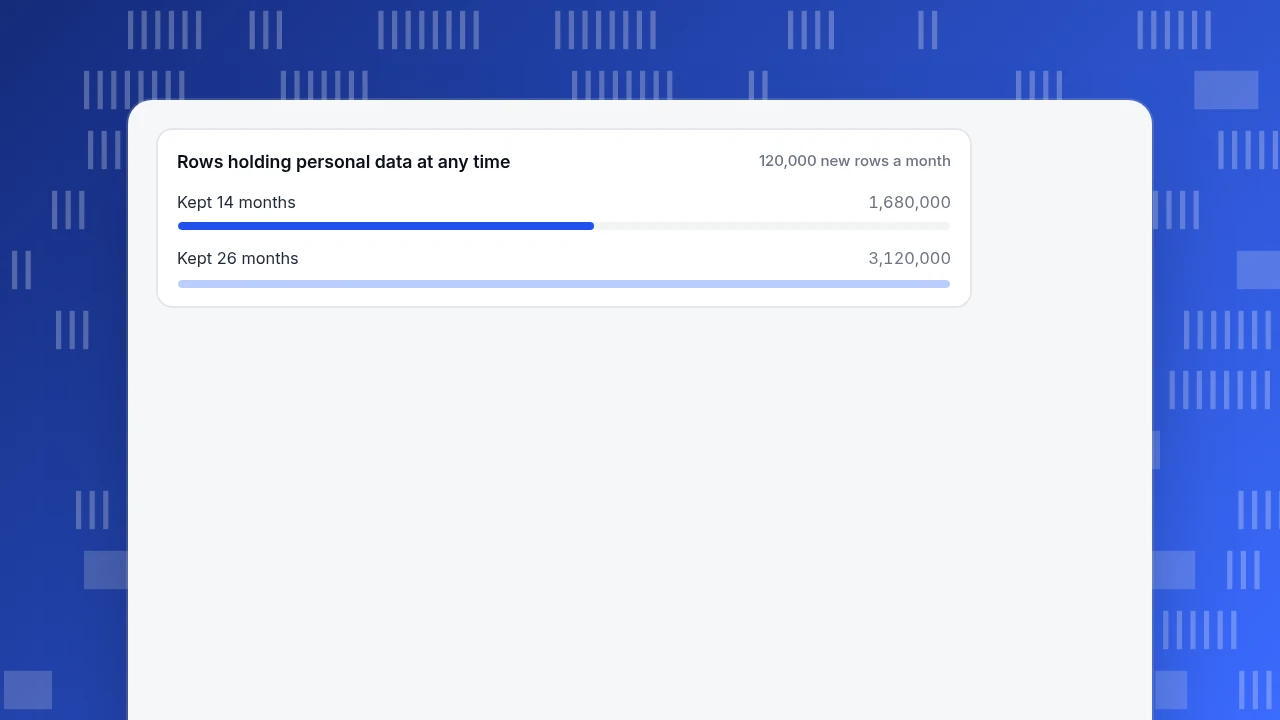
For analytics and chat. Choose a retention period per data type and apply it automatically. A worked sample: a site has 40,000 visitors a month and 3 recorded events per visitor, so 120,000 event rows a month.
- Kept 14 months: 120,000 × 14 = 1,680,000 rows hold identifiable-capable data at any time.
- Kept 26 months: 120,000 × 26 = 3,120,000 rows, 1.86 times as many, nearly doubling the number of records that could leak or have to be searched for a data-subject request.
Often you can keep what you need after the retention period: daily totals that contain no personal data support a multi-year trend line. For chat, decide how long a closed conversation is needed (for example to handle a complaint) and delete after that.
Check. For each data type, is there a retention number written down, and is the deletion automatic?
Rows holding personal data at any time
120,000 new rows a monthPrinciple 6: Integrity and confidentiality
What it means. Use appropriate technical and organisational measures against unauthorised access, accidental loss and damage.
For analytics and chat. Encrypt in transit; limit who can see chat transcripts and raw event exports by role; use individual logins instead of a shared password; remove access when someone leaves; and keep a record of who exported what. Public share links for dashboards should expose only the modules you intend and limit how many days of data a viewer can see; they should never contain visitor-level lists.
Check. If an employee leaves today, how many steps remove their access to the analytics and chat tools?
Principle 7: Accountability
What it means. Article 5(2) makes the controller responsible for complying with the other six principles and for being able to demonstrate it. It is the principle that turns the other six into paperwork, in a good way.
For analytics and chat. Keep four documents: the data inventory above, the retention schedule, a record of the legal basis per purpose, and a log of data-subject requests and how long each took. Article 25 (data protection by design and by default) belongs here: configure the defaults first, then document them. The aim is that when a regulator or a customer asks, you can answer from documents, not from memory.
Check. Could a colleague who joined last week answer "why do we collect X, on what basis, for how long" from your files?
How do the seven principles apply in TapCub?
TapCub gives you controls for the technical part; the legal basis, the notice and the paperwork stay with you. A walkthrough using the principles in order:
- Set the collection level (minimisation). In Configuration › Privacy center choose the collection tier. Tier 1 is anonymous aggregate counts with no persistent ID and no automatic collection; the default is tier 2. For the European Economic Area and the UK the default rule is tier 2 with consent required, dropping to tier 1 when there is no analytics consent, while pageviews and custom events are still recorded.
- Check what is collected (purpose, minimisation). The script does not write a cookie by default and the IP address is not stored. Form fields' contents are not recorded; form submit tracking, if switched on, only records the form's id, name and action. Chat uses IPs in memory for rate limiting only and does not store them with the conversation.
- Set retention (storage limitation). Retention periods are configured in the privacy center. Raw detail past the retention period is deleted; daily summaries contain no personal data and are not deleted by that period.
- Handle requests (accuracy, accountability). Data-subject requests for export and deletion are handled in the privacy center, and address truncation is available there too.
- Control access (integrity and confidentiality). Public sharing links can have a password, a limited set of modules and a limited number of days, and visitor lists and sessions cannot be shared publicly. Detailed exports are asynchronous.
TapCub does not decide your legal basis, write your privacy notice or tell you whether you need consent in your country; those stay with you and your adviser.
FAQ
What are the 7 principles of GDPR?
Lawfulness, fairness and transparency; purpose limitation; data minimisation; accuracy; storage limitation; integrity and confidentiality; and accountability. The first six are in Article 5(1) of Regulation (EU) 2016/679 and accountability is in Article 5(2).
Which GDPR principle is most often broken by websites?
There is no official ranking, but two come up constantly in practice: transparency, when the privacy notice does not describe what the scripts actually do, and storage limitation, when raw logs are kept indefinitely because nobody set a retention period.
Is accountability one of the principles or a separate obligation?
Both. It is the seventh principle in Article 5(2) and also drives obligations such as records of processing and data protection by design. In practice it means you can show your work.
What is the maximum fine for breaking the principles?
Article 83(5) sets up to €20 million or 4% of total worldwide annual turnover of the preceding financial year, whichever is higher, for infringements of the basic principles. Authorities weigh nature, gravity and duration, so most fines are lower.
Do the principles apply to anonymous analytics?
They apply to personal data. Truly anonymous aggregate data is outside the regulation, but check what "anonymous" means in your setup: a daily-rotating hash of an IP and browser may still be linkable, which is why the raw rows deserve the same principles as any other personal data.
Sources
- Regulation (EU) 2016/679 (GDPR), Articles 5, 25 and 83 and Recital 30 (checked 2026-11-23).
- ICO, A guide to the data protection principles: the seven principles and where each is set out (checked 2026-11-23).
- Court of Justice of the EU, Breyer, Case C-582/14, 19 October 2016: dynamic IP addresses as personal data.
Was this article helpful?
We use your answers to fix and expand this page.
Couldn’t send. Please try again in a minute.
Thanks for the feedback. We’ll use it to improve this page.You’ve already sent feedback on this page. Thanks.

Data Engineer
Writes about event design, data quality, and collection workflows, with verifiable implementation methods for reliable analytics.