Try it on your own data
Every report in this article is in the free plan. One snippet for web and apps, up to 10 sites.
Start freeA GDPR privacy notice is the document that gives people the information in Articles 13 and 14: who you are, why you use their data, on what legal basis, who receives it, how long you keep it and what rights they have. Article 13 lists up to 12 items. This guide goes through each one with wording for a site that runs analytics and live chat, audits a sample notice from 7 of 12 items to all 12, and covers timing and common gaps.
What you will learn
- Write all 12 Article 13 items even when the answer is "not applicable"; readers cannot tell that from "forgot"
- Give the notice when the data is obtained, and choose a legal basis per purpose, not once for the whole site
- Analytics and chat each need their own lines for data, purpose, retention and recipients
Which items must a GDPR privacy notice contain?
The GDPR never uses the words "privacy notice". What it requires is the information listed in Article 13 (data collected from the person) and Article 14 (data obtained from somewhere else). Article 13 gives up to 12 lettered items, and several of them apply only in some situations. Here they are, each with what it looks like for a site that runs analytics and live chat (sample wording, not legal advice):
| Article | Item | What an analytics-and-chat site writes |
|---|---|---|
| 13(1)(a) | Controller identity and contact | Company name, registered address, a privacy mailbox |
| 13(1)(b) | Data protection officer contact, if you have one | DPO mailbox, or "not applicable" if none is appointed |
| 13(1)(c) | Purposes and legal basis | One row per purpose: "measure site usage", "answer chat messages", "reply to offline messages" |
| 13(1)(d) | Legitimate interests pursued, if that is the basis | "Understanding which pages help visitors", stated in one sentence |
| 13(1)(e) | Recipients or categories of recipients | Hosting provider, analytics processor, chat processor, any AI or translation provider you switch on |
| 13(1)(f) | Transfers outside the EEA, safeguards | Country, and the mechanism used (adequacy decision or safeguards) |
| 13(2)(a) | Retention period or the criteria for it | "Raw events 365 days; chat transcripts 24 months" |
| 13(2)(b) | Rights: access, rectification, erasure, restriction, objection, portability | The six rights and how to exercise them |
| 13(2)(c) | Right to withdraw consent, if consent is the basis | Where the visitor changes the choice |
| 13(2)(d) | Right to complain to a supervisory authority | Name the authority or say "your local one" |
| 13(2)(e) | Whether giving the data is required, and what happens if not | "Chat needs your message; analytics is optional" |
| 13(2)(f) | Automated decision-making and profiling | "None" is a valid, useful answer |
Article 14 adds two things when you did not collect the data directly: the categories of data (14(1)(d)) and the source it came from (14(2)(f)). If you only collect from visitors, you can stay on Article 13. The text is at Article 13 and Article 14.
| Item missed | Typical gap | Fix |
|---|---|---|
| 13(1)(b) DPO contact | Left out because "we have none" | Write "not applicable" or the privacy mailbox |
| 13(1)(d) Legitimate interest | Basis named, interest not stated | One sentence naming the interest |
| 13(1)(f) Transfers | Not mentioned at all | Country and the mechanism used, or "none" |
| 13(2)(a) Retention | "As long as necessary" | A period or the criteria, per data type |
| 13(2)(c) Withdraw consent | Missing when basis is consent | Say consent can be withdrawn and where |
These five were the gaps in the sample audit; all are items that feel conditional.
When and in what form do you have to give it?
Three rules cover almost every site:
- Timing under Article 13: at the moment the data is obtained. For a web visitor that means before the first analytics hit or the first chat message, not after. A footer link that is only reachable after the script has already run is late.
- Timing under Article 14: within a reasonable period, and at most one month. It is earlier if you use the data to contact the person (at the first contact) or pass it to someone else (before the first disclosure).
- Form under Article 12: concise, transparent, intelligible and easily accessible, in clear and plain language. That is a standard of readability, not a length. A 9,000-word policy that mixes ten products fails it even if every item from the table is technically present.
A practical pattern that meets Article 12: a short first layer at the point of collection (what, why, who, how long, a link), and the full notice behind it. Put a visible link on every page, and again next to any form or chat entry point that collects something new.
The stakes are real. Failing the transparency duties in Articles 12 to 22 sits in the higher fine tier of Article 83(5): up to €20,000,000 or 4% of worldwide annual turnover, whichever is higher.
Privacy notice, privacy policy, cookie banner: how do they differ?
The question people actually search is "what is a privacy notice in GDPR". Short answer: it is the outward-facing document that gives the Article 13/14 information to the people whose data you handle. "Privacy policy" is the same thing in everyday speech. The things it is confused with are different:
| Thing | Who it is for | What it does | Replaces the notice? |
|---|---|---|---|
| Privacy notice (policy) | Visitors, customers | Informs: items 13/14 | n/a |
| Consent banner | Visitors, at first visit | Asks: collects a choice for device storage or a consent-based purpose | No, it should link to the notice |
| Internal records of processing | Regulator, your team | Documents what you do (Article 30) | No, different audience |
| Terms of service | Customers | Sets the contract | No |
A consent banner and a notice work together. The banner is where a choice is made; the notice is where the choice is explained. See do I need a consent banner for when a banner is needed at all and consent management platform for the tooling around it.
Which legal basis do you state for analytics and chat?
Article 13(1)(c) requires a basis for each purpose, so decide per purpose rather than once for the whole site. A way to reason about it (talk to your counsel before relying on it):
- Does the script store or read something on the visitor's device? If yes, the ePrivacy Directive, Article 5(3) requires consent, except for storage that is strictly necessary for a service the user explicitly asked for. If no, Article 5(3) is not triggered and the GDPR basis question is separate.
- Is the processing necessary for a purpose you can name that visitors would expect? Aggregate traffic measurement is often argued under legitimate interests (Article 6(1)(f)); then 13(1)(d) obliges you to state the interest.
- Is it a request from the visitor? A chat message the visitor types is processed to answer that message. An offline message with an email is processed to reply. Say exactly that, row by row.
- Is anything optional and consent-based, such as marketing identifiers or session recording? Then 13(2)(c) applies: say that consent can be withdrawn at any time and where.
Different purposes can carry different bases in one notice. That is normal, and clearer than a single sentence claiming "legitimate interests" for everything.
Worked example: auditing a notice against the 12 items
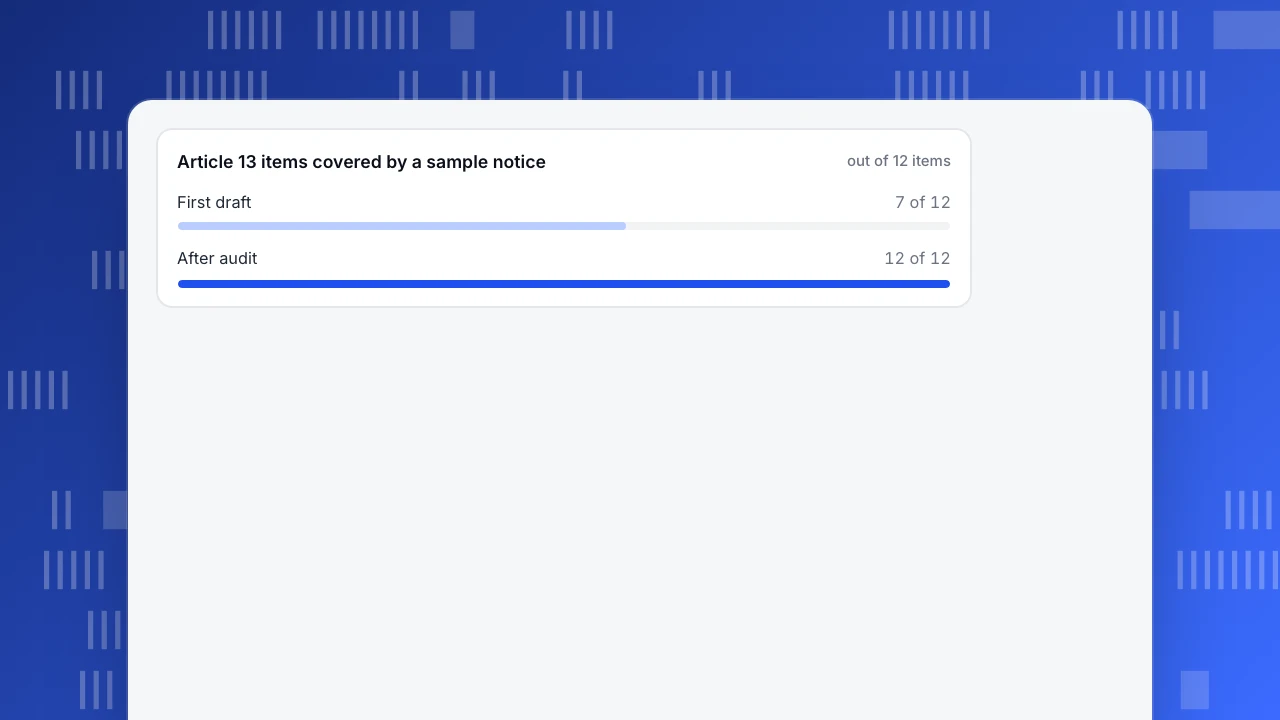
Sample data: a store with web analytics and live chat has a first-draft notice. We tick it against the 12 items from the table above.
| Group | Items | Present in first draft | After audit |
|---|---|---|---|
| Identity and contact | 13(1)(a), (b) | 1 of 2 | 2 of 2 |
| Purposes and basis | 13(1)(c), (d) | 1 of 2 | 2 of 2 |
| Recipients and transfers | 13(1)(e), (f) | 1 of 2 | 2 of 2 |
| Retention | 13(2)(a) | 0 of 1 | 1 of 1 |
| Rights and complaint | 13(2)(b), (c), (d) | 2 of 3 | 3 of 3 |
| Obligation and automation | 13(2)(e), (f) | 2 of 2 | 2 of 2 |
| Total | 12 | 7 of 12 (58%) | 12 of 12 (100%) |
7 ÷ 12 = 58.3%. The five gaps were the DPO line, the legitimate-interest statement, transfers, the retention period and the right to withdraw consent. All five are the same kind of miss: items that feel conditional and get left out. The fix is to write each one even when the answer is "not applicable" or "none", because a reader cannot tell "does not apply" from "forgot".
The audit also produced three edits the table does not show: the notice named "marketing partners" without saying who, the retention line said "as long as necessary" (not a period or criterion), and chat transcripts were missing entirely.
Article 13 items covered by a sample notice
out of 12 itemsWhat wording covers analytics and chat?
Sample sentences you can adapt. Replace the bracketed parts with your own facts, and check them against what your tools actually do.
Analytics. "We measure how the site is used so we can fix confusing pages. We record the pages viewed, the referrer and campaign tags, the approximate country or city, and the device type. We do not record your full IP address. We keep raw events for [365] days and daily totals without personal data afterwards. The basis is [legitimate interests / your consent]. You can [opt out here / change your choice here]."
Live chat. "If you start a chat, we process the messages you send, the page you were on, and the visitor identifier used to link your chat with your visit, so that we can answer you. If no one is online and you leave an offline message, we process your email address and question to reply. We keep chat records for [24 months]. If we use automated replies or translation, your message is processed by [provider category] acting on our behalf."
Notice what each paragraph contains: the data, the purpose, the retention and who else handles it. That is items (c), (e) and 13(2)(a) in two sentences.
Which mistakes show up most often?
- "As long as necessary." Article 13(2)(a) wants a period or the criteria used to set one. Write "365 days for raw events" or "until the account closes plus 6 years for invoices".
- One legal basis for everything. Chat replies and anonymous aggregate analytics do not share a basis. Split by purpose.
- Naming the tool but not the role. "We use [tool]" is not a recipient statement. Say it processes data on your behalf, and list categories at least.
- Missing automated decisions line. If you do none, say so. It costs one sentence.
- Notice behind the banner, not before. If the first analytics hit fires before the visitor can reach the link, the Article 13 timing is already missed.
- Never updating. Article 13(3) requires informing people before using data for a new purpose. Adding session recording or an AI reply feature is a new purpose; put a date on the notice and keep a changelog.
How do you keep the notice true after launch?
A notice is correct on the day it is published and wrong the day someone changes a setting. Tie it to change events: a new script or tag, a new chat feature, a new processor, a retention change, a new market. Keep a one-page register with the same 12 rows, and review it when any of those happen and at least quarterly. Date each version at the top of the notice and keep the last two versions available, so a visitor or auditor can see what applied when.
How do the analytics and chat parts work in TapCub?
The audit above produced rows about collection and retention for analytics and chat. TapCub can help you state them accurately, but it does not write your notice, decide your legal basis, or make you compliant. In the console:
- Open Configuration › Privacy center. Note the collection tier (the default is tier 2, cookie-free pseudonymous; tier 1 is anonymous aggregate with a rotating daily salt). Write your analytics paragraph from the tier you actually run.
- In the same place, read the region rule. For the EEA and the UK the default is tier 2 with consent required; with no analytics consent the project falls to tier 1 while pageviews and custom events are still recorded. That belongs in your consent and notice wording.
- Check the retention values (defaults: 365 days for events, 90 for autocapture, 730 for profiles, capped by your plan) and the address truncation. Copy the real numbers into 13(2)(a).
- For chat, open Live chat › Chat settings › Offline messages and Greeting & translation / AI assistant to see which features are on, because each one is a purpose or a recipient you must mention. TapCub's AI replies only generate text; they do not change orders or send email.
- Use the data-subject request tools in the Privacy center for access, erasure, restriction and portability, so the rights sentence in the notice matches a workflow that exists.
FAQ
What is a privacy notice in GDPR?
It is the document that gives people the information required by Articles 13 and 14: who you are, why you process their data, on what basis, who receives it, how long you keep it and what rights they have. The regulation itself never uses the label; "privacy policy" means the same thing.
What must a GDPR privacy notice include?
Up to 12 lettered items in Article 13: controller identity, DPO contact, purposes and legal basis, legitimate interests, recipients, transfers, retention, rights, withdrawal of consent, complaint right, whether providing data is mandatory, and automated decisions. Article 14 adds categories of data and the source.
When do I have to provide the notice?
For data collected from the person, at the time you collect it (Article 13). For data from elsewhere, within a reasonable period and at most one month (Article 14), earlier if you contact the person or disclose the data to someone else.
Do I need a privacy notice if I only use analytics?
If the analytics processes personal data, yes. Pseudonymous visitor identifiers can still be personal data, so the notice should cover analytics: purpose, basis, retention and recipients. Whether you also need a consent banner is a separate question.
Is a cookie banner a privacy notice?
No. A banner collects a choice; a notice explains the processing. The banner should link to the notice, and the notice should say where the visitor can change the choice.
Sources
- GDPR Article 12: transparent information and communication, checked 2026-11-21
- GDPR Article 13: information to be provided where data are collected from the data subject, checked 2026-11-21
- GDPR Article 14: information where data have not been obtained from the data subject, checked 2026-11-21
- GDPR Article 83: general conditions for imposing administrative fines, checked 2026-11-21
- Directive 2002/58/EC (ePrivacy), Article 5(3), checked 2026-11-21
Was this article helpful?
We use your answers to fix and expand this page.
Couldn’t send. Please try again in a minute.
Thanks for the feedback. We’ll use it to improve this page.You’ve already sent feedback on this page. Thanks.

Data Engineer
Writes about event design, data quality, and collection workflows, with verifiable implementation methods for reliable analytics.