Try it on your own data
Every report in this article is in the free plan. One snippet for web and apps, up to 10 sites.
Start freeEthical SEO improves search visibility by methods that serve users and follow the search engine's published rules, with nothing hidden from crawlers or readers. Google names the behaviours it treats as spam, from cloaking to scaled content abuse, and violations may rank lower or not appear at all. This guide maps tactics to policies and puts a number on the risk.
What you will learn
- Test every tactic by asking whether it still makes sense if a user and a crawler see the same page and the search engine can see what you did
- Google says violating content may rank lower or not appear; it gives no penalty lengths, so a tactic's downside is not capped by its gain
- In the sample, an $18,000 gain against a $144,000 loss breaks even at an 11.1% chance of penalty, a probability no one can state
What is ethical SEO, in terms you can test?
Ethical SEO means improving a site's visibility in search by methods that serve the people who land on it and that stay inside the search engine's published rules. The slogan is easy to agree with and hard to apply, so use a working test instead: would this tactic still make sense if the page were shown to a user and a crawler side by side, and if the search engine could see exactly what you did? If yes, it is on the right side of the line. If the tactic only works as long as someone does not notice, it is not.
The older labels map onto that test. White hat practices pass it. Black hat practices fail it by design: they deceive crawlers, users or both. Gray hat practices are the ones that are allowed on paper but exist mainly to manipulate rankings, such as guest posts written for the link rather than the reader. The rest of this guide replaces labels with the specific policies Google has published, the evidence on consequences, and a way to put a number on the risk.
Which common tactics are acceptable and which are not?
Google's spam policies name the behaviours it treats as manipulation. Matching common tactics against them gives you a concrete table:
| Tactic | Verdict | Google policy it falls under | Why |
|---|---|---|---|
| Original pages written for a real query | Acceptable | None | Serves the reader |
| Fixing broken links, speed and crawl errors | Acceptable | None | Improves access for users and crawlers |
| Earned links from people who chose to cite you | Acceptable | None | Editorial, not purchased |
Paid or sponsored links marked with rel="sponsored" or nofollow | Acceptable | Link spam, if unmarked | Marking tells Google the link is an ad |
| Repeating keywords or numbers unnaturally | Avoid | Keyword stuffing | Written for the crawler |
| Showing crawlers different content from users | Avoid | Cloaking | Deceives by design |
| White text on a white background, 0-pixel fonts | Avoid | Hidden text and links | Visible to crawlers only |
| Buying or swapping links to pass ranking credit | Avoid | Link spam | Manipulates ranking signals |
| Guest posts or press releases with keyword-rich anchors | Gray, usually avoid | Link spam (sponsored content) | Value goes to the link, not the reader |
| Many near-identical pages for similar queries | Avoid | Doorway abuse | Funnels users to a thin middle page |
| Mass-producing pages with little value, by AI or other means | Avoid | Scaled content abuse | The purpose is to rank, not to help |
| Republishing other sites' content with no added value | Avoid | Scraping | Nothing new for the reader |
| Affiliate pages with copied merchant text | Avoid | Thin affiliation | No added value |
| Third-party pages hosted to borrow the host's ranking strength | Avoid | Site reputation abuse | Exploits the host's reputation |
| Repurposing an expired domain for low-value content | Avoid | Expired domain abuse | Borrows past reputation |
Google's page makes one point worth repeating about AI: scaled content abuse is defined by the purpose of mass-producing low-value pages to manipulate rankings, whether the pages come from automation, scraping or stitching. The tool is not the test; the value to the reader is.
| Tactic | Verdict | Google policy |
|---|---|---|
| Original page written for a real query | Acceptable | None |
| Paid link marked rel="sponsored" or nofollow | Acceptable | Link spam, if unmarked |
| Showing crawlers different content from users | Avoid | Cloaking |
| Buying links to pass ranking credit | Avoid | Link spam |
| Mass-producing low-value pages, by AI or other means | Avoid | Scaled content abuse |
The full table in the guide maps fifteen common tactics to the policy each falls under.
What does Google say happens if you cross the line?
The published evidence is more specific about direction than about size. Google says content that violates its spam policies may rank lower or not appear at all in results, and that violations are found by automated systems and by human review, which can lead to a manual action. Three details sharpen this:
- Rule changes are enforced at scale. In March 2024 Google announced updates to reduce low-quality, unoriginal content in results, expecting a 40% reduction; an update added on April 26, 2024 said the rollout finished on April 19 and delivered 45%. The same post introduced three policies: scaled content abuse, site reputation abuse and expired domain abuse.
- Enforcement dates are announced. The site reputation abuse policy was published two months before enforcement began on May 5, 2024.
- Workarounds make it worse. Under the policy circumvention rule, continuing violations through new subdomains, subdirectories or sites can lead Google to restrict eligibility for search features such as Top Stories and Discover, or to remove more of the site.
Google's page does not give numeric thresholds or penalty durations, so be wary of any article that does. What you can say is that the downside is not capped by the gain from the tactic.
How do you put a number on the risk?
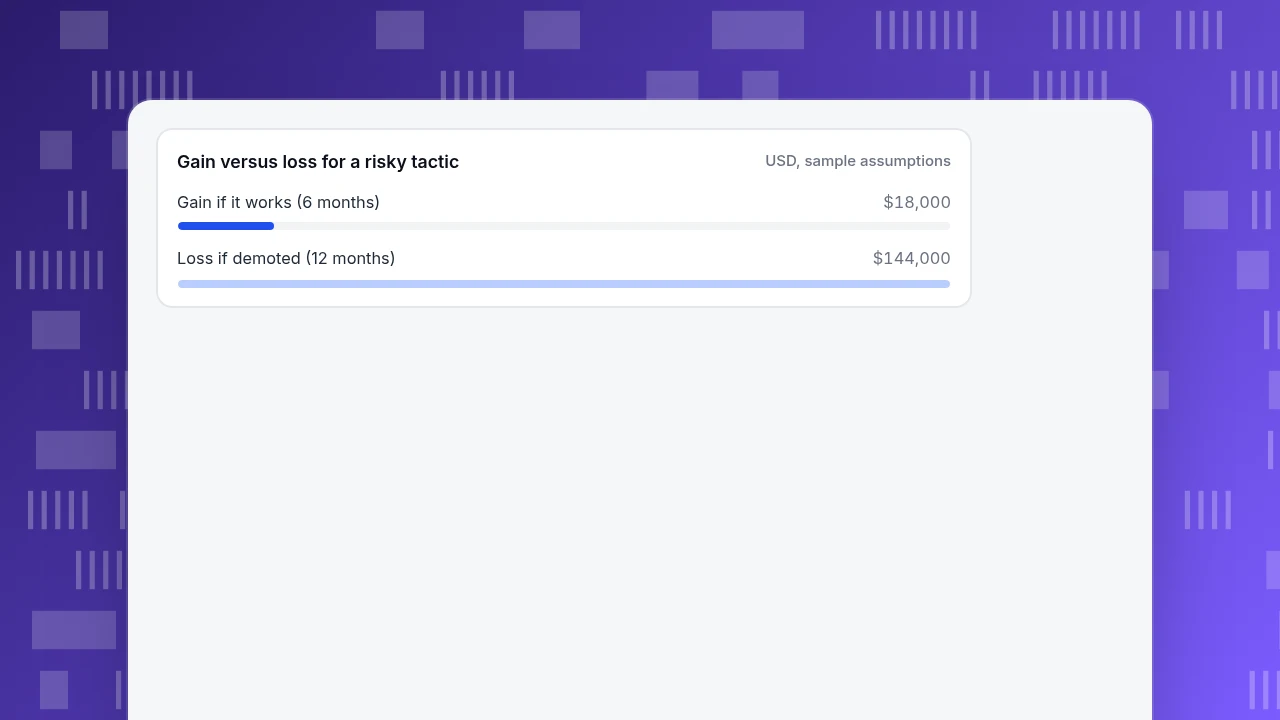
An expected-value calculation shows why even a small chance of a penalty can outweigh a tactic's payoff. Sample data with assumptions you should replace with your own: a site earns $20,000 a month from organic search. A shady tactic adds $3,000 a month for 6 months, a gain of $18,000. If the site is demoted, it loses 60% of organic revenue for 12 months: 0.60 × $20,000 × 12 = $144,000.
Expected value = (1 − p) × gain − p × loss, where p is the probability of a penalty. It is positive only when p is below gain ÷ (gain + loss) = $18,000 ÷ $162,000 = 11.1%.
| Probability of a penalty | Expected value of the tactic |
|---|---|
| 5% | +$9,900 |
| 10% | +$1,800 |
| 11.1% | $0 (break-even) |
| 25% | −$22,500 |
| 50% | −$63,000 |
Nobody can state p for a given tactic, because Google does not publish detection rates. The honest reading is a rule: with a loss eight times the gain (144 ÷ 18), you would need to be nearly certain, above about 89%, that the tactic will not be penalised, and no one is. The calculation also leaves out harms that are not in the spreadsheet, such as rebuilding trust and cleaning up links, so the real break-even is lower.
Gain versus loss for a risky tactic
USD, sample assumptionsHow do you decide the gray areas?
Ask five questions in order. Stop at the first no.
| Question | If the answer is no |
|---|---|
| Would a user see the same thing a crawler sees? | Do not do it (cloaking, hidden text) |
| Does the page add something a reader cannot get from the pages already ranking? | Improve or drop the page (thin, scraped, scaled) |
| Was every link earned or properly marked as paid or sponsored? | Add rel="sponsored" or nofollow, or remove the link |
| Would I be comfortable explaining the tactic to the customer who reads the page? | Treat it as a warning sign |
| Does it still make sense if search engines did not exist? | Reconsider; it is probably only for the crawler |
Write the answer for each tactic into a short log with a date. When someone later asks why you did or did not do something, the log is the defence.
What should you do instead?
The acceptable list in the table is also the work plan, ordered by how fast it pays back:
- Fix what blocks access. Broken links, slow pages and crawl errors cost clicks with no ethical downside.
- Rewrite titles and descriptions for pages that already rank. A page ranking in the top 10 with a low click-through rate is the cheapest win, because the ranking already exists.
- Answer real queries completely. Start from the questions people type, and add the number, example or step that competing pages leave out.
- Earn links. Publish something others want to cite: data you collected, a calculator, a clear explanation. Mark anything paid.
- Disclose. Label sponsored content, keep authorship honest and do not promise rankings to clients.
For the full playbook see how to improve organic search, and for the wider principle of honest promotion see ethical marketing.
What does honest SEO reporting look like?
Ethics also applies to what you tell the people who pay for the work. Four rules keep a report honest:
- Promise inputs, not rankings. Nobody controls a search engine's output, so commit to the work (pages fixed, links earned) and to the metrics you will watch.
- Show the base next to every rate. "Clicks up 30%" means little without the clicks it started from.
- Separate what you did from what you observed. A traffic rise after a title rewrite is a correlation until a comparison period shows it is not seasonal.
- Disclose paid placements. Sponsored posts and paid links are labelled in the report and marked on the page.
How do you monitor an ethical SEO programme in TapCub?
Take step 2, rewriting titles on pages that already rank. This is how you would run and prove it in TapCub.
- Connect search data. In Monitoring › Search performance, connect Google Search Console or Bing Webmaster and look at clicks, impressions, click-through rate and average position by page, query and country. Data arrives one to three days late.
- Find the cheap wins. The report flags pages that rank in the top 10 but have a click-through rate below the median; change the title and description there first.
- Mark every change. Add each edit under Configuration › Annotations, so a later rise or fall can be tied to a date and not to a guess.
- Check the crawl. Monitoring › Crawl health shows how search engine crawlers fare (fetches, success rate, 404s, 5xx) and Monitoring › Crawler compliance shows whether crawlers follow robots.txt. Fix errors there before writing new pages.
- Check the outcome, not only the ranking. In Web analytics › Sources, watch the organic search channel, and in Web analytics › Goals check that the extra visitors convert. Web analytics › Bots keeps crawler traffic out of the human numbers.
TapCub measures what happens on your site and in your search data. It does not build links, audit backlinks, or tell you whether a page breaks Google's policies; that judgment still comes from the table and questions above.
FAQ
What is ethical SEO?
Improving search visibility by methods that serve users and follow the search engine's published rules, with nothing hidden from crawlers or readers. A practical test is whether the tactic would still make sense if a user and a crawler saw the same page and the search engine could see what you did.
What is the difference between white hat and black hat SEO?
White hat tactics serve readers and follow Google's guidelines, such as original content, fixing crawl errors and earned links. Black hat tactics deceive crawlers or users, such as cloaking, hidden text and buying links to pass ranking credit. Gray hat sits between, allowed on paper but aimed at rankings.
Can Google penalise a site for black hat SEO?
Yes. Google says violating content may rank lower or not appear at all, and violations are found by automated systems and human review, which can lead to a manual action. It does not publish penalty lengths or thresholds.
Is buying backlinks unethical?
Buying links to pass ranking credit breaks Google's link spam policy. Paid and sponsored links are allowed for advertising if marked with rel="sponsored" or rel="nofollow", which tells Google the link is an ad, so the issue is concealment, not payment.
Is AI-generated content against Google's rules?
The policy targets mass-producing low-value pages to manipulate rankings, with AI tools, scraping or stitching. Google's page frames scaled content abuse by its purpose, not the tool. Content written to help readers is the test.
Sources
- Google Search Central. Spam policies for Google web search: named spam policies, consequences, policy circumvention and the
relqualifiers for paid links. Checked 2026-11-22. - Google. Google Search update, March 2024 (March 2024, updated April 26, 2024): 40% target, 45% result, three new policies, May 5, 2024 enforcement. Checked 2026-11-22.
Was this article helpful?
We use your answers to fix and expand this page.
Couldn’t send. Please try again in a minute.
Thanks for the feedback. We’ll use it to improve this page.You’ve already sent feedback on this page. Thanks.

Product Analyst
Focuses on event analysis, conversion funnels, and retention, using clear metric definitions and structured analysis to explain product performance.