Try it on your own data
Every report in this article is in the free plan. One snippet for web and apps, up to 10 sites.
Start freeFor a support email, pick the greeting by how well you know the customer and how upset they are, and pick the sign-off by the next step and when it happens. "Hi Maria," and "I will check on Thursday morning and write either way" beat "Dear Customer" and "Best regards". In the sample here, a next-step closing cut "any update?" follow-ups from 22.0% to 14.0%.
What you will learn
- Greeting: use the name if known, plain "Hello," if not, and no exclamation marks for upset customers
- Sign-off: state the next step and a time; "We will get back to you shortly" promises nothing
- In the sample, next-step closings cut follow-ups from 22.0% to 14.0% (z = 2.94)
How do you pick a greeting and a sign-off for a support email?
Pick them by situation, not by habit: the greeting should match how well you know the customer and how upset they are, and the sign-off should state the next step. A support email has two jobs at its edges. The greeting says "a person read this", and the closing says "here is what happens now". Everything between is the answer.
A three-question rule covers most cases:
- Do I know their name? If yes, use it: "Hi Maria,". If no, use a plain "Hello," instead of "Dear Sir or Madam".
- How upset are they? The angrier the message you received, the plainer the greeting: no exclamation marks, no jokes, no "Hey!".
- What happens next, and when? The closing carries the answer: "I will check with the warehouse and reply by 3 pm today."
The research behind this is modest but consistent. Joan Waldvogel's 2007 study in the Journal of Computer-Mediated Communication examined greetings and closings in workplace email and related their form and use to organisational culture and to status, social distance and gender. The practical reading is that there is no universal correct level of formality: it depends on the culture of your company and your customers. Mirror the customer's own tone, one step more polite.
Which greeting fits which situation?
Match the greeting to the relationship and the mood. The table gives the default and what to avoid in each case.
| Situation | Use | Avoid |
|---|---|---|
| First reply, name known | "Hi Maria," | "Dear Customer," |
| First reply, name unknown | "Hello," | "To whom it may concern," or "Dear Sir or Madam," |
| Formal or legal-sounding message from them | "Dear Ms Alvarez," | First-name basis you were not invited to use |
| Customer is angry or distressed | "Hello Maria," (plain, calm) | "Hey!", exclamation marks, emojis |
| Ongoing thread, third reply | Name only: "Maria," or no greeting | A new full greeting each time |
| Replying to a group | "Hello both," or "Hi all," | "Hey guys," |
On the whole thread: after the first exchange, you can drop the full greeting. A reply that starts with the answer is faster to read than one that starts with three lines of courtesy.
Which sign-off fits which situation?
Replace the generic closing with one that carries the next step. "Best regards" is safe and empty; "I will update you tomorrow by noon" is useful. Choose from this list:
| Situation | Closing that works | Closing to avoid |
|---|---|---|
| Answer given, case closed | "If this does not fix it, reply here and I will pick it up." | "Do not hesitate to contact us." |
| Waiting on you or a third party | "I will check back on Thursday morning and write either way." | "We will get back to you shortly." |
| Reply is late | "Thank you for waiting. I am sorry this took longer than I told you." | "Sorry for the delay." (with no reason or new date) |
| Customer must do something | "Please reply with your order number and I will take it from there." | "Let us know." |
| Escalated | "Dana from billing will reply by 3 pm today. You will not need to repeat anything." | "Someone will be in touch." |
| Bad news | "I am sorry. Here is what I can do instead: [option]." | "Unfortunately we cannot help." as the last line |
If you need a formal closing, "Kind regards," or "Sincerely," are both widely accepted. Which one you choose matters less than the line above it.
| Situation | Closing that works | Closing to avoid |
|---|---|---|
| Answer given, case closed | "If this does not fix it, reply here and I will pick it up." | "Do not hesitate to contact us." |
| Waiting on a third party | "I will check back on Thursday morning and write either way." | "We will get back to you shortly." |
| Customer must do something | "Please reply with your order number and I will take it from there." | "Let us know." |
| Escalated | "Dana from billing will reply by 3 pm today." | "Someone will be in touch." |
| Bad news | "I am sorry. Here is what I can do instead: [option]." | "Unfortunately we cannot help." |
Replace the brackets; keep the time and the name.
What does the example bank look like by scenario?
Six scenarios, each with a greeting, a closing and the version to avoid. Replace the brackets.
1. Apology after a service failure
- Greeting: "Hello Maria,"
- Opening line: "I am sorry that your order arrived damaged."
- Closing: "I have sent a replacement and will check on Thursday morning that it has arrived."
- Avoid: "Sorry for any inconvenience this may have caused." It names no problem and promises nothing.
2. Follow-up with no reply
- Greeting: "Hi Sam,"
- Closing: "If it is easier, reply with just yes or no and I will take care of the rest."
- Avoid: "Just following up again." It adds pressure and no new reason to answer.
3. Escalation to a specialist
- Greeting: "Hello Ravi,"
- Closing: "Dana in billing now has your case and the full history. She will write by 3 pm today."
- Avoid: "Your case has been escalated." Passive, and with no time attached.
4. Good news (refund approved)
- Greeting: "Hi Ana,"
- Closing: "Your refund of [amount] was issued today and usually reaches your account within [X] business days."
- Avoid: "We hope this resolves your issue and look forward to serving you again." Too long to land the news.
5. Delay
- Greeting: "Hello Tom,"
- Closing: "Your replacement will ship on [new date], not [old date]. I will email you the tracking link then."
- Avoid: "Please bear with us."
6. Closing a resolved ticket
- Greeting: "Hi Priya,"
- Closing: "Glad that is sorted. If it comes back, reply to this email and it will reopen with the history attached."
- Avoid: "Do not hesitate to contact us if you have any further questions."
What tone rules apply to every email?
Write for the person reading, in plain words, with the answer first. The U.S. government's plain language guidance rests on the Plain Writing Act of 2010, which requires public content to be written for its specific audience. Apply that to support email:
- Lead with the answer. The first sentence should be the thing they asked for, or what you have done.
- One request per email. If you need an order number and a photo, ask for both in one numbered list, not in two replies.
- Short sentences, no jargon. If a term is yours and not theirs ("RMA", "SKU"), say it in their words.
- No exclamation marks in apologies. They read as cheerfulness.
- Sign with a name. A real first name, and a role if it helps, is better than "The Support Team".
For anything with marketing content in the footer, mind the line between transactional and commercial email. The FTC's CAN-SPAM guide treats a message as transactional only if its content facilitates, completes or confirms a transaction the customer agreed to, or gives account, warranty or safety information, and says it reads these categories narrowly. A support reply is usually fine; a reply that carries a promotion can become a commercial message, with an opt-out to honour within 10 business days and penalties of up to $53,088 per email.
Does the closing line change what customers do next?
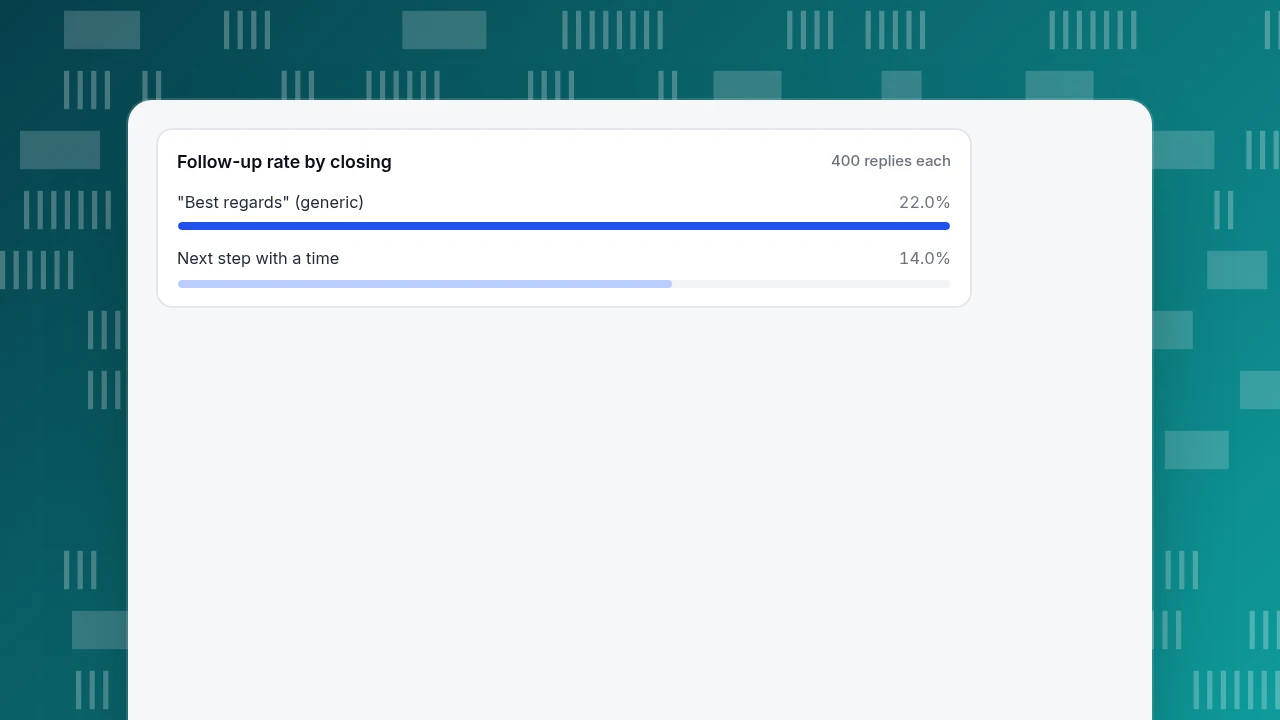
It can, and you can measure it with follow-up rate: the share of customers who write back asking "any update?" after your reply. A closing that states a next step and a time should reduce that.
Sample data: 800 support replies to similar questions, 400 with the generic closing "Best regards" and 400 with a next-step closing that gives a time. Count the replies where the customer writes again asking for status within 48 hours.
| Closing | Replies | Customers asking for an update | Follow-up rate |
|---|---|---|---|
| "Best regards" (generic) | 400 | 88 | 22.0% |
| Next step with a time | 400 | 56 | 14.0% |
The difference is 8 points, a 36.4% reduction. With the two-proportion z-test from the NIST/SEMATECH e-Handbook, the pooled rate is (88 + 56) ÷ 800 = 18.0%, the standard error is √(0.18 × 0.82 × (1/400 + 1/400)) = 0.0272, and z = (0.22 − 0.14) ÷ 0.0272 = 2.94, above 1.96, so the gap is unlikely to be chance. The 95% interval for the gap runs from 2.7 to 13.3 points.
Two caveats. The two groups must be like for like: same question types, assigned at random or alternately, not "the new template for Monday's tickets". And a lower follow-up rate is only good if the problem was actually solved; check resolution and satisfaction alongside it.
Follow-up rate by closing
400 replies eachHow to put this into practice in TapCub
Take the six scenarios above. TapCub is not an email help desk, so it does not send or template your email; it covers chat, where the same greetings and closings apply. Use it to store the wording and to measure what happens.
- Save the closings that work as replies in Live chat › Canned replies. They can be personal or site-wide; type
/in a conversation to insert one, and edit it before sending, so the name and the time are right. - When you answer a visitor in Live chat › Inbox, the side panel shows where they came from, their current page and the last two days of browsing, so your greeting can mention what they were looking at without asking.
- Watch Live chat › Reports for first response time (the first human reply) and resolution rate, which tell you whether a rewritten closing changed outcomes. A resolved conversation reopens if the visitor writes again within 24 hours, so a chat closing such as "write here if it comes back" holds true.
- For visitors who leave a message when nobody is online, work the Live chat › Chat settings › Offline messages list (New, Replied, Closed) and keep the same greeting and closing rules there.
- Send any follow-up by email from your own mail system; TapCub counts the visit if the customer clicks a tagged link back to your site.
FAQ
What is a good way to end a customer support email?
End with the next step and when it will happen, for example "I will check on Thursday morning and write either way." If the case is solved, invite a reply: "If this does not fix it, reply here and I will pick it up." Avoid closings that promise nothing, such as "We will get back to you shortly."
How do you start an email to a customer you do not know?
Use "Hello," or "Hello [Name]," when you have a name. "Dear Customer," and "To whom it may concern," sound automated. If the customer wrote formally or the message is legal in tone, use "Dear Ms Alvarez," and keep a similar level of formality in the reply.
Is "Best regards" a good sign-off for support emails?
It is safe, but it says nothing. For support, a closing that states the next step is more useful, and in the sample here, a next-step closing cut "any update?" follow-ups from 22.0% to 14.0%. Use "Kind regards," only when you need a formal tone, with the next-step line above it.
Should you use exclamation marks and emojis in support emails?
Not in apologies or messages to upset customers; they read as cheerful when the customer is not. A single exclamation mark in a positive message ("Your refund is on its way!") is fine. Follow the customer's own style, one step more polite.
Are customer support emails subject to CAN-SPAM?
Support replies that confirm or complete a transaction, or give account, warranty or safety information, are transactional and exempt from most of the Act, though the FTC says this is read narrowly. If you add promotional content, the message may count as commercial, with opt-out and penalty rules applying.
Sources
- Waldvogel, J. (2007), Greetings and closings in workplace email, Journal of Computer-Mediated Communication 12(2), 456–477 (form and use of greetings and closings related to organisational culture, status, social distance and gender). Checked 2026-11-22.
- FTC, CAN-SPAM Act: A Compliance Guide for Business (transactional messages; $53,088 per email; opt-out within 10 business days). Checked 2026-11-22.
- Digital.gov, Plain language guide (Plain Writing Act of 2010: content written for its specific audience). Checked 2026-11-22.
- NIST/SEMATECH, e-Handbook of Statistical Methods: Do two batches have the same proportion of defects? (two-proportion z-test). Checked 2026-11-22.
Was this article helpful?
We use your answers to fix and expand this page.
Couldn’t send. Please try again in a minute.
Thanks for the feedback. We’ll use it to improve this page.You’ve already sent feedback on this page. Thanks.

Product Analyst
Focuses on event analysis, conversion funnels, and retention, using clear metric definitions and structured analysis to explain product performance.