Try it on your own data
Every report in this article is in the free plan. One snippet for web and apps, up to 10 sites.
Start freeEthical marketing is marketing that passes three tests: every claim has evidence, people agreed to what you do with their data and attention, and the design lets them say no as easily as yes. This guide turns each test into a table you can run on your copy, forms and campaigns, shows what an ethical change does to the numbers in a recomputed example, and covers what to measure afterwards.
What you will learn
- Give every claim a source and a date, and keep a claims register you review each quarter
- Valid consent is freely given, specific, informed and unambiguous; unticked boxes and one-click withdrawal are the test
- Ethical changes often shrink headline numbers and improve engaged people, complaints and repeat purchase; decide which metrics you will judge by first
What does ethical marketing mean in practice?
Ethical marketing is marketing that survives three tests, applied to every claim, form and campaign:
- Truth test. Can you show evidence for each claim, today, to a stranger?
- Consent test. Did the person agree to what you are doing with their attention and data, and did they understand it?
- Freedom test. Does the design let people say no as easily as yes?
Values statements and "purpose" campaigns are optional extras. These three tests are the part you can audit. The American Marketing Association's statement of ethics lists six values (honesty, responsibility, fairness, respect, transparency and citizenship); the three tests are a working translation of the first four into things a team can check before publishing.
Ethics is not the same as legality. A pre-ticked box or a countdown timer that resets may be legal in some places and still fail the freedom test. Legal minimums set the floor; this guide is about what sits above it. If you need to know what the law requires for your business, ask a lawyer.
How do you keep marketing claims honest?
Honest claims have a source and a date. Use this table when reviewing copy:
| Claim type | Evidence you should hold | Weak version | Honest version |
|---|---|---|---|
| Number ("saves 5 hours a week") | The calculation, the sample and the date | "Saves hours every week" | "In our March 2026 test of 12 teams, median time saved was 3.5 hours a week" |
| Comparison ("faster than before") | Same measurement on both sides | "Twice as fast" | "Median load time fell from 3.2 s to 1.9 s on our checkout page" |
| Testimonial | The person's consent and any payment or free product | A quote with no context | The quote, the person's role, and "received a free plan" if true |
| Scarcity ("only 3 left") | The real inventory count | A timer that restarts on reload | A real deadline that ends once |
| "Eco" or "green" | The specific change and its measurement | "Planet-friendly" | "Packaging is 80% recycled cardboard by weight" |
Two rules sit behind this. First, in the United States the FTC Act prohibits unfair or deceptive acts or practices in commerce (15 U.S.C. § 45), and the FTC's endorsement rules (16 CFR Part 255) say that a material connection between an endorser and the seller, such as a payment or free product, has to be disclosed clearly. Second, a claim you cannot support is a problem even where nobody checks. The "weak" column above is where most ethical lapses happen: not outright lies, but numbers with the context cut off.
A quick practice that works: keep a claims register, a spreadsheet with one row per claim, its source link, the date checked and the next review date. Review it quarterly. Claims whose evidence has aged out (a 2023 survey, a price that changed) are rewritten or removed.
What counts as valid consent for marketing data?
Consent is only meaningful if it is freely given, specific, informed and unambiguous. That wording comes from the GDPR and is explained in the European Data Protection Board's Guidelines 05/2020 on consent. Applied to marketing, it gives you a checklist you can run on any sign-up form or banner:
| Check | Passes | Fails |
|---|---|---|
| Freely given | Sign-up works without ticking the marketing box | Download is blocked unless you accept newsletters |
| Specific | Separate boxes for newsletter and for sharing with partners | One box covering everything |
| Informed | One sentence saying what you will send and how often | "I agree to the terms" with a 40-page link |
| Unambiguous | An unticked box the person ticks | A pre-ticked box, or silence treated as yes |
| Easy to withdraw | Unsubscribe link in every email, one click | Login required, or a "call us" step |
Two more habits matter outside the form. Do not buy lists: nobody on them agreed to hear from you, so every send is unwanted by definition. And match the promise to the use: people who gave an email for a receipt did not agree to a weekly newsletter. For the long version of how to build this into products and processes, see privacy by design, and for how consent shapes the data you do hold, see first-party data strategy. The permission itself is explained in the glossary entry on opt-in.
One more rule of thumb for B2B teams: a business email address is still a person's data, and rules on cold outreach vary by country and by whether the recipient is a company or a sole trader. Check before you send, and always identify yourself and offer an opt-out.
Which dark patterns should you remove first?
"Dark patterns", also called deceptive design patterns, are interface choices that steer people toward something they would not choose with a clear view. The EDPB's Guidelines 03/2022 describe them for social media platforms, but the same patterns appear in ordinary marketing sites. This audit list is ordered by how often they show up and how easy they are to fix:
| Pattern | What it looks like | Fix |
|---|---|---|
| Pre-ticked box | Marketing opt-in already checked | Leave it unticked |
| Confirmshaming | "No thanks, I don't like saving money" | Neutral label: "No thanks" |
| Hidden unsubscribe | Grey 8 px text in the footer | Normal-size link in the first screen of the email |
| Fake urgency | Countdown that resets on reload | Remove it, or tie it to a real end date |
| Hard to cancel | Sign-up online, cancel by phone | Same channel, same number of clicks |
| Asymmetric banner | Big "Accept all", tiny "Reject" | Equal-weight buttons |
| Trick questions | "Untick if you prefer not to not receive…" | One plain sentence, one box |
A useful test for any of them is click symmetry: count the clicks and the reading effort needed to say yes and to say no. If saying no takes more, you have found one. Fix the top three on your site first; they cost an afternoon each.
| Dark pattern | What it looks like | Fix |
|---|---|---|
| Pre-ticked box | Marketing opt-in already checked | Leave it unticked |
| Confirmshaming | "No thanks, I don't like saving money" | Neutral label: "No thanks" |
| Hidden unsubscribe | Tiny grey footer text | Normal-size link on the first screen |
| Fake urgency | Countdown that resets on reload | Remove it or use a real end date |
| Hard to cancel | Sign up online, cancel by phone | Same channel, same clicks |
| Asymmetric banner | Big Accept all, tiny Reject | Equal-weight buttons |
Test any of them with click symmetry: count the clicks and reading effort to say yes and to say no.
What does an ethics audit change? A worked example
Sample data: a store changes its newsletter box from pre-ticked to unticked. Over the same month it gets 5,000 sign-ups at checkout both times.
| Before (pre-ticked) | After (unticked) | |
|---|---|---|
| Marketing opt-ins | 4,000 (80% of 5,000) | 1,500 (30% of 5,000) |
| Open rate | 9% | 31% |
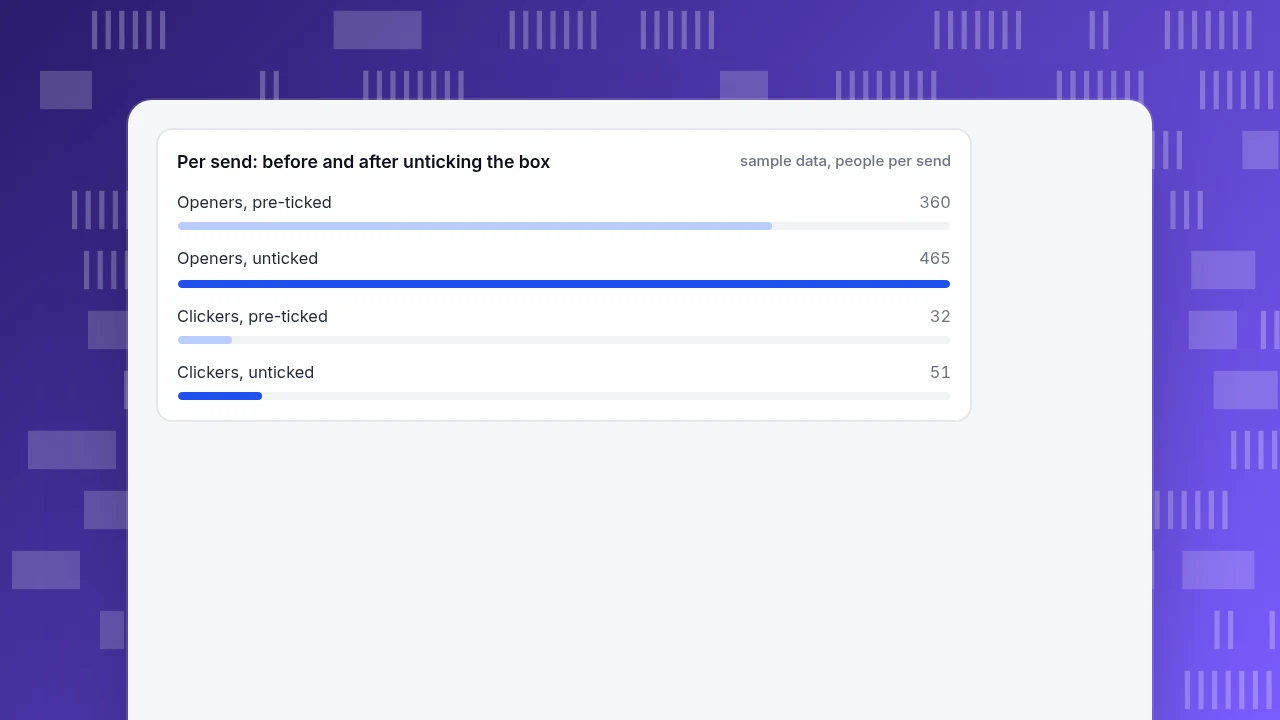
| Openers per send | 4,000 × 9% = 360 | 1,500 × 31% = 465 |
| Click rate | 0.8% | 3.4% |
| Clickers per send | 4,000 × 0.8% = 32 | 1,500 × 3.4% = 51 |
| Spam complaint rate | 0.30% | 0.05% |
| Complaints per send | 4,000 × 0.30% = 12 | 1,500 × 0.05% = 0.75 |
The list shrank by 62.5% ((4,000 − 1,500) ÷ 4,000), and yet more people opened (465 vs 360, +29%) and clicked (51 vs 32, +59%) each send, with 12 complaints a send down to about one. The people removed from the list were never an audience; they were a number. The one cost is real: fewer people to reach. If your plan depends on list size as a vanity metric, this change will look like a loss until you track opens, clicks and orders per send instead.
The lesson is general. Ethical changes often shrink a headline metric (opt-ins, sign-ups, "conversion") while improving the metrics that tie to money and trust (complaints, refunds, engaged subscribers, repeat purchase). Decide in advance which metrics you will judge the change by.
Per send: before and after unticking the box
sample data, people per sendHow do you measure ethical marketing without tracking people unfairly?
Measure outcomes, not surveillance. These signals tell you whether people feel treated fairly:
- Complaint and unsubscribe rate per send. Rising complaints mean the permission or the promise is off.
- Refund and chargeback rate per campaign. A campaign with a high refund rate may have oversold.
- Opt-in decline share, the share of people who see a consent prompt and decline. A very low decline rate on a consent prompt is a signal to check whether the design is pushing.
- Support tickets that contain "misleading", "didn't know" or "unsubscribe", tagged by hand once a month.
- Repeat purchase or renewal at 90 days. Honest acquisition tends to retain.
Collect these with the least data that answers the question. Aggregate counts answer most of them; you rarely need individual-level tracking. When you do, state what you collect and why in plain language.
What are the most common ethical marketing mistakes?
- Treating "ethical" as a label. A badge with no practice behind it is itself a misleading claim.
- Vague green or social claims. "Sustainable" with no measurement invites the question "compared to what?".
- Bundled consent. One tick for newsletter, partners and profiling fails the "specific" test.
- Assuming legal means fine. Legal minimums vary by country; trust is lost everywhere.
- Fake social proof. Invented reviews, undisclosed paid reviews or "1,243 people are viewing this" with no real counter.
- Reviewing only once. Evidence ages; claims and consent text need a recurring review, not a launch-day check.
How to check ethical marketing outcomes in TapCub
Take the store above. After it unticks the newsletter box, it wants to know whether the change hurt the things it can actually measure on the website. TapCub measures what happens on the site; it does not judge your claims or run your email, so the review of copy and the unsubscribe handling stay with you. The steps:
- Choose a collection level on purpose. In Configuration › Privacy center, pick the collection tier. Tier 1 is anonymous summary data with no persistent ID, no automatic collection and no identity; the default is tier 2. For the European Economic Area and the UK the default rule is tier 2 with consent required, dropping to tier 1 when there is no analytics consent, and pageviews and custom events are still recorded.
- Honour data requests. The same page handles data subject requests (export and delete) and sets address truncation and retention periods, so a deletion request has somewhere to go.
- Check the newsletter flow like any other conversion. Create a goal for the sign-up confirmation in Web analytics › Goals and watch the rate before and after the change, with an annotation in Configuration › Annotations on the day you changed the box.
- Tag campaigns honestly. Use clear UTM names (see Web analytics › Sources) so a campaign's visits and orders can be compared with its refund and complaint numbers from your email and payment tools.
- Know the boundary. TapCub does not fact-check claims, send email or measure complaint rates; those numbers come from your email and payment tools. It is not a legal product either, and whether you need consent depends on your configuration and local law.
FAQ
What are the 3 main principles of ethical marketing?
Sources differ on the exact list, but three recur: honesty (truthful, supportable claims), respect for consent and privacy (people agreed, and understood), and fairness (no manipulative design or exploitation of vulnerable groups). Many guides add social responsibility. The three-test version above compresses these into truth, consent and freedom.
Is ethical marketing the same as legal marketing?
No. Law sets minimums that differ by country and change over time. Ethical marketing aims above them: it avoids things that may be legal but still mislead, such as a pre-ticked box or a countdown that resets. For legal questions about your business, consult a lawyer.
Does ethical marketing hurt conversion rates?
Sometimes the headline number falls and the quality number rises. In the sample above, opt-ins dropped from 80% to 30% of sign-ups but openers per send rose 29% and complaints fell. Judge changes by engaged people, complaints and repeat purchase, not by raw sign-ups.
What are examples of unethical marketing?
Fake scarcity timers, invented or undisclosed paid reviews, pre-ticked consent boxes, confirmshaming opt-outs, subscriptions that are easy to start and hard to cancel, vague claims such as "eco-friendly" with nothing behind them, and bought email lists.
How do you do analytics ethically?
Collect the least data that answers your question, tell people what you collect, respect consent where it is required, and use aggregate numbers wherever they are enough. Set retention periods and have a route for deletion requests.
Sources
- American Marketing Association. AMA Statement of Ethics. Ethical norms and values for marketers.
- European Data Protection Board. Guidelines 05/2020 on consent under Regulation 2016/679. Free, specific, informed and unambiguous consent.
- European Data Protection Board. Guidelines 03/2022 on deceptive design patterns in social media platform interfaces.
- U.S. Code. 15 U.S.C. § 45, unfair methods of competition unlawful.
- Electronic Code of Federal Regulations. 16 CFR Part 255, Guides concerning the use of endorsements and testimonials in advertising.
Was this article helpful?
We use your answers to fix and expand this page.
Couldn’t send. Please try again in a minute.
Thanks for the feedback. We’ll use it to improve this page.You’ve already sent feedback on this page. Thanks.

Product Analyst
Focuses on event analysis, conversion funnels, and retention, using clear metric definitions and structured analysis to explain product performance.