Try it on your own data
Every report in this article is in the free plan. One snippet for web and apps, up to 10 sites.
Start freeCustomer complaint examples fall into seven common types: late delivery, wrong or damaged items, missing refunds, billing errors, products not as described, slow service and account problems. Every good reply acknowledges the specific problem, names who is handling it, states the fix with a date and closes the loop. Count complaints by type to fix the most frequent cause first.
What you will learn
- Four-part reply: acknowledge the specific problem, name the owner, state the fix with a date, close the loop
- Sample: three types (delivery, wrong or damaged item, refund) were 63.5% of 400 complaints; service attitude was 5%
- Deadlines: FTC rule, refunds mostly within seven working days; EU directive, reimbursement within 14 days of notice
What does a good complaint reply contain?
Every complaint reply, whatever the topic, needs the same four parts in the same order. The examples below all follow this frame, so learn it once.
- Acknowledge the specific problem. Name what went wrong in the customer's own terms ("your order arrived without the charger"), not a generic "sorry for the inconvenience".
- Say who is dealing with it. "I'll take this from here" removes the fear of being passed around.
- State the fix and the date. A concrete action with a time: "a replacement ships today, tracking by 5 pm". If you cannot fix it yet, say what you will do and when you will next write.
- Close the loop. Say what you will check afterwards, and leave a way back to the same person or conversation.
Three rules sit on top of the frame. Do not argue about whose fault it is before the customer's problem is fixed. Do not promise what a policy or a rule does not give you, because a promise you cannot keep makes the next complaint worse. And do not copy the same sentence into every reply; a reusable reply should have blanks for the details that matter (order number, date, amount) and be edited before sending.
Late or missing delivery
What the customer says: "My order was due Tuesday and nothing has arrived."
Reply example: "I'm sorry your order [number] hasn't reached you by [date]. I've checked with the carrier: it is currently [status]. I'll take this from here. If it isn't with you by [new date], I'll send a replacement or refund you in full, whichever you prefer. I'll write again on [date] with an update either way."
What to fix: a delivery promise you could not keep. If you are in the United States and sell by mail, internet or telephone order, the FTC's Mail, Internet, or Telephone Order Merchandise Rule requires that you have a reasonable basis to ship within the time you stated, or within 30 days if you stated none, that you notify the customer before the promised time if you cannot ship, and offer a choice between agreeing to the delay and canceling; most required refunds are due within seven working days after cancellation. Build your late-delivery reply around those dates.
Wrong or damaged item
What the customer says: "I ordered the blue one and received the red one" or "it arrived broken."
Reply example: "I'm sorry the [item] in order [number] arrived [damaged / not what you ordered]. Thank you for the photo. I'm sending a replacement today, and you don't need to return the first one [or: here is a prepaid return label]. Tracking will be sent to [email] by [time]. If you'd rather have a refund, tell me and I'll process it today."
What to fix: the picking or packing step. Ask for a photo once, early, so the customer is not asked twice; offer the choice of replacement or refund so that the customer decides.
Refund not received
What the customer says: "You said you'd refund me and I've seen nothing."
Reply example: "I'm sorry the refund for order [number] hasn't reached you. I can see it was issued on [date] for [amount] to the card ending [last four digits]. Banks can take [number] working days to show it. If it isn't there by [date], send me a screenshot of your statement and I'll trace it with our payment provider."
What to fix: unclear timing. Know your own refund process and its deadline. In the European Union, the Consumer Rights Directive (2011/83/EU) gives consumers 14 days to withdraw from a distance contract (Article 9) and requires the trader to reimburse no later than 14 days from the day it is informed of the decision to withdraw (Article 13). In the United States the FTC rule above sets seven working days for most required refunds. Tell the customer the date you are committed to, and meet it.
Double charge or billing error
What the customer says: "I've been charged twice."
Reply example: "I'm sorry for the double charge on [date]. I've confirmed two payments of [amount] on order [number]. I've refunded one, [amount], which shows as [pending / complete] now; your bank may take [number] working days to show it. I'll check on [date] that it has gone through and write to you if it hasn't."
What to fix: the duplicate. Look at whether the customer clicked twice, whether a payment retry went through, or whether two orders were created. A billing mistake is a trust problem, so refund first and investigate afterwards.
Product not as described
What the customer says: "This isn't what the page showed."
Reply example: "Thank you for telling me, and I'm sorry the [item] didn't match what you expected. Could you tell me which part differs from the page, such as size, color or a feature? Whatever it turns out to be, you can [return it for a refund / exchange it] within [days]. I'll also pass your feedback to our product team so the page is corrected."
What to fix: the product page. If the same complaint comes in repeatedly, the page is the cause, and fixing the page prevents more complaints than any reply does.
Slow or unhelpful service
What the customer says: "I've been waiting two days" or "nobody helped me."
Reply example: "I'm sorry you waited that long and your question wasn't answered. That isn't what we want. I've read the whole conversation, so you won't need to repeat anything. [Answer or action]. I'll check back with you on [date], and my name is [name] if you reply."
What to fix: the process, not the person. Look at the first response and the resolution time for that period; see customer service workflow. A complaint about service is the one where a reply that reads like a template makes things worse.
Account or login problems
What the customer says: "I can't log in" or "my account was locked."
Reply example: "I'm sorry you're locked out. For your security I can't see your password, but I can send a reset link to the email on the account. [Instructions]. If that doesn't work in the next 15 minutes, reply here and I'll escalate to our account team."
What to fix: the self-service route. Many account complaints are answered by a published help page; answering from the knowledge base saves agent time and gives the customer an instant answer.
| Complaint type | What to fix | Deadline to know |
|---|---|---|
| Late or missing delivery | The delivery promise | FTC: delay notice before the promised time |
| Wrong or damaged item | Picking and packing | Offer replacement or refund |
| Refund not received | Unclear timing | FTC seven working days; EU 14 days |
| Double charge or billing error | The duplicate payment | Refund first, investigate after |
| Product not as described | The product page | Your return window |
| Slow or rude service | The process | First response and resolution time |
| Account or login | Self-service route | Reset link, help page |
Sample data for counts elsewhere in this article; deadlines from the FTC guide and Directive 2011/83/EU.
Which complaints come up most often?
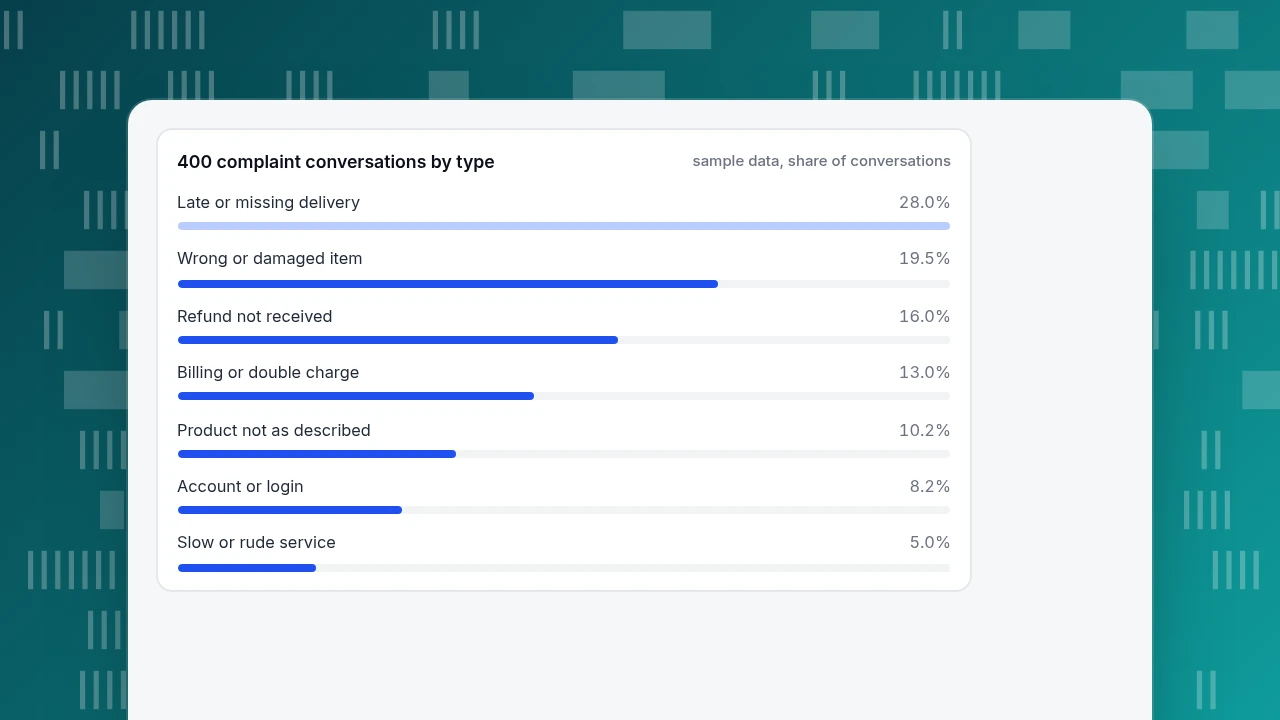
Examples tell you how to answer; counting tells you which to fix. Tally the reason for each complaint conversation over a month and sort by count. Sample data: 400 complaint conversations.
| Complaint type | Conversations | Share | Cumulative share |
|---|---|---|---|
| Late or missing delivery | 112 | 28.0% | 28.0% |
| Wrong or damaged item | 78 | 19.5% | 47.5% |
| Refund not received | 64 | 16.0% | 63.5% |
| Billing or double charge | 52 | 13.0% | 76.5% |
| Product not as described | 41 | 10.2% | 86.8% |
| Account or login | 33 | 8.2% | 95.0% |
| Slow or rude service | 20 | 5.0% | 100.0% |
| Total | 400 | 100% |
You can recompute it: 112 ÷ 400 = 28.0%, and 112 + 78 + 64 = 254 of 400 is 63.5%. Three types account for nearly two thirds of complaints. A delivery fix removes 28% of the volume; the whole service-attitude category is 5%, so retraining agents would help far less than fixing delivery promises.
Add a second cut, the page where the complaint started. If a quarter of "not as described" chats begin on one product page, that page is the fix. Review the counts monthly and watch the top three, not all seven.
400 complaint conversations by type
sample data, share of conversationsCommon mistakes when answering complaints
- A generic apology. "Sorry for the inconvenience" with no specifics reads as a refusal to engage.
- Defending before fixing. Arguing who was at fault first costs the customer's goodwill.
- Promising what the rules don't give. Do not state a refund window or policy you cannot honor.
- No date. "We'll look into it" without a time is the most common cause of a second complaint.
- Making the customer repeat themselves. Read the earlier conversation first.
- Fixing the reply instead of the cause. If one type keeps rising, change the process (delivery promise, product page), not only the wording.
- Never counting. Without a tally the loudest complaint, not the most frequent one, gets fixed. For wording that helps in difficult conversations, see empathy statements; for common questions, see customer service questions.
How to handle complaints and find the pattern in TapCub
Take the 400-conversation sample. TapCub helps you answer faster and find where complaints come from; it does not label complaint types for you.
- Answer with reusable replies. In Live chat › Canned replies, save one reply per type from the examples above, with a shortcut such as
/late-delivery. Agents type/in the composer to insert it and edit it before sending; nothing is sent automatically. Keep personal versions private with the personal switch, and share the rest at site level. The use count per reply shows which lines are actually sent, so it also roughly measures which complaint types are frequent. See using canned replies and canned responses. - Pass context along. In Live chat › Inbox, add an internal note (visible only to agents) with the type and order number before you transfer; the next agent sees it on the timeline. The visitor drawer shows the visitor's source, recent browsing trail and earlier conversations, so nobody has to ask again.
- Find the pattern. Search the conversation list by message text for words such as "late", "refund" or "charged", and count the results per month. There is no complaint-type field, so keep your tally in a spreadsheet using the categories above.
- See where complaints start. Live chat › Reports lists the top 10 pages where chats started, without query strings, and a heatmap of chat starts by weekday and hour. A product page near the top of the list for "not as described" chats is your page to fix.
- Turn repeat questions into answers. Put the top three questions in the Live chat › Knowledge base as Q&A entries, which are sent as written without an AI call, and pin them so visitors can read them without opening a conversation.
TapCub does not resolve complaints, issue refunds or classify them automatically; those stay with your team and your payment provider.
FAQ
What are examples of customer complaints?
The common ones are late or missing delivery, wrong or damaged items, refunds that have not arrived, double charges or billing errors, products that do not match their description, slow or unhelpful service, and account or login problems. In the sample, the first three made up 63.5% of 400 complaints.
How do you respond to a customer complaint?
Acknowledge the specific problem, say who is handling it, state the fix with a date, and close the loop with a follow-up. Avoid generic apologies and avoid arguing about fault before the problem is fixed. Every reply above uses this four-part frame.
How long do you have to refund a customer?
It depends on the rule. Under the FTC's mail, internet or telephone order rule in the United States, most required refunds are due within seven working days after cancellation. In the European Union, the Consumer Rights Directive requires reimbursement within 14 days of being informed of the withdrawal. Check the rule that applies to you.
How do you find the root cause of complaints?
Tally the reason for every complaint for a month, sort by count and look at the top three; then add a second cut by the page or step where the complaint started. In the sample, delivery was 28% of volume and service attitude was 5%, so delivery promises came first.
Should every complaint reply be personalized?
Yes in the details, not necessarily in every sentence. Use a reusable reply with blanks for the order number, date and amount, and edit it before sending so it reads as a response to this customer's problem. Replies that read like templates make service complaints worse.
Sources
- Federal Trade Commission. Business Guide to the FTC's Mail, Internet, or Telephone Order Merchandise Rule — reasonable basis to ship in the stated time or 30 days, notice before the promised time, refund within seven working days. Checked 2026-11-22.
- European Union. Directive 2011/83/EU on consumer rights — Article 9 (14-day withdrawal period) and Article 13 (reimbursement within 14 days of being informed). Checked 2026-11-22.
Was this article helpful?
We use your answers to fix and expand this page.
Couldn’t send. Please try again in a minute.
Thanks for the feedback. We’ll use it to improve this page.You’ve already sent feedback on this page. Thanks.

Product Analyst
Focuses on event analysis, conversion funnels, and retention, using clear metric definitions and structured analysis to explain product performance.