Try it on your own data
Every report in this article is in the free plan. One snippet for web and apps, up to 10 sites.
Start freeA customer relationship management strategy is a plan for how you win, grow and keep customers using what you know about them, and it starts with data decisions, not software: who counts as a customer, what counts as an interaction and who owns each stage. In the sample below, merging duplicate records changed a conversion rate from 1.5% to 2.0% before any campaign changed.
What you will learn
- Settle four decisions first: who is a customer, what is an interaction, who owns each stage, what is the identifier
- Give every lifecycle stage an entry rule, an exit rule, an owner and one metric
- Choose the tool last, then check it can hold your definitions
What is a customer relationship management strategy?
A customer relationship management (CRM) strategy is a plan for how your business will win, grow and keep customers, using what you know about them. It is not the choice of CRM software. The software stores records and runs workflows; the strategy decides which records matter, who acts on them and what you are trying to change.
Payne and Frow's widely cited framework (Journal of Marketing, 2005) describes CRM as five connected processes: strategy development, value creation, multichannel integration, information management and performance assessment. Notice that only one of the five is about technology. The other four are decisions about customers, offers, channels and measurement. That is why many CRM projects stall: the tool is bought before the decisions are made, and the tool then holds records nobody agreed how to read.
The practical consequence is the thesis of this article: a CRM strategy starts with data decisions: who counts as a customer, what counts as an interaction and who owns each step. Everything else (segments, campaigns, dashboards) depends on those three answers.
Which four decisions come before any tool?
| Decision | The question | Example answer | What breaks if you skip it |
|---|---|---|---|
| Who is a customer? | Person, company or both? Paid only, or trials too? When do they stop being one? | "A customer is a paying company account; someone is lapsed after 90 days with no paid plan" | Every count and conversion rate differs by team |
| What is an interaction? | Which events count as contact, and from which systems? | "Purchase, support chat, ticket, login, invoice question" | You cannot see a relationship if you cannot say what it is made of |
| Who owns each stage? | Which named role moves a customer to the next stage? | "Sales owns trial to paid; success owns months 1 to 3" | Customers fall between teams |
| What is the identifier? | What joins records into one person or account, and how are duplicates merged? | "Account ID for companies, verified email for people" | One person appears as three, and every rate is skewed |
Write the answers on one page and get every team that touches customers to sign it. If two teams disagree, that disagreement is the first thing your strategy needs to resolve. For what a joined-up customer record is, see single customer view; for the system layer that collects and joins data from several sources, see customer data platform.
| Decision | The question | What breaks if you skip it |
|---|---|---|
| Who is a customer? | Person, company or both? Paid only? When do they stop being one? | Every count and rate differs by team |
| What is an interaction? | Which events count as contact, from which systems? | You cannot see a relationship you cannot define |
| Who owns each stage? | Which named role moves a customer on? | Customers fall between teams |
| What is the identifier? | What joins records, and how are duplicates merged? | One person appears as three; every rate is skewed |
Write the four answers on one page and have every customer-facing team sign it before choosing a tool.
How do you write the strategy, step by step?
- Set one or two goals with numbers. For example "raise 12-month retention of paid accounts from 80% to 85%". Goals like "build stronger relationships" cannot be checked.
- Settle the four decisions above and write them down.
- Define the lifecycle stages. For example: lead, trial, new customer (first 90 days), established, at risk, lapsed. Each stage gets an entry rule, an exit rule and an owner.
- Choose the segments you will treat differently. Two or three, not twelve. Segment by value or behaviour and by lifecycle stage, and say how each is handled.
- List what you do at each stage. One or two actions per stage and the channel for each.
- Choose metrics per stage. One number per stage, such as trial-to-paid rate or month-1 active share, with a target.
- Map data to systems. For each interaction, where it is recorded and how it reaches the shared record.
- Set a review rhythm. Look at the stage metrics monthly and revisit definitions each quarter.
Then, and only then, pick the tool and check it can hold these definitions.
Worked example: a 40-person software company
Sample data: a B2B software company has 12,400 contact records in its CRM and wants to know what its sales and marketing performance is. First, the identifier decision.
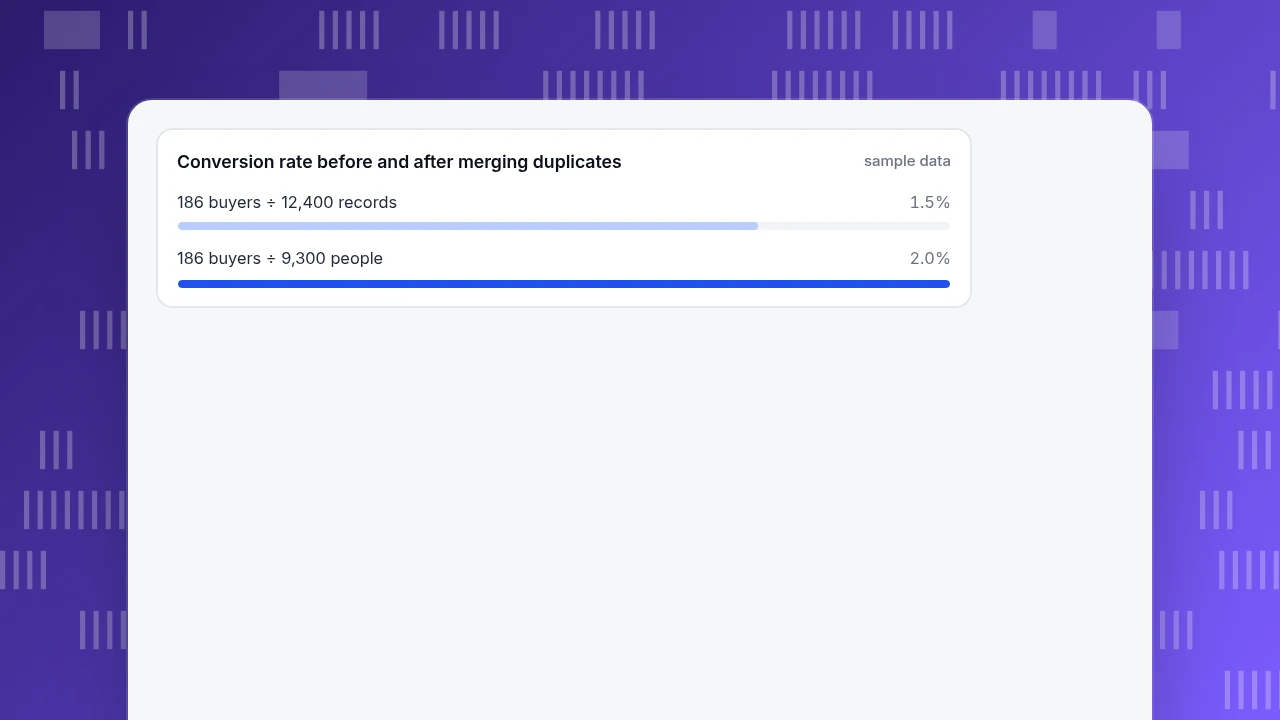
Duplicates change every rate. The company agrees that a person is identified by a verified work email. Merging records with the same email leaves 9,300 people; 12,400 − 9,300 = 3,100 duplicates, or 3,100 ÷ 12,400 = 25% of the database. In a year, 186 people became paying contacts. Measured on the raw records, 186 ÷ 12,400 = 1.5%; on people, 186 ÷ 9,300 = 2.0%. The same business looks one-third better with a clean identifier, and every previous comparison between campaigns was muddled by duplicates.
Stages with owners. The company writes its stages down:
| Stage | Entry rule | Exit rule | Owner | One metric |
|---|---|---|---|---|
| Lead | Gave an email | Starts a trial or 60 days idle | Marketing | Lead to trial rate |
| Trial | Started a trial | Pays, or 14 days end | Sales | Trial to paid rate |
| New customer | First payment | 90 days after payment | Customer success | Share active in month 1 |
| Established | Past day 90, active | No activity for 30 days | Customer success | 12-month retention |
| At risk | No activity for 30 days | Active again, or 90 days pass | Customer success | Share re-activated |
| Lapsed | No paid plan for 90 days | Pays again | Marketing | Win-back rate |
One month through the funnel. Using one month of sample data, 1,000 new leads: 8% start a trial, giving 80; 25% of those pay, giving 20; and 80% of those are active in month 1, giving 16. Reading down the table tells the team where to work: the 25% trial-to-paid step has the most room, and its owner is named.
Without the four decisions this would have been three teams quoting three different numbers.
Conversion rate before and after merging duplicates
sample dataWhat do CRM strategies look like in practice?
The same four decisions produce different strategies in different businesses. These are illustrative patterns, not case studies.
| Business | Customer means | Interactions that count | Stage owner | Metric |
|---|---|---|---|---|
| Online store | A person with at least one order | Orders, returns, support chats, email clicks | Marketing for win-back; support for issues | Repeat purchase rate within 90 days |
| Local service (for example a clinic or salon) | A person with a booking in the past 12 months | Bookings, no-shows, reminders answered | Front desk | Rebooking rate within 6 months |
| B2B software | A paying company account | Logins, feature use, support tickets, invoices, review meetings | Customer success | 12-month net revenue retention |
| Agency or consultancy | A client with an active contract | Meetings, deliverables, invoices, feedback | Account manager | Client retention at renewal |
Notice what changes: the unit (person or company), the signals and the owner. What stays the same is that each cell is a decision made in advance. For the success side of B2B, see customer success strategy.
What goes wrong in CRM strategy?
- Buying the tool first. The tool will hold whatever definitions you give it, including contradictory ones.
- Counting everything as an interaction. An opened email and a signed contract are not the same strength of signal. Rank interactions or count only the ones that matter to a stage.
- Collecting every field you can. Data you do not use is a cost and a risk. The EU's General Data Protection Regulation requires personal data to be adequate, relevant and limited to what is necessary (Article 5(1)(c)); this is a good test even where the law does not apply.
- No owner for stage changes. If nobody is named for "at risk", nobody acts.
- Too many segments. If you cannot say how each segment is treated differently, merge it.
- Never re-reading the definitions. Products, prices and customers change; a customer definition from two years ago may be wrong.
What can TapCub contribute to a CRM strategy?
TapCub is not a CRM. It has no contact pipeline, lead scoring, email campaigns or deal tracking, and it does not replace your CRM. What it can do is supply the behaviour side of the record and check whether your definitions match what people actually do. Here is how the software company above would use it.
- Identify people when they log in. The product calls
tapcub.loginafter sign-in. In All-platform analytics › Users › People, the person then has a profile with a timeline of their behaviour by day, and the live chat also knows who they are, so agents do not need to ask for an email. - Write the interaction list into the tracking plan. In All-platform analytics › Data › Tracking plan, record each event you count as an interaction (name, platform, trigger, properties, owner and status) and use the real-time check to see whether it is arriving with its required properties.
- Check the stage rules against behaviour. In All-platform analytics › Behavior › Behavior analysis, run retention and lifecycle for the people in each stage, to see whether "no activity for 30 days" really separates at-risk clients.
- Build the segments. In All-platform analytics › Users › Segments & tags, make a rule segment for each stage (done / not done conditions, refreshed daily), or use the RFM groups, which sort people into 10 buckets and record movement between them. Anonymous visitors have no profile, so they never join a segment.
- Use the profile before a call. Open the person in All-platform analytics › Users › People, or the company in All-platform analytics › Users › Accounts, to see recent behaviour and, for accounts, a 0 to 100 health score before anyone picks up the phone.
- Send the data to your CRM. TapCub does not sync to a CRM by itself; use All-platform analytics › Data › Data export for raw details or the server interface for events, and keep the CRM as the place where owners and deals live.
FAQ
What is a CRM strategy?
It is a plan for how you win, grow and keep customers using customer data. It sets who counts as a customer, what counts as an interaction, which stages exist, who owns them and what you measure. The software comes after those decisions.
What are the key components of a CRM strategy?
Payne and Frow describe five processes: strategy development, value creation, multichannel integration, information management and performance assessment. In practice, write down your customer definition, interaction list, lifecycle stages with owners, segments, one metric per stage and a review rhythm.
What are examples of customer relationship management?
An online store tracking repeat purchase within 90 days, a clinic measuring rebooking within six months, a software company watching net revenue retention and an agency tracking renewal. Each defines its customer, its interactions and its owner differently, which is the point.
How do you create a CRM strategy?
Set one or two numeric goals, settle the four data decisions, define lifecycle stages with entry rules and owners, pick two or three segments, assign one metric per stage and map data to systems. Choose the tool last and review the definitions every quarter.
Is TapCub a CRM?
No. TapCub measures what people do on your website, app and live chat, identifies logged-in users and groups them into accounts and segments. It does not manage deals, score leads or send emails, so keep a CRM for those and use TapCub for the behaviour data.
Sources
- Adrian Payne & Pennie Frow. A Strategic Framework for Customer Relationship Management. Journal of Marketing 69(4), 2005: the five-process CRM framework. Verified 2026-11-19 (the publisher blocks automated requests).
- European Union. Regulation (EU) 2016/679 (General Data Protection Regulation), Article 5(1)(c): data minimisation. Verified 2026-11-19.
Was this article helpful?
We use your answers to fix and expand this page.
Couldn’t send. Please try again in a minute.
Thanks for the feedback. We’ll use it to improve this page.You’ve already sent feedback on this page. Thanks.

Product Adoption Consultant
Explores customer onboarding, live conversations, and self-service, turning common usage questions into practical guidance and improvements.