Try it on your own data
Every report in this article is in the free plan. One snippet for web and apps, up to 10 sites.
Start freeA chat transcript is the saved text of a conversation, and because visitors type names, emails and order numbers into it, it is usually personal data. To handle one well, mask card numbers before storage, never keep card verification codes, set a retention period you can justify in writing, and be able to find and export a person's conversations within one month.
What you will learn
- Mask card numbers and IDs before storage; never keep card verification codes (PCI SSC: not stored after authorization, even if encrypted)
- No law fixes the number of days; the ICO says you justify and document the period. Going from 90 to 365 days means 4.06 times as many conversations to protect
- Answer access requests within one month (GDPR Article 12(3)); make conversations findable by the identifier a person gives you
What a chat transcript contains, and why it is personal data
A chat transcript is the saved text of a conversation between a visitor and your team: every message, the time of each, who wrote it, and often the page the visitor was on and the attachments they sent. It is not a neutral log. Visitors type their names, email addresses, order numbers and sometimes card numbers into a chat box, so a transcript is usually personal data, and the rules that apply to personal data apply to it.
Three questions follow from that, and the rest of this article answers them in order. How do you save and send a transcript? What do you remove before you store or share it? How long do you keep it? A fourth comes when someone asks for their copy: can you find and produce it?
How to save and send a transcript
There are three common routes, and each has a different risk.
| Route | What you get | Watch for |
|---|---|---|
| Export from the chat tool | A structured record of one conversation: messages, timeline events, consent records | Who is allowed to export, and where the file goes afterwards |
| Email the visitor a copy | A readable copy for the person who wrote it | Sending to the right address; redaction; whether staff-only notes are excluded |
| Copy and paste into a ticket or CRM | A searchable internal record | A second copy that your retention rules do not reach |
The third route is the one that causes trouble. A transcript pasted into a ticket sits outside the chat tool's retention setting, so it survives long after the original is deleted. If you must copy one, redact it first, link back to the conversation instead of pasting where you can, and add the copy to your retention schedule.
Here is a sample email transcript, written so that it is safe to send. Staff notes are left out, the sensitive details are masked, and the footer says how long the copy is kept.
Subject: Your chat with Northwind support, 14 March 2026 Hi Jane, here is a copy of your conversation as requested. Visitor: Hi, I was charged twice for order 88213. Agent: Sorry about that. Can you confirm the email on the account? Visitor: j@example.com. The card is * 1111 if that helps. Agent: Please don't send full card numbers here. I can see both charges. Visitor: OK. You can reach me on a number ending 0123 if it drops. Agent: Thanks. I've started the refund. You'll see it in 5 to 7 days. We keep chat records for 90 days after the last message, then delete them. To ask for a copy of everything we hold about you or to have it deleted, reply to this email.
What to remove before you store or share a transcript
Redaction means replacing sensitive details with a masked form before the text is stored. Do it as early as possible, because anything stored unmasked can be copied, exported and leaked.
| Detail | Example | What to do | Why |
|---|---|---|---|
| Full card number | 4111 1111 1111 1111 | Mask all but the last 4 digits | The card number should never sit in a chat log |
| Card verification code | 123 | Delete entirely; never store after authorization | PCI SSC says such data must not be stored after authorization, even if encrypted |
| Government ID number | National ID, passport | Mask all but the last 4 | Rarely needed to solve a chat |
| Phone number | +44 7700 900123 | Mask all but the last 4 digits if you do not need it | Keep it only if a call-back is the plan |
| Email address | jane.doe@example.com | Keep in the stored record if you need to reply; mask in shared copies | Needed for follow-up, not for an internal report |
| Passwords and access codes | One-time code | Delete from the stored message | Valid for only a short time, but still sensitive |
The card verification rule is the strictest. The PCI Security Standards Council's FAQ (July 2021) says sensitive authentication data "must not be stored after authorization even if encrypted", and that card-on-file and recurring payments do not require the code. A chat log that keeps a visitor's code after the payment has gone through breaks that rule even though nobody meant it to. The practical answer is to tell visitors not to type it and to mask anything that looks like a card number.
Sample data: here is how a masking rule treats the six-message conversation above. It looks for strings of 13 to 19 digits, keeps only those that pass the Luhn checksum, and replaces all but the last 4 digits.
- 4111 1111 1111 1111: passes the checksum, so it is a card number; it becomes
**** **** **** 1111. - 88213: only five digits, so it is left alone, which is right because it is an order number.
- A near miss, 4111 1111 1111 1112: fails the checksum, so it is not masked; this is why rules based on the checksum miss typos and why you should still tell visitors not to paste card numbers.
- Phone number +44 7700 900123: matched by its international prefix and masked to the last 4 digits.
- Result for the conversation: 1 card number, 1 phone number and 1 email address found; the card and phone are masked and the email is kept in the stored record.
A rule like this is a safety net, not permission to collect. GDPR Article 5(1)(c) requires personal data to be "adequate, relevant and limited to what is necessary", so the first fix is to stop asking for details you do not need.
| Detail | What to do | Why |
|---|---|---|
| Full card number | Mask all but the last 4 digits | A card number should never sit in a chat log |
| Card verification code | Delete; never store after authorization | PCI SSC: not allowed even if encrypted |
| Government ID number | Mask all but the last 4 | Rarely needed to solve a chat |
| Phone number | Mask all but the last 4 if not needed | Keep only if a call-back is planned |
| Email address | Keep if you must reply; mask in shared copies | Needed for follow-up, not for reports |
| Passwords and one-time codes | Delete from the stored message | Short-lived but still sensitive |
General guidance, not legal advice. Check the rules that apply where your visitors live.
How long to keep chat transcripts
There is no single legal number. The UK Information Commissioner's Office says the UK GDPR "does not set specific time limits for different types of data" and that "it is up to you to justify" the period based on your purposes. At the end of the period you should "erase or anonymise it unless there is a clear justification for keeping it for longer", and you should "establish and document standard retention periods". The EU text points the same way: Article 5(1)(e) says personal data must be kept in a form that identifies people "for no longer than is necessary".
So the job is to choose a period you can defend and write it down. Ask three questions for each reason you keep transcripts:
- Do you need the text, or only the outcome? For quality review, a few weeks is usually enough. For a dispute about a refund, keep the conversation as long as the dispute window.
- Who relies on it? If support agents look back only a few weeks, a year of history is not justified by that use.
- What does a longer period cost? Every extra month is more data to protect, to search when someone asks for their copy, and to disclose if there is a breach.
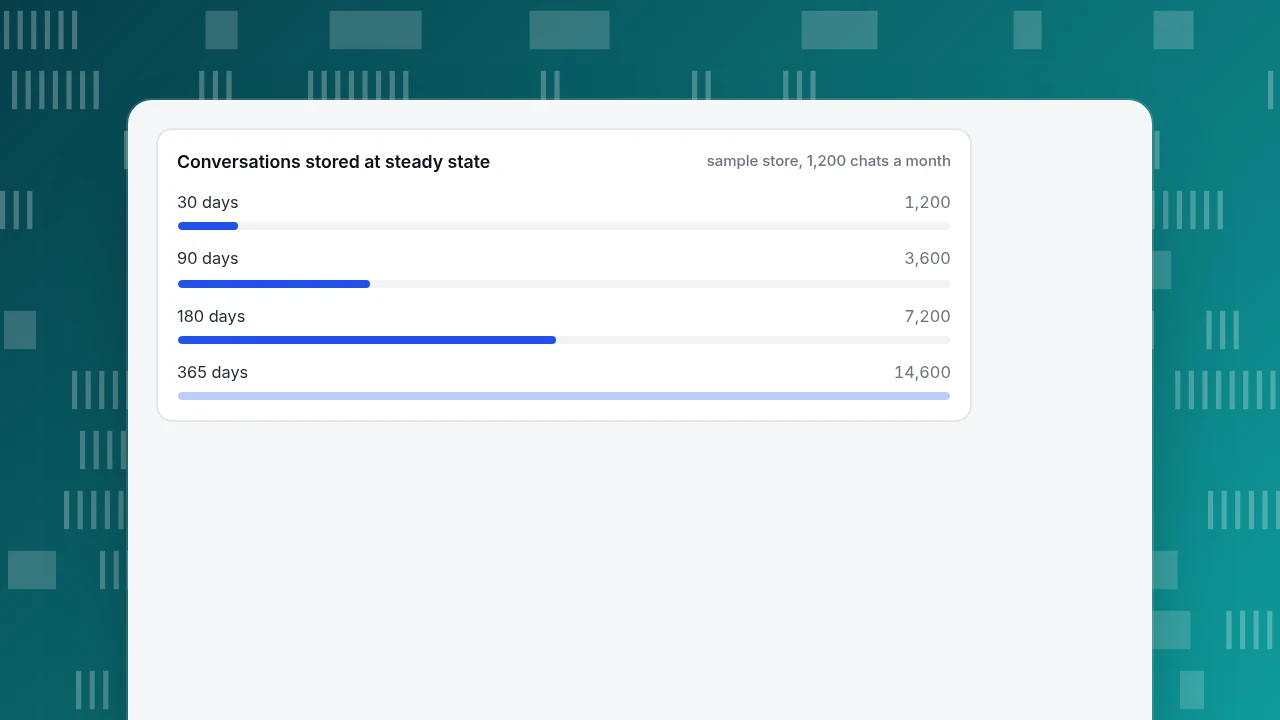
Sample data: a store handles 1,200 chats a month, so the number of stored conversations at steady state is 1,200 × days ÷ 30.
| Retention | Conversations held | Compared with 30 days |
|---|---|---|
| 30 days | 1,200 | 1× |
| 90 days | 3,600 | 3× |
| 180 days | 7,200 | 6× |
| 365 days | 14,600 | about 12× |
Moving from 90 to 365 days quadruples the conversations you are responsible for (3,600 to 14,600, a factor of 4.06). If your review process only ever looks back 30 days, the extra 13,400 conversations (14,600 − 1,200) are risk with no benefit. Choose the shortest period that covers your real use, and apply it to every copy, not just the original.
Conversations stored at steady state
sample store, 1,200 chats a monthAccess requests and deletion
When a visitor asks for their data, the transcript is part of it. GDPR Article 15 gives the person the right to confirm whether their data is processed and to get a copy, and Article 12(3) requires you to respond "without undue delay and in any event within one month", extendable by two further months for complex or numerous requests, with notice and reasons given in the first month.
Plan for this before the first request arrives:
- Make transcripts findable by identity. If you can search only by chat ID, you cannot find someone's conversations by email address. Decide how a conversation is linked to a person, for example through a login ID or the email they gave.
- Decide who can export and delete. Both actions need a role you trust, and both should be logged.
- Check every copy. An export from the chat tool does not cover the copy pasted into a ticket. Keep a short list of where transcripts can end up.
- Keep a note of what you did. Record the date of the request, what you produced or deleted, and who did it.
See our guide to what each role can see of personal data and the glossary entry on PII for the surrounding definitions, and keep personal data out of analytics for the same discipline on the analytics side.
A checklist you can adopt
- Tell visitors the chat is recorded and link to your privacy notice.
- Mask card numbers and other identifiers before storage, and tell visitors not to paste them.
- Do not store card verification codes or passwords.
- Set one retention period per transcript purpose, justified in writing, and apply it to copies.
- Limit who can export or delete, and log both.
- Make conversations searchable by the identifier a person would give you.
- Answer access requests within one month and keep a record.
- Exclude staff-only notes from any copy sent to a visitor.
How to do this in TapCub
Take the store above: 1,200 chats a month, a 90-day retention decision and card numbers appearing in chat. Here is how that looks in TapCub.
- Turn on masking. In Live chat › Chat settings › Privacy, switch on Mask sensitive data. Before storage, card numbers that pass a checksum, Chinese national ID numbers, Chinese mobile numbers and numbers with an international prefix keep only their last 4 digits, and the inbox marks the message as masked. Email addresses are left as written, because offline messages need them, so redact them yourself in any copy you share.
- Set the retention period. On the same page, set Conversation retention (days) to 90. It can be shortened but cannot exceed the plan cap (Free 30 days, Pro 90, Max 180, Ultra 365, unless your account page shows a different number). The clock counts from the conversation's last message. After you shorten it, a daily cleanup removes older conversations and the site owner gets an in-app notice with the expected date, so export anything you must keep first.
- Tell visitors. The chat window states "This conversation is recorded", and the link beside it comes from Privacy notice URL, so point it at your own policy.
- Handle an access or deletion request. Find the conversation in Live chat › Inbox; the list searches visitor code and message text, so someone who typed their email in the chat can be found by it, while others may only be found by visitor code. Then open it. Export returns the messages, timeline events and consent records as they are stored at that moment, and the action is audited. Delete removes messages and attachment files immediately and cannot be undone. Analysts and agent-only members cannot export or delete by default, so grant that deliberately. Satisfaction scores already counted in reports are not rolled back.
- Send a copy. The docs describe export from the inbox, but no send-by-email option for visitors. To email a copy like the sample above, export the conversation, remove staff-only notes and send it yourself.
TapCub keeps the chat record and enforces the retention you set. Deciding what is necessary, and keeping copies that live outside TapCub in line with it, remains your responsibility.
FAQ
What is a chat transcript?
A chat transcript is the saved text of a conversation, including messages, timestamps and who wrote each one. It often also holds the visitor's name, email, order numbers and the page they were on. Because it identifies a person, it is usually personal data and should be handled under your privacy and retention rules.
How long should you keep chat transcripts?
Keep them only as long as you can justify for a stated purpose. UK and EU rules set no fixed number; the ICO says it is up to you to justify the period and to document it. Many teams choose a few weeks for quality review and longer only for disputes. Delete or anonymise at the end of the period.
Can a customer ask for their chat transcript?
Yes. Under GDPR Article 15 a person can ask for confirmation that you process their data and for a copy of it, and chat transcripts are part of that. You must respond without undue delay and within one month, extendable by two months for complex requests, as set out in Article 12(3).
Should you redact chat transcripts before sharing them?
Yes. Remove card numbers, verification codes, government IDs, passwords and any detail the reader does not need. Keep the email address only if the reader must reply. PCI guidance says card verification codes must not be stored after authorization, so never keep them in a transcript at all.
How do you send a chat transcript to a customer?
Export the conversation, remove staff-only notes, mask sensitive details, check the address, and send it by email with a line saying how long you keep the record and how to request deletion. Do not paste it into an unencrypted channel the customer did not choose.
Sources
- European Union, General Data Protection Regulation, Article 5: Principles relating to processing of personal data. Data minimisation (5(1)(c)) and storage limitation (5(1)(e)). Checked 2026-11-20.
- European Union, GDPR Article 15: Right of access and Article 12: Transparent information. Copy of data; response within one month (12(3)). Checked 2026-11-20.
- UK Information Commissioner's Office, Storage limitation. No fixed time limits; justify and document retention. Checked 2026-11-20.
- PCI Security Standards Council, FAQ 1533: why storage of sensitive authentication data after authorization is not permitted, July 2021. Checked 2026-11-20.
Was this article helpful?
We use your answers to fix and expand this page.
Couldn’t send. Please try again in a minute.
Thanks for the feedback. We’ll use it to improve this page.You’ve already sent feedback on this page. Thanks.

Product Experience Specialist
Writes about product experience, practical workflows, and growth, turning complex processes into clear steps for everyday decisions.