Try it on your own data
Every report in this article is in the free plan. One snippet for web and apps, up to 10 sites.
Start freeA good backlink is an editorial link from a relevant page that links to few other places, set in the main text with descriptive anchor text and not paid for without a label. It also sends some visitors. Score six signals from 0 to 2 and you can compare any two links on one scale.
What you will learn
- Six signals, 0 to 2 each: relevance, placement, anchor text, outgoing links, link type and visits; 10 to 12 is strong
- A link on a page with 10 outgoing links gets 20 times the share of one on a page with 200, all else equal (simplified model)
- A nofollow link can still be a good link for visits; a link bought without a label fails whatever its score
What makes a backlink good?
A good backlink is a link a real reader would follow and a search engine has no reason to discount. It sits in the main text of a page about your topic, uses words that describe where it leads, comes from a page that links to few other places, and is not paid for without a label. Authority scores are a shortcut for some of this, not the definition.
Two tests catch most bad links before you score anything:
- Would this link exist if search engines did not? Editors cite a source because it helps their reader. A link that exists only because someone traded, paid or automated it fails.
- Does it send people? A good link usually shows up as visits in your analytics, even if the number is small. A link that never sends a single visit is not necessarily harmful, but it has not proven it is useful either.
This article turns those ideas into a rubric you can apply to any link in about a minute. If you want examples of the link types themselves, see backlink examples; the definition is on the backlink page.
The six signals, scored
Search engines do not publish a link-value formula, so no score is "official". The rubric below is ours. Each signal comes from guidance published by Google Search Central or by Ahrefs' help center, and the points are a simple way to compare links on the same scale: 0, 1 or 2 per signal, 12 at most.
| Signal | 2 points | 1 point | 0 points |
|---|---|---|---|
| Relevance | Page is about your topic | Adjacent topic | No reason to mention you |
| Placement | In the main text of the page | In a resource list or author box | Footer or sidebar |
| Anchor text | Describes the destination | Brand name or bare URL | Generic ("click here") or stuffed keywords |
| Outgoing links on the page | 20 or fewer | 21 to 100 | More than 100 |
| Link type | Plain editorial link | nofollow, ugc or labeled sponsored | (see red flags) |
| Visits in 30 days | 50 or more | 5 to 49 | Fewer than 5 |
The thresholds for outgoing links and visits are judgment calls; change them to suit your site, but keep them fixed so scores stay comparable.
Where each signal comes from:
- Relevance and placement. Ahrefs' help center says links from pages on the same topic carry more weight and that the most valuable links appear editorially in the main content rather than the footer or sidebar.
- Anchor text. Google's link guidance asks for anchor text that is descriptive, concise and relevant to both pages, and warns against generic phrases, keyword stuffing and very long anchors.
- Outgoing links. Ahrefs notes that a page linking to hundreds of URLs shares its value across all of them. The next section shows what that does to the numbers.
- Link type. Google defines
sponsored,ugcandnofollowas the labels for paid, user-generated and untrusted links. - Visits. This one is yours, not theirs. It is the only signal you can measure directly in your own data.
| Signal | Good (2) | Weak (0) |
|---|---|---|
| Relevance | Page is about your topic | No reason to mention you |
| Placement | Main text of the page | Footer or sidebar |
| Anchor text | Describes the destination | Generic or keyword-stuffed |
| Outgoing links | 20 or fewer | More than 100 |
| Link type | Plain editorial link | Paid without a label (reject) |
| Visits, 30 days | 50 or more | Fewer than 5 |
Points are our own rubric, built from Google Search Central and Ahrefs guidance; thresholds are adjustable but should stay fixed once chosen.
How outgoing links dilute a link
Ahrefs describes the effect qualitatively; a simple model makes it concrete. Assume a page passes one unit of value, split evenly across its outgoing links. This is a simplification, not how any search engine actually computes it, but it shows the direction and the size of the effect.
- Page with 10 outgoing links: each link gets 1 ÷ 10 = 10% of the unit.
- Page with 200 outgoing links: each link gets 1 ÷ 200 = 0.5% of the unit.
The first link is worth 10% ÷ 0.5% = 20 times the second, with everything else equal. This is why a link inside a short editorial article beats a link on a long resource page with hundreds of entries, even when the second site looks stronger on an authority score.
A practical rule: open the linking page, count the links in the main content, and score the signal before you look at any domain metric.
Score six sample links
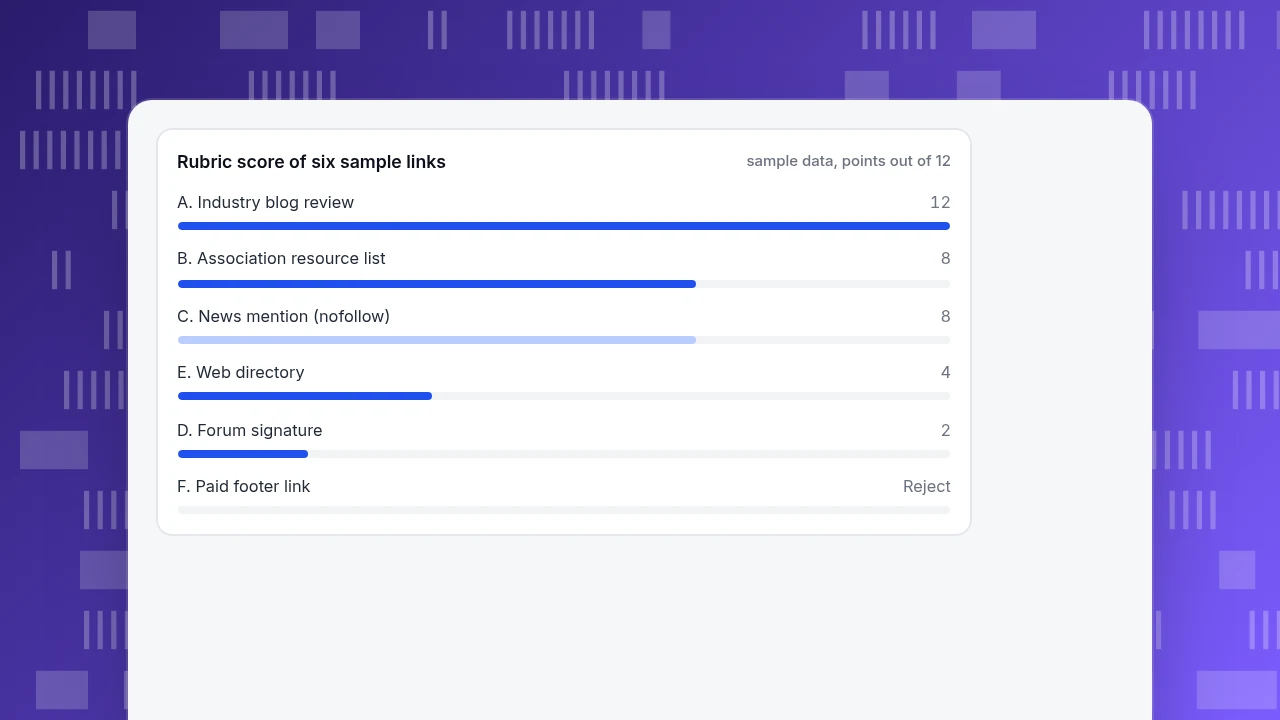
Sample data: six links pointing to one site, scored with the rubric. The visit counts are 30-day referral sessions.
| Link | Rel. | Place | Anchor | Outlinks | Type | Visits | Score |
|---|---|---|---|---|---|---|---|
| A. Industry blog review, body text, 12 outlinks, followed, 84 visits | 2 | 2 | 2 | 2 | 2 | 2 | 12 |
| B. Trade association resource list, 60 outlinks, followed, 22 visits | 2 | 1 | 1 | 1 | 2 | 1 | 8 |
C. News mention in the body, 25 outlinks, nofollow, 130 visits | 1 | 2 | 1 | 1 | 1 | 2 | 8 |
D. Forum signature, ugc, 300 outlinks, 2 visits | 1 | 0 | 0 | 0 | 1 | 0 | 2 |
| E. General web directory, 400 outlinks, followed, 0 visits | 0 | 1 | 1 | 0 | 2 | 0 | 4 |
| F. Footer link on a partner site, keyword anchor, bought without a label | n/a | n/a | n/a | n/a | n/a | n/a | Reject |
How to read it:
- A (12) is the target: editorial, relevant, few other links, and it sends people.
- C (8) beats expectations. It is
nofollow, so Ahrefs says it likely does not count as a vote, yet it sends 130 visits. It is a good link for readers and brand, even if it adds little to rankings. - B (8) is solid but weaker because the page lists 60 other organizations.
- D (2) and E (4) are the weak tier. Neither needs to be removed, but neither deserves effort to get more of them.
- F is not scored. See the next section.
Score bands we use: 10 to 12 strong, 6 to 9 fine, 5 or lower weak. A weak link is low value; a flagged link is a problem.
Rubric score of six sample links
sample data, points out of 12Red flags that override the score
Google's spam policies list the patterns it treats as link spam. Three of them explain link F:
- Buying or selling links for ranking, including paying for posts or links, or trading goods or services for them.
- Keyword-rich links hidden in widgets or spread across sites in footers or templates.
- Text ads or text links that pass ranking credit.
The same page also lists automated link creation, link exchange schemes, low-quality directory links, and forum comments or signatures with optimized links. Any link in these groups fails regardless of its other points.
Paid placement itself is not forbidden. Google says buying and selling links for advertising or sponsorship is a normal part of web business; the requirement is that such links are qualified with rel="nofollow" or rel="sponsored". A labeled sponsored link can still be good for visits and awareness. An unlabeled one that passes ranking credit is a policy risk.
If you find a flagged link pointing at you that you did not build, document it and decide whether to ask for removal; if you built it, fix the label or remove it.
Does a nofollow link still count as good?
It can, because "good" has two meanings: good for rankings and good for the business. Google's documentation says nofollow asks it not to associate your site with the linked page, and Ahrefs says such links likely do not count as a vote. For ranking purposes, treat them as neutral.
For the business, look at the visits. In the sample, link C scores 8 mainly because it sends 130 visits a month. If those visitors sign up or buy, the link is worth more than a followed link on a page nobody reads. Score it, then check what the visitors did.
How many good backlinks do you need?
There is no number that applies to every site, and the data shows why chasing a count is the wrong goal. Ahrefs analyzed about 14 billion pages in its Content Explorer database (published December 1, 2023): 96.55% get no traffic from Google. Among roughly 20 million pages with no referring domains, only 2,997 get more than 1,000 search visits a month, about 1 in 6,671. Ahrefs notes that pages with more referring domains tend to get more traffic and rank for more keywords, and also says this is correlation, not proof of cause.
What that supports is modest: links and visibility travel together, and having none is a steep handicap. It does not tell you how many are enough. A better question is which of your key pages have no good links yet. List your ten pages that matter, count the links in the A and B tiers for each, and start with the ones at zero.
How to check a link in TapCub
The visits signal is the one you can measure yourself. Here is how to score link A from the sample using what your analytics already collected.
- Find the referring site. Open Web analytics › Sources and the Referrers tab. Each row shows visitors, sessions, pageviews, bounce and duration for one referring domain. Sort by sessions and find the domain.
- Read the number carefully. The default, First source of session, counts each session once, for the source it arrived from. Switch to Every arrival and the same visitor can appear under several sources, so rows may add up to more than the total. For the rubric, use the default.
- See where the visit landed. Open Web analytics › Pages and the entry pages tab to see which page those visitors entered on. A link that lands people on a page unrelated to the anchor text is a mismatch worth fixing in the link or the page.
- Check whether they did anything. Open Web analytics › Goals to see conversions for the same period, or look at the Channels table, which includes a conversions column. A link with 130 visits and 0 goals is a different link from one with 130 visits and 6 sign-ups.
- Add search data if you have it. With Google Search Console connected under Monitoring › Search performance, you can see which pages gained clicks and impressions after a link appeared. Data is typically 1 to 3 days behind.
TapCub does not crawl the web for backlinks and does not compute a link authority score, so it cannot tell you about links that have never sent a visit. Use a backlink index for discovery and TapCub for what the links actually delivered. Visits from links that carry no tracking show up as referrers; links you control, such as a partner placement, can use UTM parameters to appear under the UTM tab as well.
FAQ
What is a good backlink?
A good backlink is an editorial link from a relevant page that links to few other sites, placed in the main text with descriptive anchor text, and not paid for without a label. A good link also sends some visitors to your site. Authority scores can help you shortlist, but the page itself decides.
Is a nofollow backlink good?
It is good for visits and brand, and neutral for rankings. Google says nofollow asks it not to associate your site with the linked page, and Ahrefs says such links likely do not count as a vote. If a nofollow link sends 100 or more relevant visits a month, it can be worth more than a followed link nobody sees.
How do I know if a backlink is bad?
Check the red flags first: paid without a sponsored or nofollow label, hidden or sitewide keyword links in footers, automated link creation, link exchanges, low-quality directories and forum signatures. Then score the signals. A link from an unrelated page with hundreds of outgoing links and no visits is weak, though not necessarily harmful.
How many backlinks do I need to rank?
No fixed number exists. Ahrefs found that 96.55% of about 14 billion indexed pages get no Google traffic and that pages with no referring domains almost never reach 1,000 monthly visits, but it also says this is correlation. Count good links to the pages that matter and start with those at zero.
Does anchor text matter for backlinks?
Yes, as context. Google asks for anchor text that is descriptive, concise and relevant to both pages and advises against generic phrases and keyword stuffing. Brand and URL anchors are normal. A profile where every link uses the same exact keyword looks unnatural.
Sources
- Google Search Central, Link best practices for Google (crawlable links, anchor text, external links). Checked 2026-11-22.
- Google Search Central, Spam policies for Google web search (link spam). Checked 2026-11-22.
- Google Search Central, Qualify your outbound links to Google (
sponsored,ugc,nofollow). Checked 2026-11-22. - Ahrefs Help Center, What makes a high-quality backlink. Checked 2026-11-22.
- Ahrefs, 96.55% of content gets no traffic from Google (December 1, 2023; about 14 billion pages). Checked 2026-11-22.
Was this article helpful?
We use your answers to fix and expand this page.
Couldn’t send. Please try again in a minute.
Thanks for the feedback. We’ll use it to improve this page.You’ve already sent feedback on this page. Thanks.

Product Analyst
Focuses on event analysis, conversion funnels, and retention, using clear metric definitions and structured analysis to explain product performance.