Try it on your own data
Every report in this article is in the free plan. One snippet for web and apps, up to 10 sites.
Start freeTo say no to a customer in chat, use four parts in order: acknowledge the request, give the reason in one sentence, offer what you can do instead, and make the next step easy. Check first that you are allowed to refuse, because some rights are legal. In the sample, refusal chats using this shape averaged 3.50 out of 5 against 2.75 before, with 40 chats in each group.
What you will learn
- Use four parts in order: acknowledge, one-sentence reason, an alternative, an easy next step
- Check the law and your written policy before refusing; a wrong no is worse than a clumsy one
- Measure ratings and return on refusal chats only, and treat 40 chats as a pilot, not proof
Why is saying no harder in live chat?
In a call, a refusal comes with a voice; in chat it arrives as a few lines of plain text that the customer reads at their own speed and can screenshot. Three things make it riskier than saying no by phone:
- No tone. "That is not possible" reads as cold even when the agent meant to be kind.
- Speed. A short chat reply tempts agents to send the bare no.
- A record. The customer, and your own team, can reread the exact words later.
The fix is a fixed shape for every refusal, so the empathy is built into the sentence order instead of depending on how the agent feels that hour. This guide gives the shape, eight ready-to-paste scripts, a legal check before you refuse, and a way to measure whether customers still stay afterwards. For the broader library of replies see live chat scripts, and for the empathy part see empathy statements.
What is the four-part structure of a good refusal?
Use the same four parts in the same order:
- Acknowledge what they want, in their words.
- Give the reason in one sentence, with no policy jargon.
- Say what you can do instead. An alternative turns a flat no into a choice.
- Make the next step easy: a link, a yes-or-no question, or a handover.
Example, with the parts labelled:
"I can see you'd like a refund for the jacket you bought in September. (1) Our returns window is 30 days, and this order is at day 52, so I can't refund it. (2) What I can do is offer a store credit for the full price, or send you the size exchange form. (3) Which would you prefer? (4)"
Notice what is missing: no "unfortunately", no "as per our policy", no apology repeated three times. One honest sentence of reason is worth more than a paragraph of cushioning.
Are you actually allowed to say no?
Before you send a refusal, check three things. A wrong no is worse than a clumsy one.
- Is it a legal right? For distance contracts in the EU, the consumer "shall have a period of 14 days to withdraw ... without giving any reason" (Directive 2011/83/EU, Article 9(1), subject to the exceptions in Article 16). If a customer in scope asks to return an item within 14 days of delivery, "outside our policy" may be the wrong answer. Check your region's rules before the macro goes out.
- Is the reason true? Say only what your actual policy says. In Moffatt v. Air Canada (2024 BCCRT 149) a tribunal held an airline responsible for what its website chatbot told a customer and ordered it to pay $812.02. Whatever an agent or an automated reply tells a customer about policy, the company owns.
- Is there a person with authority? If the answer depends on an exception only a manager can grant, say so and route it, rather than refusing yourself.
If any answer is "I'm not sure", do not refuse yet. Say "let me check" and come back.
Eight refusal scenarios with scripts
Sample scripts to adapt. Replace the bracketed parts and your own numbers.
| Scenario | Script | Tone | Follow-up |
|---|---|---|---|
| Refund outside the window | "I can see you'd like to return it. This order is past our 30-day window, so I can't refund it. I can offer store credit for the full amount or an exchange. Which would you like?" | Warm, firm | Create credit or exchange within the chat; confirm by email |
| Feature we don't have | "Thanks for asking about [feature]. We don't offer it today, so I won't promise it. Many people get the same result by [workaround]. Want the steps?" | Honest, helpful | Log the request with the customer's use case |
| Price match or discount | "I understand you've seen a lower price. We don't price-match, but I can [free shipping / a code on your next order]. Shall I apply it?" | Friendly | Apply the offer in the same message |
| Change a shipped order | "I can see it left our warehouse this morning, so I can't change the address now. You can redirect it with the carrier at [link], or return it once it arrives and we'll refund in full." | Clear, calm | Send carrier link; offer to check status tomorrow |
| Out of stock with no date | "That size is out of stock and I don't have a restock date, so I can't promise one. I can email you the day it returns, or suggest the closest alternative. Which helps?" | Direct | Add to notify list; send one alternative |
| Outside support scope | "That's outside what we can help with, because [reason]. For this, [better route] is the right place. I'm glad to help with anything about your order or account." | Respectful | Give the link or contact; offer a related help |
| Abusive language | "I want to help, and I can't continue if the chat keeps this language. If you'd like to rephrase, I'm here. Otherwise I'll end the chat and you can email us." | Calm, firm | End the chat after one warning; note it in the record |
| Account info without verification | "To protect your account I can't share details until I verify you. I can send a verification link to the email on file. Shall I send it?" | Protective, polite | Send the link; share nothing before verification |
Keep two rules across all eight: say "I can't" (a fact about you), not "you can't" (a judgement about them), and always end with something the customer can say yes to.
| Scenario | Offer instead of the refusal | Tone |
|---|---|---|
| Refund outside the window | Store credit or exchange | Warm, firm |
| Feature we do not have | A workaround, request logged | Honest, helpful |
| Price match request | Free shipping or a code | Friendly |
| Change a shipped order | Carrier redirect or return | Clear, calm |
| Account info before verification | Verification link | Protective, polite |
Five of the eight scenarios; full scripts are in the article.
Which words make a no worse?
Rewrite these before they reach a customer:
| Avoid | Why | Say instead |
|---|---|---|
| "Unfortunately that's not possible" | Sounds automatic, gives no reason | "I can't do that because [reason]" |
| "It's company policy" | Hides behind a rule | "The rule is [rule], and it exists because [reason]" |
| "You should have..." | Blames | "The window closed on [date]" |
| "No." alone | No next step | "No, and here's what I can do" |
| "I understand, but..." | "But" cancels the empathy | "I understand, and here is what I can do" |
When should you hand the chat to someone else?
Hand it over when the customer has been refused once and still disagrees, when the amount or the exception is above your authority, or when the situation involves safety, legal threats or a vulnerable customer. A good handover tells the colleague what was asked, what was already refused, and what was offered, so the customer does not repeat themselves. Do not hand over simply to avoid the refusal: a transfer with no context feels like a second no.
How do you know whether customers stay after a refusal?
Measure two things on refusal chats only: the satisfaction score, and whether the customer comes back. Sample data: 40 refusal chats before using the structure, and 40 after.
| Rating | Before (40 chats) | After (40 chats) |
|---|---|---|
| 1 | 8 | 3 |
| 2 | 10 | 5 |
| 3 | 10 | 10 |
| 4 | 8 | 13 |
| 5 | 4 | 9 |
| Average | 2.75 | 3.50 |
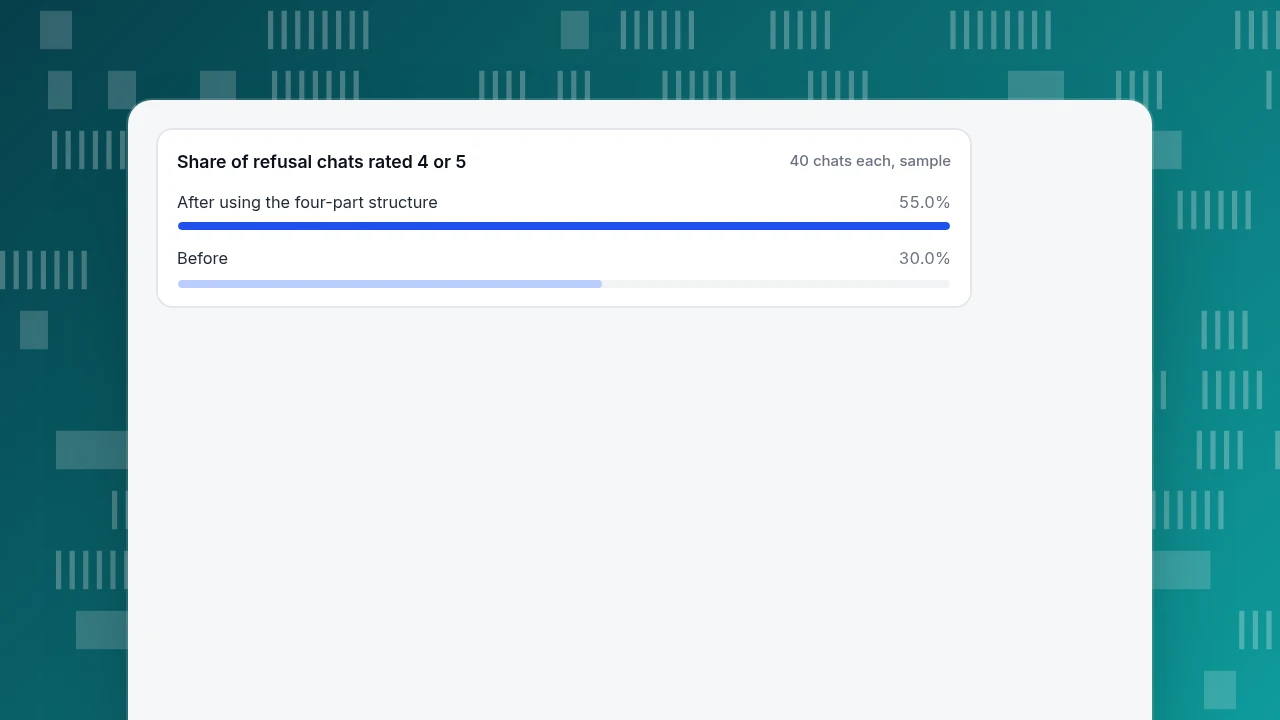
| Rated 4 or 5 | 12 (30.0%) | 22 (55.0%) |
The average rose by 0.75 points. With standard deviations of about 1.28 and 1.20, the 95% interval for that difference is 0.21 to 1.29 points, so it is unlikely to be chance, though not precise. The second measure is weaker: customers who bought again within 30 days rose from 14 of 40 (35.0%) to 20 of 40 (50.0%). That 15-point gap has a z-score of about 1.36, which does not clear the usual bar, so call it a hint, not a result. To detect a 15-point difference reliably you would need roughly 166 chats in each group.
Rules for this kind of check: compare the same type of refusal, keep the groups similar in size and season, and watch for the case where fewer customers answer the survey after a refusal. Treat 40 chats as a pilot.
Share of refusal chats rated 4 or 5
40 chats each, sampleWhat mistakes do teams make when saying no?
- Over-apologizing. Three sorrys sound insincere; one clear reason sounds respectful.
- Refusing before checking. A wrong refusal costs more than a slow answer; "let me check" is always allowed.
- Using one macro for different situations. A script for an out-of-window refund fits no other case; keep eight, not one.
- Making the customer repeat. After a transfer, the second agent starts from the first agent's notes.
- Offering nothing. If there is truly no alternative, say what you will do to help in another way, such as passing the feedback on.
How do you set up and track refusal scripts in TapCub?
Take the eight scripts and put them to work.
- Save the scripts. In Live chat › Canned replies, add each script with a short shortcut (up to 40 characters), a title (up to 80) and content (up to 4,000). Site-level replies are available to every agent who can handle chats; turn on Personal if you want a draft only you can see. In a chat, type
/to insert one and edit it before sending, which is where you replace the bracketed parts. See use canned replies. - Use what you know about the visitor. The inbox sidebar shows where the visitor came from, their recent pages over the last 2 days and past conversations, so you can see which page they were on when they asked for the refund. This is also the quickest way to confirm the order they mean.
- Hand over cleanly. Transfer the chat to a colleague from the workbench, and write the handover note in your own words (what was asked, what was refused, what was offered) so the second agent does not have to ask again.
- Read the rating. In Live chat › Reports, satisfaction is a score from 1 to 5 given within 24 hours after the chat is resolved, one per conversation. TapCub does not tag chats as refusals, so keep a simple list of refusal conversation IDs in your own sheet and compare the scores before and after you adopted the structure.
- Know the limit. TapCub does not set refund or exchange policy and does not take actions such as issuing store credit; those happen in your own systems, and the AI assistant only drafts replies from your knowledge base.
FAQ
How do you say no to a customer politely in chat?
Use four parts in order: acknowledge the request, give the reason in one sentence, offer what you can do instead, and make the next step easy. Say "I can't" rather than "you can't", skip "unfortunately", and end with a question the customer can answer yes to.
Should you apologize when you say no to a customer?
Once, briefly, if you or the company caused the problem. Repeated apologies sound scripted. A clear reason and a useful alternative show more respect than three sorrys.
How do you say no to a customer without losing them?
Offer a real alternative: store credit instead of a refund, a workaround instead of a missing feature, a restock alert instead of a promise. In the sample, refusal chats using this structure averaged 3.50 against 2.75 before, though the sample was only 40 chats each.
What if the customer keeps pushing after you say no?
Restate the same answer calmly once, repeat the alternative, and hand the chat to a colleague with the notes if the request is above your authority. Do not change the answer to end the argument, because that teaches customers that pushing works.
Can you refuse a refund request?
Only if the law and your own written policy allow it. In the EU, consumers have 14 days to withdraw from most distance contracts without giving a reason, subject to exceptions. Check your region's rules before using a refusal script.
Sources
- European Parliament and Council. Directive 2011/83/EU on consumer rights, Article 9(1) — 14-day withdrawal period for distance contracts without giving any reason. Checked 2026-11-22.
- Civil Resolution Tribunal of British Columbia. Moffatt v. Air Canada, 2024 BCCRT 149 — company responsible for information on its website including its chatbot; $812.02 ordered.
Was this article helpful?
We use your answers to fix and expand this page.
Couldn’t send. Please try again in a minute.
Thanks for the feedback. We’ll use it to improve this page.You’ve already sent feedback on this page. Thanks.

Product Experience Specialist
Writes about product experience, practical workflows, and growth, turning complex processes into clear steps for everyday decisions.