Try it on your own data
Every report in this article is in the free plan. One snippet for web and apps, up to 10 sites.
Start freeChatbots cost anywhere from a flat monthly fee to about $1 per resolved conversation, depending on whether you are billed per month, per conversation or per resolution. Compare them per resolved conversation: in a worked month of 2,000 conversations and a 35% resolution rate, the three models cost $1.10 to $1.68, against $4.00 for a person.
What you will learn
- Compare pricing models in one unit: monthly cost ÷ conversations resolved without a person
- At 20% resolution per-resolution pricing wins; above 20.2% the $400 flat plan is cheaper in the sample
- Budget upkeep, setup and handoff time: they were $373 of a $773 month, and wrong answers are the cost no price page shows
What you are really paying for
Chatbot prices look wildly different because vendors charge for different units. There are three common ways to be billed, and each puts the risk on a different side:
| Pricing model | You pay per | Who carries the risk | Example from a published price |
|---|---|---|---|
| Flat plan | Month, often with an AI usage allowance and overage | You: the bill is the same whether the bot resolves 10 chats or 1,000 | A monthly subscription plus usage |
| Per conversation | Conversation the bot takes part in | You: a conversation that ends in a handoff is billed anyway | A fixed amount per conversation |
| Per resolution | Conversation the bot resolves | The vendor: unresolved chats are free | One vendor's help center lists $0.99 per resolution, charged at most once per conversation |
The per-resolution model depends on how a resolution is defined, and definitions differ. The vendor page quoted above counts a resolution as either a confirmed one (the customer says it helped) or an assumed one (the customer leaves without asking for more), and does not charge when the customer asks for a human or comes back to a conversation that was already resolved. Read that definition before comparing a per-resolution price with a flat plan: an assumed resolution is a conversation where the visitor may simply have given up.
The headline price is only part of the bill. The rest of this guide gives you a formula to compare all three on the same footing, a worked month, and the costs that appear on no pricing page. If you are weighing the savings against the cost, the return side is in chatbot ROI; how a support bot fits into a service team is in customer service chatbot.
The cost formula: one monthly number divided by resolved conversations
Write the cost of a chatbot as one monthly figure, then divide by the conversations it resolved:
Monthly cost = platform or usage fees + upkeep time + setup spread over its life + extra handling of handoffs
Cost per resolution = monthly cost ÷ conversations resolved without a person
Use resolved conversations, not all conversations, as the divisor. A bot that answers 2,000 chats and resolves 700 has not done 2,000 jobs. This also puts a flat plan, a per-conversation plan and a per-resolution plan in the same unit.
Five line items belong in the monthly cost:
- Platform fee. The subscription, per-conversation charge or per-resolution charge.
- AI usage. Language-model providers bill per million tokens, with input and output tokens priced separately, according to Anthropic's pricing page. A conversation that carries long knowledge-base passages costs more than a short one.
- Upkeep. Time to write new answers, fix wrong ones and read transcripts. A bot that is not maintained gets worse as products and policies change.
- Setup, spread over its useful life. Hours spent connecting the knowledge base and testing, divided by the months you expect to use the bot.
- Handoff handling. Conversations the bot touched but a person finished. The person still spends the time, and the visitor has waited longer.
Worked example: one month, three pricing models
Sample data: a store receives 2,000 chat conversations in a month. The bot resolves 700 of them without a person (35%); the other 1,300 are handed off or abandoned.
The shared costs. Upkeep is 10 hours a month at $28 an hour, which is $280. Setup is 40 hours at $28, which is $1,120, spread over 12 months, or $93.33 a month. Together: $373.33 a month. The $28 hourly figure is an assumption: the US Bureau of Labor Statistics reports a median of $21.53 an hour for customer service representatives (May 2025), and the example adds a 30% allowance for payroll costs and overhead, giving $27.99, rounded to $28. Change both numbers for your own team.
The platform fee under three models.
- Flat plan: $300 a month plus $100 of AI usage above the allowance, $400.
- Per conversation: $0.40 × 2,000 conversations = $800. This price is an assumption for the example.
- Per resolution: $0.99 × 700 resolutions = $693.
| Model | Platform fee | Shared costs | Monthly cost | Cost per resolution |
|---|---|---|---|---|
| Flat plan | $400.00 | $373.33 | $773.33 | $1.10 |
| Per conversation | $800.00 | $373.33 | $1,173.33 | $1.68 |
| Per resolution | $693.00 | $373.33 | $1,066.33 | $1.52 |
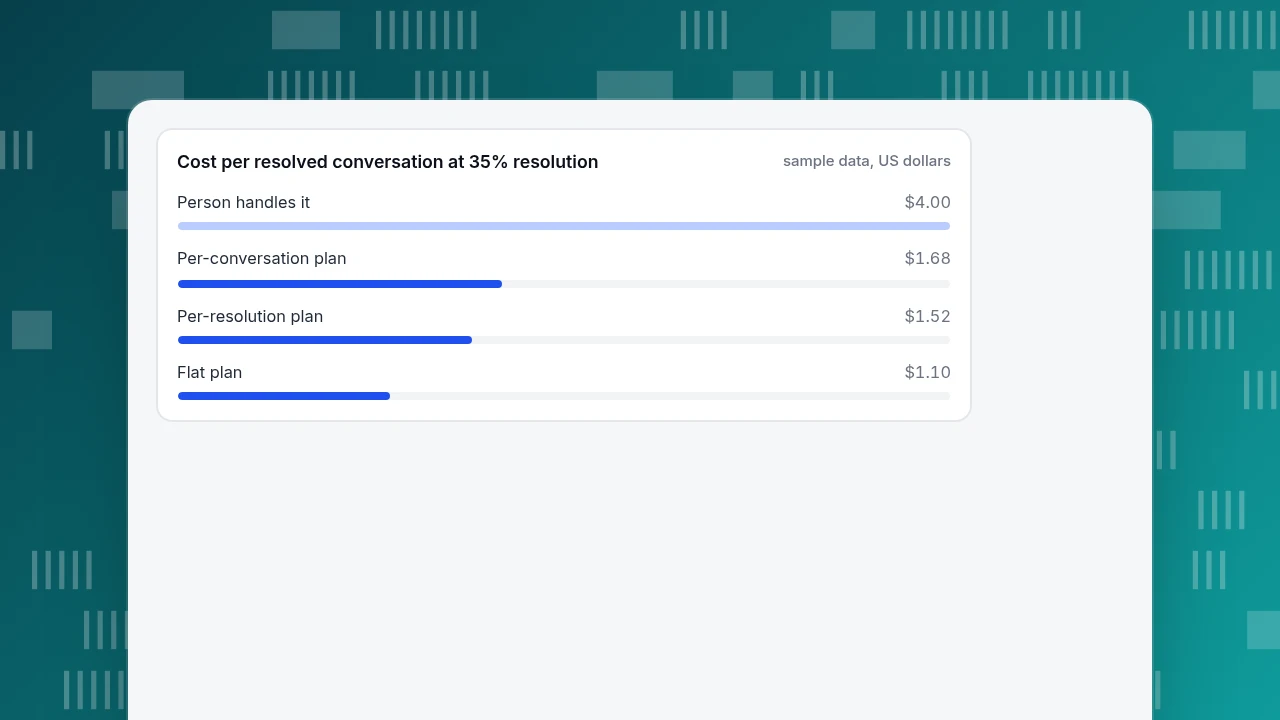
At a 35% resolution rate the flat plan is cheapest per resolution, but the order depends on the resolution rate, which is the next section. A conversation resolved by a person costs far more: at 7 conversations an hour, $28 ÷ 7 = $4.00. Even the most expensive model above is under half of that, per resolved conversation.
Cost per resolved conversation at 35% resolution
sample data, US dollarsHow the resolution rate flips the ranking
Flat and per-conversation plans do not depend on how many chats the bot resolves, so more resolutions spread the same bill over more conversations. A per-resolution plan has a floor at its unit price, $0.99, plus shared costs. Recomputing the example at three resolution rates, still 2,000 conversations:
| Resolution rate | Resolved | Flat plan | Per conversation | Per resolution |
|---|---|---|---|---|
| 20% | 400 | $1.93 | $2.93 | $1.92 |
| 35% | 700 | $1.10 | $1.68 | $1.52 |
| 50% | 1,000 | $0.77 | $1.17 | $1.36 |
Two decision rules fall out of the numbers:
- Break-even against a person. The flat plan, at $773.33 a month, beats the $4.00 human cost as soon as it resolves more than 773.33 ÷ 4.00 = 193.3 conversations, about 9.7% of 2,000.
- Flat versus per-resolution. The platform fees cross when $400 = $0.99 × R, so R = 404 resolutions, 20.2% of conversations. Below that rate, per-resolution is cheaper because you pay only for what works; above it, the flat plan is.
So: if you do not yet know your resolution rate, a per-resolution price limits the downside while you learn it; if your knowledge base already answers more than about one conversation in five, a flat plan is usually cheaper.
| Resolution rate | Resolved | Flat plan | Per conversation | Per resolution |
|---|---|---|---|---|
| 20% | 400 | $1.93 | $2.93 | $1.92 |
| 35% | 700 | $1.10 | $1.68 | $1.52 |
| 50% | 1,000 | $0.77 | $1.17 | $1.36 |
Sample data: 2,000 conversations, $373.33 shared costs, flat fee $400, $0.40 per conversation, $0.99 per resolution. Cells are cost per resolved conversation; a person costs $4.00.
Cost per contact versus cost per resolution
Published benchmarks usually quote a cost per contact, not per resolution, so they cannot be compared with the figures above without care. Gartner's 2019 customer-service poll put the average cost at $8.01 per contact for live channels such as phone, live chat and email, and about $0.10 per contact for self-service channels such as company websites and mobile apps. Three things limit its use:
- It is a 2019 average across respondents, not a figure for your business.
- A self-service contact is a contact, not a resolution. In the same release, Gartner reported that only 9% of customers solved their issue completely in self-service, so the true cost of a resolved self-service issue is higher than $0.10.
- Your own sum, with your wage and your resolution rate, will beat any average.
Use published figures to sanity-check the order of magnitude: your cost per resolved conversation should land between the self-service and live-channel figures, and well below the live-channel one if the bot is working.
The costs that are not on the pricing page
These items decide whether the real bill matches the estimate:
| Hidden cost | Why it appears | Rule of thumb for the estimate |
|---|---|---|
| Wrong answers | A bot can state something false with confidence, and a visitor may act on it | Budget review time: read a sample of transcripts every week |
| Handoff time | A handed-off conversation is longer, because the person must read the history | Count handoffs as person time, not free |
| Knowledge drift | Prices, policies and products change | Add every policy change to the upkeep hours |
| Usage spikes | Per-conversation and usage plans scale with traffic | Check the overage price against a campaign month, not a quiet one |
| Extra seats or add-ons | The bot may need a help desk plan underneath | Add it to the platform fee |
The most dangerous one is the first. A resolution figure that counts a wrong answer as resolved flatters every cost-per-resolution number in this guide. Sample real conversations before you trust the rate.
Estimate your own cost in six steps
- Count conversations. Last month's chat volume, not website visitors. Example: 2,000.
- Estimate a strict resolution rate. Read 50 conversations and mark each as resolved only if no person was needed and the visitor did not return about the same issue within seven days. Example: 35% of 2,000 = 700.
- Price your people. Take a wage, add your payroll allowance, divide by conversations handled per hour. Example: $4.00.
- List fees for each pricing model you are considering, at your volume and at your volume plus 50%.
- Add upkeep and setup. Example: $373.33 a month.
- Divide and compare. Cost per resolution for each model, next to the $4.00 human figure, at three resolution rates. Choose the model whose ranking survives the 20% and 50% rows.
In TapCub: getting the inputs for the formula
Take the six steps above and ask where the numbers come from.
- Count conversations. Open Live chat › Reports. It shows conversations started in the period, a resolution rate (resolved divided by conversations), and offline messages counted separately and not as resolved.
- Check how much the knowledge base carries. On the same report, the knowledge base hit rate is the share of questions answered by a direct Q&A match or a retrieved answer. In Live chat › Knowledge base, a Q&A entry is sent as written without an AI call, so it adds no AI usage; a document entry is retrieved and an AI model drafts the answer. A pinned Q&A shown in the visitor FAQ opens without creating a conversation, so it appears in neither the conversation count nor the AI quota. Playground tests do not use the quota.
- Set how the bot replies. In Live chat › Chat settings › AI assistant, choose off, only when all agents are offline, or AI answers first. The AI generates replies only; it does not change orders or send email.
- Review a sample. Open resolved conversations in Live chat › Inbox to check whether the answers were right. TapCub's first-response time does not include an AI reply, and satisfaction scores are one per conversation within 24 hours of resolve.
TapCub does not report a cost per resolution and does not state a bot-resolved count as a single figure; you build the strict count from your sample in step 2 above. TapCub is not a billing tool either: take the fee side from your invoices.
FAQ
How much do chatbots cost?
It depends on the pricing unit. Flat plans are billed per month, per-conversation plans per chat, and per-resolution plans per resolved chat; one published per-resolution price is $0.99. In the worked example, 2,000 conversations and a 35% resolution rate gave $1.10 to $1.68 per resolution, against $4.00 for a person.
How much does a chatbot cost per month?
In the example, between $773 and $1,173 a month for 2,000 conversations, including $373 for upkeep and setup. The platform fee was $400 to $800 of that. Your figure moves with conversation volume, resolution rate and how many hours you spend maintaining answers.
Is a per-resolution chatbot cheaper than a flat plan?
Only below a certain resolution rate. In the example, with a $400 flat fee, per-resolution pricing was cheaper below 404 resolved conversations, which is 20.2% of 2,000. Above that, the flat plan costs less per resolution.
What hidden costs does a chatbot have?
Upkeep time, setup spread over its life, handoff handling, AI usage that grows with long answers, and the cost of wrong answers. Sample transcripts every week; a resolution rate that includes wrong answers makes every cost figure look better than it is.
How do I know if a chatbot is worth the cost?
Compare its cost per resolved conversation with the cost of a person handling the same conversation. In the example the bot was $1.10 to $1.68 against $4.00, and broke even at about 9.7% of conversations resolved. Add extra sales only after correcting for selection bias, as covered in the ROI guide.
Sources
- Vendor help center. How a resolution is counted and priced: $0.99 per resolution, confirmed and assumed resolutions, charged at most once per conversation. Checked 2026-11-20.
- US Bureau of Labor Statistics. Customer service representatives, Occupational Outlook Handbook: median pay $21.53 an hour, $44,770 a year, May 2025. Checked 2026-11-20.
- Gartner. Gartner Says Only 9% of Customers Report Solving Their Issues Completely via Self-Service, 25 September 2019: $8.01 per contact for live channels, about $0.10 for self-service. Figures as reported in the release; the page returns an access error to automated tools.
- Anthropic. Pricing: model usage billed per million tokens, input and output priced separately. Checked 2026-11-20.
Was this article helpful?
We use your answers to fix and expand this page.
Couldn’t send. Please try again in a minute.
Thanks for the feedback. We’ll use it to improve this page.You’ve already sent feedback on this page. Thanks.

Product Analyst
Focuses on event analysis, conversion funnels, and retention, using clear metric definitions and structured analysis to explain product performance.