Try it on your own data
Every report in this article is in the free plan. One snippet for web and apps, up to 10 sites.
Start freeChatbot development platforms fall into four types, from support-first chat products to code frameworks, and the choice depends on one question: must the bot only answer, or also act? In the sample, a weighted matrix puts buying first at 3.90 against 2.85 for building, but when custom actions get more weight, building wins 3.75 to 3.25. Below: the matrix, a three-year cost example, vendor questions and a pilot.
What you will learn
- Decide whether the bot must act beyond answering before comparing platforms; it flipped the sample ranking from 3.90 vs 2.85 to 3.25 vs 3.75
- Building cost 3.6 times as much as buying over three years in the sample, mostly people's time
- Four non-negotiables: disclose it is a bot, defend against prompt injection, limit its actions and own its answers
What counts as a chatbot development platform?
A chatbot development platform is anything you use to create, run and improve a bot that talks to customers, and the term covers four quite different things. Which one you need depends on what the bot must do after it answers.
| Type | You provide | The platform provides | Fits when |
|---|---|---|---|
| Support-first chat product | Help content and rules for handoff | Widget, knowledge base, AI replies, inbox, reports | You mainly answer questions and hand off to staff |
| Flow or low-code builder | Conversation flows, some integrations | Visual editor, channels, hosting | You need scripted steps such as forms and routing |
| Conversation AI cloud service | Intents or prompts, integration code | Language understanding, speech, scaling | You have developers and want enterprise controls |
| Code framework plus a model API | Everything, in code | A library and a model endpoint | You need custom actions, data control or a novel product |
The categories overlap, and most products sit between two of them. What matters is not the category but who maintains each part: the widget, the answers, the integrations, the evaluation and the safety checks. "Build" means you maintain more of those parts; "buy" means the vendor does. For how bot types differ, see types of chatbots; for filling the knowledge it answers from, see how to train a chatbot.
How do you decide between build and buy?
Score the options against weighted criteria rather than a feature list. The sample below is for a five-person team with no machine-learning engineer that wants a bot for website support. Weights add to 100; scores run from 1 (poor) to 5 (strong). Both are judgments for this team, not facts about any product.
| Criterion | Weight | Buy (support-first) | Builder platform | Build in code |
|---|---|---|---|---|
| Time to first useful answer | 20 | 5 | 4 | 1 |
| Custom actions and integrations | 20 | 2 | 4 | 5 |
| Control of data and where it goes | 15 | 3 | 3 | 5 |
| Handoff to humans and one inbox | 15 | 5 | 3 | 2 |
| Control of answer quality | 10 | 4 | 3 | 3 |
| Analytics out of the box | 10 | 4 | 3 | 2 |
| Maintenance load | 10 | 5 | 3 | 1 |
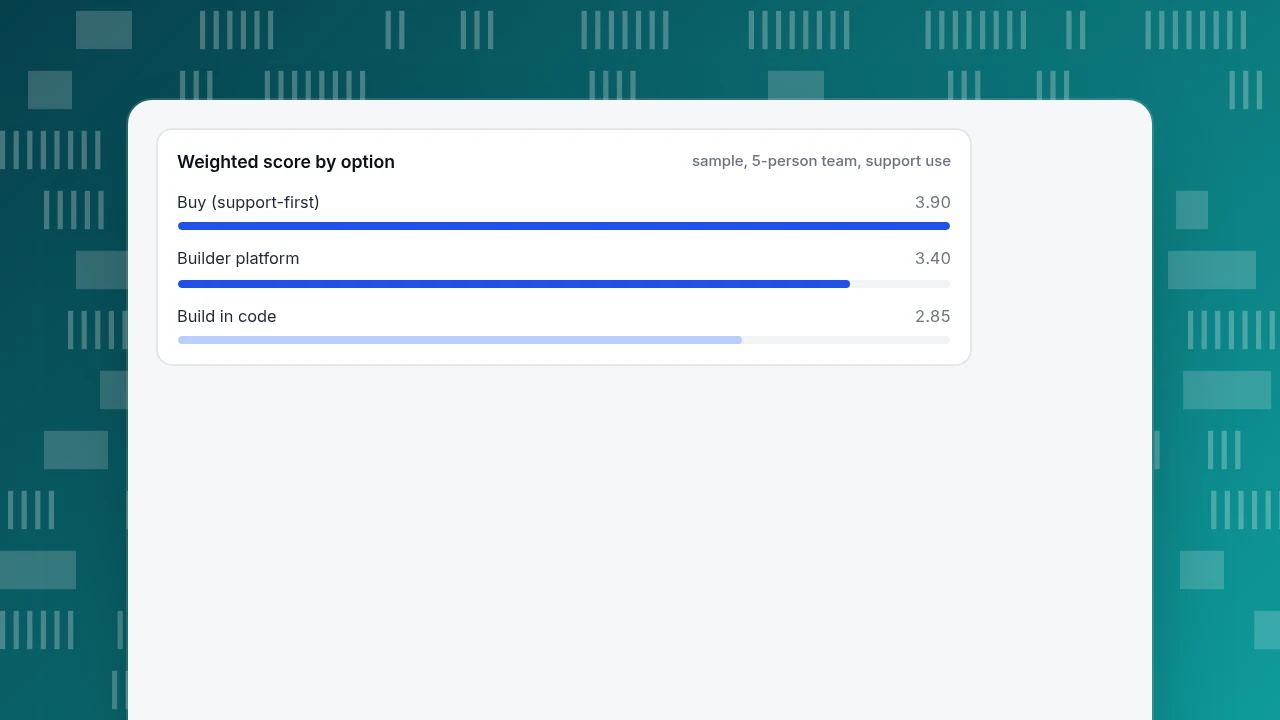
| Weighted score | 100 | 3.90 | 3.40 | 2.85 |
Each score is Σ(weight × score) ÷ 100. For "Buy": 20×5 + 20×2 + 15×3 + 15×5 + 10×4 + 10×4 + 10×5 = 390, so 3.90. The matrix does not tell you what to pick; it shows what your weights imply, and invites you to argue about the weights rather than the brand.
Weighted score by option
sample, 5-person team, support useHow do you set the weights honestly?
Weights are where bias enters. Three habits keep them honest:
- Set them before you look at any product. Write the seven numbers in a doc, date it, then score.
- Tie each weight to a cost. If a missed deadline costs a quarter's revenue, time to first answer deserves 20 or more; if a data leak would end a contract, data control deserves more than maintenance.
- Have two people set them independently. Where their weights differ by more than 10 points, discuss the criterion, not the product.
If changing any one weight by 10 points flips the winner, the decision is close, and the pilot, not the matrix, should settle it.
What if your priorities are different?
Change the weights and the answer can flip. Suppose the same team learns the bot must look up order status and change delivery addresses. Raise custom actions to 40, data control to 20 and cut time to first answer to 5, with handoff 10, quality 10, analytics 5 and maintenance 10 (still totalling 100).
| Option | Original weights | Action-heavy weights |
|---|---|---|
| Buy (support-first) | 3.90 | 3.25 |
| Builder platform | 3.40 | 3.45 |
| Build in code | 2.85 | 3.75 |
Under the action-heavy weights, building in code wins, 3.75 against 3.25. The lesson: decide how much the bot must do beyond answering before you compare platforms. If it only answers and hands off, a support-first product is the efficient choice. If it must act on orders or accounts, plan for developer time, and for the safety work in the next sections.
What does build versus buy cost over three years?
Sample data with stated assumptions, 36 months, 3,000 conversations a month (108,000 in total):
| Cost line | Buy | Build in code |
|---|---|---|
| Subscription or hosting and model fees | $400 × 36 = $14,400 | $350 × 36 = $12,600 |
| Setup or initial build | 40 h × $60 = $2,400 | 400 h × $80 = $32,000 |
| Upkeep (answers, fixes, review) | 6 h/month × $60 × 36 = $12,960 | 20 h/month × $80 × 36 = $57,600 |
| Security review and testing | included in the product | 60 h × $80 = $4,800 |
| Total | $29,760 | $107,000 |
| Per conversation | $0.28 | $0.99 |
Building costs 3.6 times as much (107,000 ÷ 29,760) in this sample, and almost all of the difference is people's time, not the model bill. The rates, hours and volume are assumptions; replace them with yours. The sensitive inputs are upkeep hours and initial build hours, because that is where projects overrun. Building makes sense when the custom capability is worth more than the difference, here about $77,000.
| Type | You provide | Fits when |
|---|---|---|
| Support-first chat product | Help content and handoff rules | You mainly answer and hand off |
| Flow or low-code builder | Flows and some integrations | You need scripted steps |
| Conversation AI cloud service | Intents or prompts plus code | You have developers and want enterprise controls |
| Code framework plus model API | Everything, in code | You need custom actions or data control |
Categories overlap; what matters is who maintains each part.
What should you ask every vendor?
Ask these ten questions, in this order, and write down the answers:
- What happens when the bot does not know? Does it hand off with the conversation context?
- Can I answer exactly (no AI) for high-risk questions such as prices and policies?
- Can I test answers before they go live, and see which source produced each answer?
- Where is conversation data stored, for how long, and can I delete it?
- Which model providers see my data, and is it used to train anything?
- What does a month cost at 3,000 conversations, including AI usage beyond the plan?
- Can I export my knowledge and conversation history if I leave?
- How are handoffs counted, and does a handed-off chat count as bot-resolved?
- Which actions can the bot take on its own, and can each be turned off?
- How is the bot disclosed to visitors, and can I edit that text?
If an answer to 2 or 9 is vague, treat it as a no.
What is the safety and compliance floor?
Whatever you choose, four points are not negotiable:
- Disclose that it is a bot. Article 50(1) of the EU AI Act requires providers to design AI systems that interact with people so those people are informed they are dealing with AI, unless it is obvious from context. Check the dates and scope that apply to you.
- Defend against prompt injection. OWASP lists prompt injection as LLM01 in its 2025 Top 10 for LLM applications: user input that changes the model's behavior in unintended ways. Keep instructions and untrusted text separate and test with hostile inputs before launch.
- Limit what the bot can do. OWASP lists excessive agency as LLM06. Give the bot the narrowest set of actions, and require a human step for anything that spends money or changes a record.
- Own the answers. A Canadian tribunal held an airline responsible for what its website chatbot told a customer (Moffatt v. Air Canada, 2024 BCCRT 149). A vendor's disclaimer will not move that responsibility.
How do you run a two-week pilot?
Test one or two shortlisted options on real questions:
- Export 100 recent real customer questions. Remove personal data.
- Load your knowledge into each option and ask all 100.
- Grade each answer as correct, partly correct, wrong or handed off. Wrong answers stated confidently are the worst outcome; count them separately.
- Set pass lines beforehand, for example at least 70 correct or correctly handed off and no more than 2 confident wrong answers.
- Run the best option live for two weeks on one page, and read the handoffs.
Sample data: if option A gives 74 correct, 14 handed off, 10 partly correct and 2 wrong, and option B gives 66, 6, 12 and 16 wrong, A passes (74 + 14 = 88 correct or handed off, 2 wrong) and B fails on wrong answers (16 against a limit of 2) even though its raw "correct" count looks close.
How does TapCub fit in?
TapCub's live chat is a "buy" option for website support, not a platform for building your own bot. It answers questions from a knowledge base, hands the rest to people and reports on the result. Against the criteria above:
- Answers and quality control. In Live chat › Knowledge base, Q&A entries are sent as written and use no AI call; document entries are searched and drafted by a model. The Playground tests answers without using quota.
- AI modes. In Live chat › Chat settings › AI assistant, choose off, only when all agents are offline, or AI first. The AI only generates replies: it does not change orders, send email or call other systems. If you need those actions, TapCub is not the platform.
- Handoff. When the knowledge is not enough, the conversation goes to a person in Live chat › Inbox, which shows the visitor's source and recent pages.
- Measure. Live chat › Reports shows resolution rate, first response and knowledge base hit rate; Live chat › Reports › Conversion attribution compares visitors who chatted with those who did not.
FAQ
What is a chatbot development platform?
A tool or service used to create, run and improve a chatbot. It ranges from support-first chat products to flow builders, cloud conversation services and code frameworks that call a model API. The right type depends on what the bot must do after answering.
Should I build or buy a chatbot?
Buy when the bot mainly answers questions and hands off to people; build when it must take custom actions, keep data in your own systems or be the product. In the sample, buying cost $29,760 over 3 years and building $107,000.
How do you choose a chatbot platform?
Score options against weighted criteria: time to first answer, custom actions, data control, human handoff, answer quality control, analytics and maintenance. Then run a two-week pilot on 100 real questions with pass lines set beforehand.
What does it cost to build a chatbot?
In the sample, 400 build hours at $80 plus $350 a month for hosting and model use and 20 upkeep hours a month came to $107,000 over three years. People's time dominates, so estimate your own hours before comparing prices.
What are the biggest chatbot security risks?
Prompt injection (OWASP LLM01), excessive agency (LLM06) and wrong answers the company is held responsible for. Limit the bot's actions, test with hostile inputs and keep exact answers for risky topics.
Sources
- OWASP GenAI Security Project. LLM01:2025 Prompt Injection — Top 10 for LLM applications (2025), including LLM06 Excessive Agency. Checked 2026-11-22.
- European Union. Regulation (EU) 2024/1689 (AI Act), Article 50 — people informed that they interact with an AI system. Checked 2026-11-22.
- Civil Resolution Tribunal of British Columbia. Moffatt v. Air Canada, 2024 BCCRT 149 — company responsible for information given by its chatbot.
Was this article helpful?
We use your answers to fix and expand this page.
Couldn’t send. Please try again in a minute.
Thanks for the feedback. We’ll use it to improve this page.You’ve already sent feedback on this page. Thanks.

Product Experience Specialist
Writes about product experience, practical workflows, and growth, turning complex processes into clear steps for everyday decisions.