Try it on your own data
Every report in this article is in the free plan. One snippet for web and apps, up to 10 sites.
Start freeA customer data platform architecture has three layers: collect data from sites, apps and servers, unify records into one profile per person, and activate by making profiles and segments available to other tools. Governance runs through all three. Start with deterministic identity keys such as logins and verified emails, and decide what each tool may read.
What you will learn
- Test any design with three questions: data from several sources, linked into one profile per person, readable by other systems
- Match on trusted keys only: in the sample, 12 identifiers collapse into 6 profiles (3 known, 3 anonymous), and nothing is merged on a guess
- Safari deletes script-written storage after seven days without interaction, so cookies alone cannot link visits; a login can
What a customer data platform architecture is
A customer data platform (CDP) architecture is the arrangement of systems that collect data about customers from many places, join the records that belong to the same person, and make the result available to other tools. The CDP Institute defines a CDP as software that creates and maintains a persistent, unified customer record that is accessible to other systems. Its page treats gathering and linking data as the minimum set of functions required to meet that definition, and says the capabilities can be delivered natively or composed from external systems such as a data warehouse.
That gives a useful test for any design, including a diagram on a vendor's slide. Three things must exist: data comes in from several sources, records are linked into one profile per person, and other systems can read the profile. This article calls those layers collect, unify and activate, and wraps them in a fourth concern, governance. Our glossary entry on the customer data platform gives the short definition; this article is about how the parts fit.
The three layers and what each one decides
| Layer | Its job | Main decisions | Sign it is failing |
|---|---|---|---|
| Collect | Capture events and attributes from sites, apps, servers and files | Event names and properties; client or server; consent before capture | Same action has three names; conversions missing from ad blockers |
| Unify | Link records into one profile per person | Which keys count as the same person; what to do with anonymous data | Customer counts differ between tools; one person appears several times |
| Activate | Make profiles and segments available to other systems | Who reads, how fresh, what leaves the platform | Segments are exported by hand, or go stale |
| Governance (all layers) | Consent, minimisation, retention, access | What you keep, for how long, who can see it | Nobody can say where an email address is stored |
Each layer has its own failure mode, and a problem in one is often blamed on another. A report that says there are 12,000 customers when sales knows there are 9,000 is usually a unify problem, not a collect problem. The sections below take the layers in order.
| Layer | Its job | Sign it is failing |
|---|---|---|
| Collect | Capture events and attributes from sites, apps, servers and files | One action has three names; conversions missing |
| Unify | Link records into one profile per person | Customer counts differ between tools |
| Activate | Make profiles and segments available to other systems | Segments exported by hand, or stale |
| Governance | Consent, minimisation, retention, access | Nobody can say where an email is stored |
Layers are a working model, not an industry standard. The CDP Institute definition requires only unified, persistent, accessible records.
Collect: how data gets in
The collect layer has four sources, and a design usually needs more than one.
- Client scripts and SDKs in the browser and apps record page views, clicks and behaviour as it happens. They are detailed but can be blocked, and what they can store on the device is limited.
- Server events sent from your backend record things that must not be missed or faked: orders, payments, sign-ups, refunds.
- Imports bring in files such as customer lists and logs from systems you do not control.
- Webhooks and connectors from other tools, where those tools support them.
How the data then moves between systems is covered in our guide to the data pipeline.
The limit on client storage is worth knowing. WebKit's tracking prevention (blog post by John Wilander, 24 March 2020) deletes all of a website's script-writable storage after seven days of Safari use without the user interacting with the site, which includes cookies written by JavaScript. A visitor who returns after nine days may therefore arrive as a new anonymous visitor. For the architecture, this means a cookie cannot be the only link between visits; the platform needs a deterministic key the visitor provides, such as a login, to reconnect them.
Agree on the event schema before anything else. A shared list of event names and required properties is what lets web, app and server data line up later. If one team sends signup and another sign_up, the unify layer will never repair it.
Unify: how records become one person
Identity resolution links identifiers that belong to the same person. The safe approach, and the one to start with, is deterministic: two records are the same person only if they share a key you trust, such as a login ID, a verified email, a customer ID from billing. Anything else, a similar name or the same device type, is a guess, and merging on guesses fuses two people into one profile.
Sample data: twelve records from four systems. Each has some of an anonymous or device ID, an email and a billing customer ID.
| Record | Source | Anonymous / device ID | Customer ID | |
|---|---|---|---|---|
| R1 | web | anon_a1 | ||
| R2 | web | anon_a1 | jo@example.com | |
| R3 | web | anon_b7 | ||
| R4 | app | dev_x9 | jo@example.com | |
| R5 | chat | anon_a1 | ||
| R6 | billing | jo@example.com | cus_204 | |
| R7 | web | anon_c3 | ||
| R8 | web | anon_c3 | sam@example.com | |
| R9 | billing | sam@example.com | cus_377 | |
| R10 | web | anon_d4 | ||
| R11 | app | dev_y2 | ||
| R12 | chat | anon_e5 | kim@example.com |
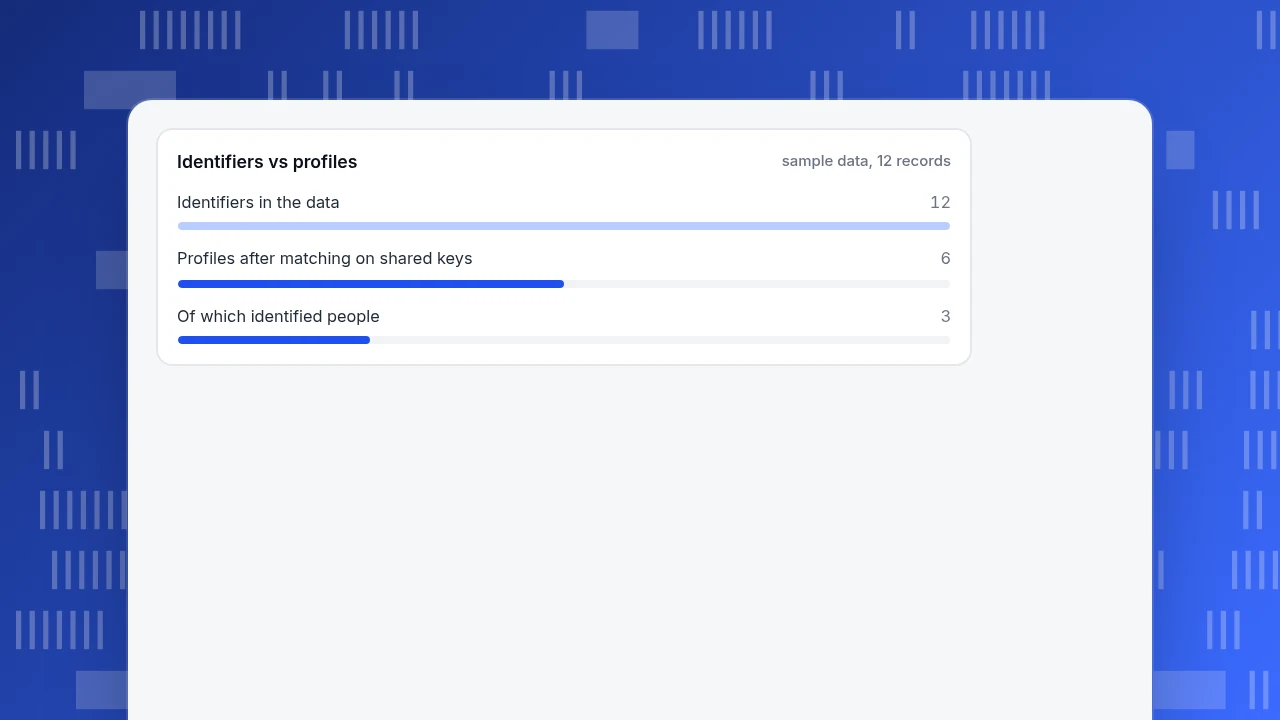
The 12 records contain 12 distinct identifiers. Linking records that share any key gives six profiles:
- Jo: R1, R2, R4, R5 and R6 become one profile, held together by anon_a1, jo@example.com and cus_204, with the app device dev_x9 attached when R4 shares Jo's email. Four identifiers collapse into one person.
- Sam: R7, R8 and R9, linked when R8 reveals sam@example.com and R9 shares it, so the earlier anonymous visits belong to a known customer.
- Kim: R12 alone, an identified person with one record so far.
- Three anonymous profiles: R3 (anon_b7), R10 (anon_d4) and R11 (dev_y2). No shared key links them to anyone.
R3 might be Jo returning on a new cookie after more than a week, as in the Safari case above, but nothing in the data proves it, so a deterministic rule leaves it alone. That is the right default: a false split can be repaired later when the person logs in, while a false merge puts two customers' data in one profile.
Decide what happens when a key changes. A person who changes their email, or a login ID shared by two people, will break a rule that treats keys as permanent. Keep an audit trail of merges, and a way to undo one.
Identifiers vs profiles
sample data, 12 recordsActivate: how other systems use the profile
The activate layer is where the profile leaves the platform or is read by something else. There are three common routes: an API or database query that other tools call, file exports on a schedule, and push connections that send a segment to another tool. The CDP Institute's definition requires only that the record be accessible to other systems, by whatever method.
Four questions decide the design:
- Who reads, and how fresh must the data be? An hourly refresh is plenty for a weekly email list; a live chat window that shows an account's plan needs the value within seconds.
- What leaves the platform? Sending a whole profile to every tool multiplies the places an email address lives. Send the field each tool needs.
- Who owns the segment definition? If marketing defines "active customers" one way and support another, you have two answers to one question. Define it once in the platform.
- What happens when someone is deleted or withdraws consent? The deletion has to reach every system that received the data.
Remember that sending a message, scoring a lead or bidding on an audience is a job for the tool that does it. The platform's job ends at making the right profile and segment available.
Governance runs through all three layers
Two parts of the GDPR shape the design directly. Article 5(1)(c) requires personal data to be "adequate, relevant and limited to what is necessary", so the collect layer should not capture a field because it might be useful one day. Article 4(5) defines pseudonymisation as processing personal data so that it "can no longer be attributed to a specific data subject without the use of additional information", kept separately and protected. Hashing an email before it is stored is a common example; the hash is still personal data if the lookup table exists.
Practical consequences:
- Record consent where you collect, and carry it with the profile, so the activate layer can refuse to send what consent does not cover.
- Keep identifiers and behaviour in separate stores where you can, joined only when needed.
- Give each field an owner and a retention period.
- Limit who can see raw profiles. Most roles need aggregates.
Build, buy or compose
| Approach | How it works | Where it fits | Cost of choosing it |
|---|---|---|---|
| All-in-one platform | One product does collect, unify and activate | Teams without data engineers who need results quickly | Less control over the model; data lives in the vendor's system |
| Composable (warehouse-centred) | Collection tools write to a data warehouse; identity and segments are built there | Teams with data engineers and a warehouse already | You build and maintain identity resolution and the activation jobs |
| Analytics tool plus a few integrations | Collect and light unify in an analytics product; activation is manual or by file | Smaller teams that mostly need to understand behaviour | No automated profile for outbound tools |
None of them is more correct than the others. The CDP Institute's definition covers both a packaged product and a set of components that together behave like one. Choose by who will maintain it, because the unify layer needs ongoing attention: the rules, the audit trail and the merges all need an owner.
Questions to answer before you design
- Which three decisions do you want to make with a unified profile, and which fields do they need?
- Which source is the authority for each field: the sign-up form, billing, support?
- Which keys do you trust for a deterministic match, and what happens when one changes?
- How will you treat anonymous visitors: keep them as aggregates, or hold a profile?
- Who may read raw profiles, and who may export?
- How does a deletion request reach every copy?
How TapCub covers the three layers
TapCub is not a full customer data platform, and the honest way to describe it is by the layers above. It covers collect and the analysis side of unify well, and activate only in a narrow sense. Take a store that wants one view of web visitors, app users and chat conversations.
- Collect. One script puts web visitors, chat and, with the SDKs, iOS, Android, Flutter, React Native and HarmonyOS apps and mini programs into one project, using the same events and user model. Your server sends orders and sign-ups through the HTTP API, and All-platform analytics › Data › Data import takes CSV events, CSV user properties and Nginx or Apache logs. Event definitions live in All-platform analytics › Data › Tracking plan.
- Unify. A visitor starts anonymous. When your site calls
tapcub.login(), the device's earlier anonymous events receive the user ID, and the person appears in All-platform analytics › Users › People with a day-by-day timeline that merges bound devices. Email and mobile identifiers are hashed. A visitor who never logs in stays in aggregates and gets no profile, which is the three anonymous profiles in the example. For a B2B product,tapcub.group()rolls people up into accounts in All-platform analytics › Users › Accounts. - Activate, in a limited sense. Segments defined in All-platform analytics › Users › Segments & tags (rule, static or real-time) are reused in funnels, retention and other analyses. Monitors in All-platform analytics › Operations › Monitors notify you when a metric crosses a threshold. For anything that sends messages or builds ad audiences, TapCub does not do it: it is not a CRM or an email or advertising tool. Raw event detail can leave through an asynchronous export in All-platform analytics › Data › Data export.
- Govern. Configuration › Privacy center sets the collection tier, consent behaviour and retention, and handles data subject requests.
If you need outbound activation, pair TapCub's profile and segment analysis with the tool that sends. TapCub reports who did what, and your sending tool does the sending.
FAQ
What is customer data platform architecture?
It is the arrangement of systems that collect customer data from many sources, link records into one profile per person, and make those profiles available to other tools. A simple way to describe it is three layers: collect, unify and activate, with governance (consent, minimisation, retention, access) running through all of them.
What are the main components of a CDP?
Collection (scripts, SDKs, server events and imports), an identity layer that links records into profiles, a store for profiles and events, segmentation, and ways for other systems to read the data, by API, file or connector. The CDP Institute's minimum is gathering and linking data into a persistent record other systems can access.
What is identity resolution in a CDP?
Identity resolution is linking identifiers that belong to the same person, such as an anonymous cookie, a login ID, an email and a billing ID. Deterministic matching merges records only when they share a trusted key. In the sample, 12 identifiers became six profiles, three identified and three anonymous.
Do I need a CDP or is a data warehouse enough?
It depends on who will maintain it. A warehouse can hold the data and, with engineering work, do identity resolution and segmentation, which the CDP Institute says is one valid way to meet the definition. A packaged platform does more of that work for you. Choose the one your team can maintain.
Is TapCub a customer data platform?
No. TapCub collects web, app and mini program data into one project, links anonymous visitors to logged-in users, and builds segments for analysis, but it does not send messages or build ad audiences. Use it for the collect and analyse part and pair it with a tool that sends.
Sources
- CDP Institute, What is a CDP? Definition of a CDP; gathering and linking data as the minimum functions; native or composed delivery. Checked 2026-11-20.
- WebKit, Full Third-Party Cookie Blocking and More, John Wilander, 24 March 2020. Seven-day cap on script-writable storage. Checked 2026-11-20.
- European Union, GDPR Article 5 (data minimisation, 5(1)(c)) and Article 4 (pseudonymisation, 4(5)). Checked 2026-11-20.
Was this article helpful?
We use your answers to fix and expand this page.
Couldn’t send. Please try again in a minute.
Thanks for the feedback. We’ll use it to improve this page.You’ve already sent feedback on this page. Thanks.

Data Analyst
Explores traffic sources, conversion funnels, and retention, using clear metric definitions and concrete examples to explain what the numbers mean.