Try it on your own data
Every report in this article is in the free plan. One snippet for web and apps, up to 10 sites.
Start freeSMS customer service is support by text message: asynchronous, on the customer's phone, and billed per message segment. Text beats live chat for follow-ups where the customer is away from your site, and live chat beats text when they are stuck on your page. The deciding number is cost per contact, which is dominated by agent minutes, not by the text fee.
What you will learn
- Text is billed per segment: 160 characters in GSM-7, 70 with an emoji; in the sample one emoji turns a 1-segment reply into 3
- Agent time dominates cost per contact: the message fee is 5.9% of a $2.48 text contact, and SMS beats chat only under about 6.7 active minutes
- Measure your own median first human reply per channel; for marketing texts US rules require prior express written consent and "stop" must be honored within ten business days
What SMS customer service is
SMS customer service is support delivered by text message: a customer sends a text to a business number, or replies to one, and an agent or an automated flow answers in the same thread. It is asynchronous by nature. Neither side has to be at a screen, the thread stays on the customer's phone, and a reply can arrive an hour later without the conversation feeling broken.
That is the reason to compare it with live chat and email rather than with phone calls. All three are written channels, but they differ in how fast the customer expects an answer, who has to be present, what the business pays per contact and what rules apply. This article gives the structural comparison, a cost-per-contact calculation you can rerun with your own numbers, a way to measure response time properly and the consent rules that apply in the US. For the full channel map see customer support channels, and for the web-based option see live chat customer service.
Why the phone is the channel to think about
The case for text is that almost everyone has a phone with them. Pew Research Center's mobile fact sheet reports, from a survey fielded 30 January to 18 June 2026, that 98% of US adults own a cellphone of some kind and 91% own a smartphone. A support number that accepts texts reaches nearly all customers without an app, an account or a browser visit.
Reach is not demand. Owning a phone says nothing about whether customers prefer to text a business, and no single survey settles that. What it does show is that the cost of adding the channel on the customer's side is close to zero, so the question becomes whether it is worth the cost on yours.
SMS vs live chat vs email: what actually differs
| SMS | Live chat | ||
|---|---|---|---|
| Where it happens | Customer's messaging app | Browser, on your site or app | Mail client |
| Is the customer present? | No | Yes, on the page | No |
| Must an agent be online? | Not for each message, but replies are expected quickly | Yes, or the widget should fall back to a form | No |
| Thread persists | Yes, on the phone | Per session, depending on setup | Yes |
| Length | Short: 160 characters per segment in basic text | Short to medium | Any |
| Attachments | Limited | Possible | Yes |
| Knows what page the customer is on? | No | Yes, if the chat is on your site | No |
| Identity | A phone number | A visitor ID or login | An email address |
| Regulation | US consent rules for texts (see below) | Site privacy rules | Anti-spam and privacy rules |
| Cost per message | A per-segment fee plus carrier fees | Included in seat price | Usually included |
Three practical consequences. Text wins for follow-ups that do not need the customer on your site: delivery changes, appointment confirmations and "your replacement is shipped". Live chat wins when the customer is already on the page and stuck, because the agent can see where they are. Email wins when the answer is long or carries documents.
| Situation | Better channel | Why |
|---|---|---|
| Delivery change, appointment reminder, "it shipped" | SMS | Customer is not on your site; a short message is enough |
| Customer is stuck on your checkout page | Live chat | Agent sees the page and answers in seconds |
| Customer needs to send documents or a long explanation | Attachments and length | |
| Issue needs a second answer tomorrow | SMS or email | The thread persists |
| Nobody online outside office hours | Email or offline form | Neither side must be present |
| Customer would rather not share a phone number | Live chat | Chat needs no number |
Working rules for this article; check them against your own cost per contact and resolution rate per channel.
What a text costs: segments and fees
A text is billed per segment, not per message. Twilio's SMS documentation says a message in the basic GSM-7 character set holds 160 characters in a single segment and 153 per segment when it has to be split; a message with characters outside GSM-7, such as an emoji, switches to UCS-2, which holds 70 characters in one segment and 67 per segment when split.
Twilio's US pricing page (current as of November 2026) lists $0.0083 per segment for outbound or inbound long-code, toll-free and short-code messages, plus carrier fees on each message that depend on the recipient's network. Outbound carrier fees on the page range from $0.0035 to $0.005 per message, depending on the recipient's carrier. The page notes that prices can change without notice, so check the current one before budgeting.
Using those figures (our arithmetic), at $0.0083 plus $0.005 = $0.0133 per outbound segment:
| Message | Characters | Character set | Segments | Outbound cost |
|---|---|---|---|---|
| Plain reply | 150 | GSM-7 | 1 | $0.0133 |
| Plain reply, one character longer than 160 | 161 | GSM-7 | 2 | $0.0266 |
| Same 150-character reply with one emoji | 150 | UCS-2 | 3 | $0.0399 |
| Long explanation | 460 | GSM-7 | 4 | $0.0532 |
One emoji turns a one-segment, 1.3-cent reply into a three-segment, 4-cent one. Fractions of a cent do not matter alone, but the same pattern repeated across thousands of replies does, and it shows why templates should be written in plain characters.
Cost per contact: worked example
The message fee is small. The cost of a contact is dominated by agent time. Sample data: a conversation resolved over text takes 6 outbound messages averaging 1.3 segments and 5 inbound single-segment messages, at $0.0083 per segment and a $0.005 carrier fee outbound.
- Outbound: 6 × 1.3 × ($0.0083 + $0.005) = $0.1037
- Inbound: 5 × 1 × $0.0083 = $0.0415
- Messaging cost per conversation: $0.1452
Now add agent time. Assume an agent costs $28 an hour, or $0.4667 a minute. Active agent time is the minutes spent writing and reading, not the elapsed time between messages.
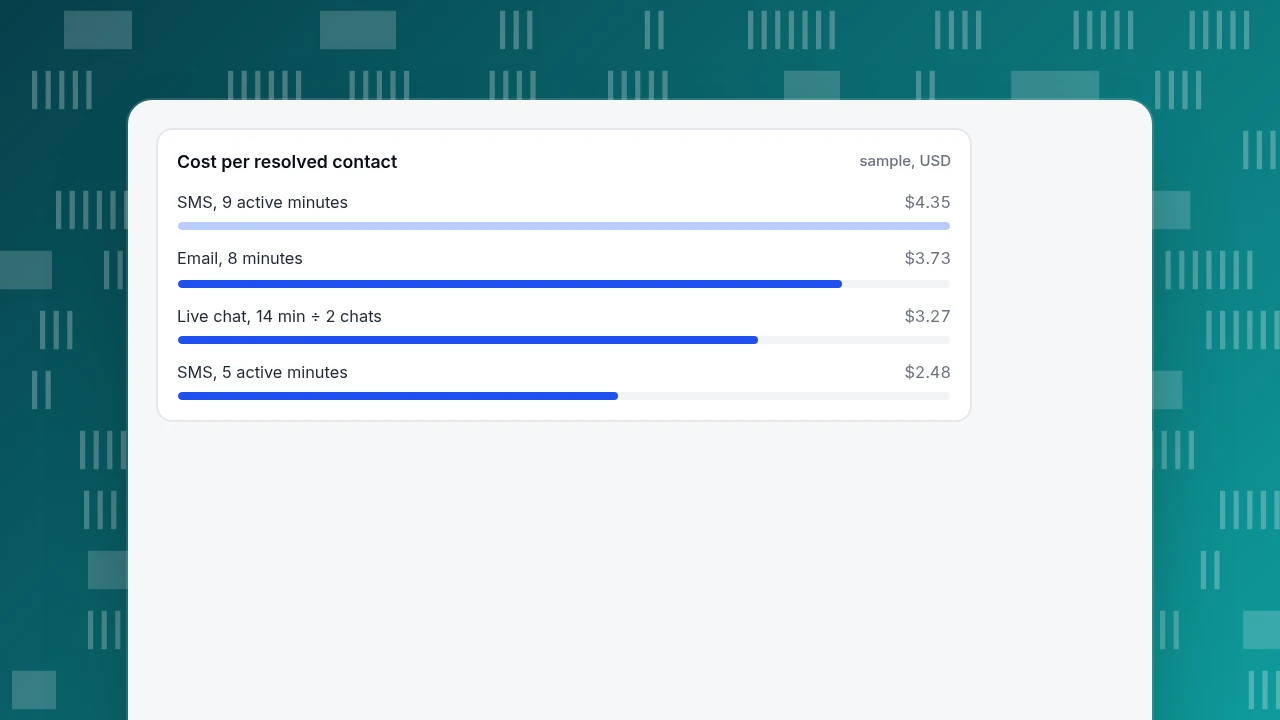
| Channel | Active agent minutes per resolved contact | Agent cost | Messaging fee | Total per contact |
|---|---|---|---|---|
| SMS, fast | 5 | $2.33 | $0.15 | $2.48 |
| SMS, slow | 9 | $4.20 | $0.15 | $4.35 |
| Live chat (14 min handled, 2 chats at once) | 7 | $3.27 | $0 per message | $3.27 |
| 8 | $3.73 | $0 per message | $3.73 |
Three conclusions follow, and each depends on your own numbers:
- The messaging fee is 5.9% of the fast SMS contact ($0.145 ÷ $2.48). Argue about handling minutes, not per-message prices.
- The break-even is about 6.7 active minutes. SMS costs less than live chat at 7 effective minutes only if a text resolution takes under about 6.7 minutes of agent time ($3.27 − $0.145 = $3.12, divided by $0.4667 per minute). The slow case, at 9 minutes, loses.
- Concurrency is what makes chat competitive. Handling two chats at once halves its effective minutes. Text conversations can also overlap, because customers reply slowly, so measure your concurrency instead of assuming one.
Seat or platform fees, number rental and registration fees are not in the table. Add them per month and divide by contacts.
Cost per resolved contact
sample, USDMeasuring response time without fooling yourself
Vendor articles quote different benchmark figures for each channel, and they disagree widely, so the figure that matters is your own, measured per channel. Two rules make it trustworthy.
Use the median, and look at the slow tail. Sample data: nine text conversations with first human replies after 0.5, 0.7, 0.9, 1.0, 1.2, 1.5, 2.0, 3.5 and 18.0 minutes.
- Mean = 29.3 ÷ 9 = 3.26 minutes
- Median (the fifth value) = 1.2 minutes
- Slowest = 18 minutes
The mean is nearly three times the median because of one slow reply. Report the median for the typical customer and the 90th percentile or slowest reply to show who waited.
Count only a human's first reply. An automatic "we got your message" does not answer the question. Define first response as the first reply from a person, and report it separately for business hours and for after-hours.
Resolution needs its own number: resolved conversations divided by all conversations, per channel. A fast channel with a low resolution rate pushes work to a second contact. For related definitions see first response.
The rules for texting customers in the US
This is a summary, not legal advice. Check your own case with counsel.
- Consent. The FCC's rule at 47 CFR 64.1200 defines prior express written consent as "an agreement, in writing, bearing the signature of the person called that clearly authorizes the seller" to send marketing messages. A customer who texts you first and gets an answer about their own question is in a different position from a customer you text with a promotion; keep support texts to the support issue.
- Opt-out. Under 64.1200(a)(10), consent may be revoked by any reasonable method, and a reply such as "stop" to a text "constitutes a reasonable means per se to revoke consent". Revocation requests must be honored "within a reasonable time not to exceed ten business days". Process "stop" the same day and keep an opt-out list.
- Calling hours. The rule at 64.1200(c)(1) bars telephone solicitations before 8 a.m. or after 9 p.m. in the called party's local time. It is written for marketing calls, but a sensible support team follows it anyway for anything that is not a reply.
- Carrier rules. Carriers set their own registration and content requirements for business messaging numbers; ask your messaging provider what applies before you launch.
When text beats live chat, and when it does not
| Situation | Better channel | Why |
|---|---|---|
| Delivery change, appointment reminder, "it shipped" | SMS | The customer is not on your site, and a short message is enough |
| Customer is on your checkout page and stuck | Live chat | The agent can see the page and answer within seconds |
| Customer needs to send documents or a long explanation | Attachments and length | |
| Issue needs a second answer tomorrow | SMS or email | The thread persists; chat sessions may not |
| You have no one online outside office hours | Email or offline form | Neither side needs to be present |
| Customer would rather not share a phone number | Live chat | Chat needs no number |
If you can offer only one, pick by where your customers are when they need help. If they are on your site, chat. If they are away from it, text or email.
What TapCub does and does not do here
TapCub has no SMS channel: it does not send or receive text messages. What it offers is the web side of the comparison, plus numbers to judge chat against whatever else you run.
- Turn on chat on a site that already has the script. In Live chat › Chat settings › Appearance, switch on the live chat option and the bubble shows without changing site code.
- Hand out a chat link. The separate chat page URL (in the form
https://chat.askcub.com/followed by your site key) can be sent in a text, an email signature or a QR code, so a customer who reached you by text can continue in chat. - Cover the quiet hours. In Live chat › Chat settings › Office hours set your working hours by time zone, and in Live chat › Chat settings › Offline messages let visitors leave an email and a question when nobody is on.
- Measure the channel. Live chat › Reports shows conversations, resolve rate (resolved ÷ all conversations), first response (counting only a person's first reply), satisfaction scored 1 to 5 within 24 hours after resolve, and knowledge-base hit rate. Offline messages are counted separately and do not count as resolved.
- Link chat to outcomes. Live chat › Reports › Conversion attribution compares goal conversion between visitors who chatted and those who did not.
Use the first-response and resolve-rate figures from step 4 in the table above to replace the sample minutes with your own.
FAQ
Is text customer service better than live chat?
Neither wins everywhere. Text suits follow-ups where the customer is away from your site, such as delivery changes and appointment reminders. Live chat suits customers who are on your page and need an answer in seconds. Decide with your own cost per contact and resolution rate per channel.
How much does SMS customer service cost?
The message fee is small. Using Twilio's published US price of $0.0083 per segment plus a carrier fee of about $0.005, a six-message reply costs roughly 10 cents outbound. Agent time dominates: at $28 an hour a five-minute text contact is about $2.33 of labour, so the fee is under 6% of the total.
Do I need consent to text customers?
For marketing texts, yes: the FCC's rules require prior express written consent. A customer who texts you first and gets an answer about their own question is in a different position, but you must honor "stop" requests within ten business days. This is a summary, not legal advice; check with counsel.
What is a good response time for text support?
There is no reliable single benchmark; published figures differ by source and industry. Measure the median first reply from a person, per channel, and the slowest tail. In the nine-conversation sample the median was 1.2 minutes and the mean 3.3, because one reply took 18 minutes.
Why did my text cost more than expected?
Because texts are billed per segment. A message over 160 characters splits into 153-character segments, and one emoji or other non-GSM character switches it to 70 characters per segment. In the sample, a 150-character reply with one emoji used three segments instead of one.
Sources
- Pew Research Center, Mobile Fact Sheet (survey fielded 30 January to 18 June 2026). Checked 2026-11-22.
- Twilio, US SMS pricing (per-segment and carrier fees, current as of November 2026). Checked 2026-11-22.
- Twilio, What is the SMS character limit? (GSM-7 and UCS-2 segment sizes). Checked 2026-11-22.
- Legal Information Institute, 47 CFR § 64.1200 (consent, revocation, calling hours). Checked 2026-11-22.
Was this article helpful?
We use your answers to fix and expand this page.
Couldn’t send. Please try again in a minute.
Thanks for the feedback. We’ll use it to improve this page.You’ve already sent feedback on this page. Thanks.

Product Experience Specialist
Writes about product experience, practical workflows, and growth, turning complex processes into clear steps for everyday decisions.