Try it on your own data
Every report in this article is in the free plan. One snippet for web and apps, up to 10 sites.
Start freeMultilingual chatbots and support start with data, not a language list: read the browser language and country of your visitors, estimate chats per language, and cover small languages with two-way translation rather than hiring. Reserve a native-speaking agent for a language that reaches about 600 chats a month. Below: the signals, a worked example sized in agent hours, the thresholds and what to measure after launch.
What you will learn
- Use browser language first and country as a check, because one country has many languages
- Estimate chats and agent hours per language; most languages are too small to staff but add up to a real stream
- Cover small languages with two-way translation, review a sample each month, and hire native speakers only where volume or risk demands
Which languages should your website support in chat?
Support the languages your visitors already arrive in, in order of how many of them there are, and cover the long tail with translation. The data to decide it is already in your analytics: the browser language of each visitor and their country. Neither is perfect, so read them together.
| Signal | What it tells you | Where it misleads |
|---|---|---|
| Browser language | The language the visitor's browser is set to, a good proxy for the language they read comfortably | Shared computers, work laptops set to English, travellers |
| Country | Where the visit came from, from the IP address | A country is not a language: Switzerland, Canada, India and the United States each have several |
| Chat messages | What people actually write when they ask a question | Only visitors who chose to chat, so it under-counts those who left because they could not |
| Language of the page they read | Which localized page they were on | Only helps if you have localized pages |
Country alone misleads in a way that is easy to quantify. The US Census Bureau's American Community Survey reported 67.8 million people aged 5 and older speaking a language other than English at home in 2019, almost 1 in 5, and about 62% of those speak Spanish. A visitor from the United States with a Spanish browser is therefore a normal case, not an exception. That is why this guide uses browser language first and country as a check.
Why does language matter for support at all?
Because many people prefer, and some insist on, information in their own language. CSA Research surveyed 8,709 consumers in 29 countries in 2020 (released July 2020) and reported that 76% prefer products with information in their own language, and that 40% will never buy from websites in other languages. These are consumer-research results about buying, not about chat, but a support question is the moment a visitor decides whether to buy, so the finding applies directly: a visitor who cannot ask a question in their language is a visitor you may lose.
The decision is not "support every language". It is "find the languages where the visitors and the potential chats justify the effort, and pick the cheapest way to cover each".
Worked example: language share against support effort
Sample data: a site gets 20,000 visitors a month. The chat start rate is assumed to be 1.5% of visitors (sample figure, taken from the English-language visitors and applied to every language), and an average chat takes 8 minutes of agent time.
| Browser language | Visitors | Share | Expected chats (1.5%) | Agent hours (8 min each) |
|---|---|---|---|---|
| English | 14,000 | 70.0% | 210 | 28.0 |
| Spanish | 2,000 | 10.0% | 30 | 4.0 |
| German | 1,200 | 6.0% | 18 | 2.4 |
| French | 1,000 | 5.0% | 15 | 2.0 |
| Portuguese | 600 | 3.0% | 9 | 1.2 |
| Japanese | 500 | 2.5% | 7.5 | 1.0 |
| Other | 700 | 3.5% | 10.5 | 1.4 |
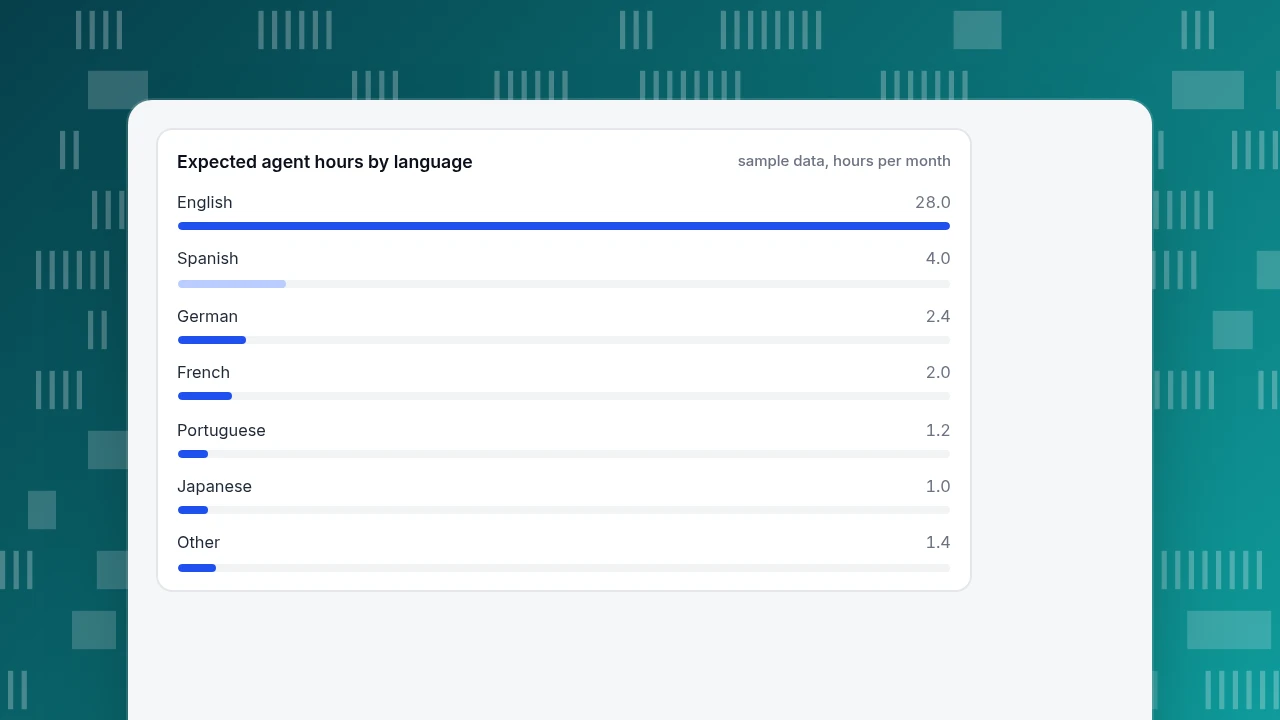
Reading it. The 6,000 non-English visitors are 30% of traffic (6,000 ÷ 20,000). At the assumed 1.5% they would start 90 chats a month (6,000 × 0.015) and need 12 agent hours (90 × 8 ÷ 60). Spread across six languages that is 1 to 4 hours per language per month. No language comes near a part-time hire, but all of them together are a real stream of questions that go unanswered if the team only reads English. This is the case translation fits: many languages, each too small to staff.
Check the assumption. If real non-English chat starts are far below 1.5%, the gap is itself a finding: visitors may be leaving because they see no way to ask in their language. Compare chat starts per 100 visitors by language after you turn on translation, and update the table.
Expected agent hours by language
sample data, hours per monthWhat traffic thresholds decide the approach?
Use rules written in terms of expected monthly workload, not a feeling. The thresholds below are our suggested starting points; adjust them to your team.
| Expected chats per month in one language | Approach | Reason |
|---|---|---|
| Below about 10 | Reply in English, add a line saying so, keep offline message as the fallback | Not enough demand to justify any setup |
| About 10 to 100 | Two-way translation with an agent who reads English | Cheap to run, covers many languages at once |
| About 100 to 600 | Translation plus a short answer library in that language, written and checked by a fluent reader | Common questions get exact, reviewed wording |
| 600 or more (about 80 agent hours at 8 minutes a chat) | Consider a native-speaking agent for that language | Volume now justifies half a full-time role |
In the example above, Spanish (30 chats) and German (18 chats) sit in the second band and the rest in the first or second. Nothing reaches the third band. Reconsider the table every quarter: a language that doubles is the one to watch.
| Expected chats per month in one language | Approach | Reason |
|---|---|---|
| Below about 10 | Reply in English, add a line saying so, keep the offline message | Not enough demand to justify setup |
| About 10 to 100 | Two-way translation with an agent who reads English | Cheap, covers many languages at once |
| About 100 to 600 | Translation plus a short reviewed answer library in that language | Common questions get exact wording |
| 600 or more | Consider a native-speaking agent | About 80 agent hours at 8 minutes a chat |
Thresholds are suggested starting points; adjust them to your team.
Translation or a native-speaking hire?
| Question | Two-way translation | Native-speaking agent |
|---|---|---|
| Languages covered | Many, from one agent | One language per hire |
| Time to start | Same day | Weeks to recruit and train |
| Quality | Good for questions and answers, weaker on idiom, tone and legal or medical wording | High, including tone |
| Cost | Usage of a translation service | Salary or contract |
| Failure mode | A mistranslated line the agent cannot detect | Gaps in coverage hours |
Use translation as the default and review a sample of translated chats each month with someone who reads the language; hire where volume or risk (contracts, health, refunds) demands native judgment. Translation also does not change the interface of your site or the language of your help articles; it only changes the conversation. How two-way translation works in a live inbox is covered in two-way translation support; when the first answer should come from an assistant rather than a person, see AI support agent.
How do you tell whether language support is working?
Measure it by language, with the same three numbers every month, so the effect of turning translation on is visible instead of assumed:
- Chat starts per 100 visitors. In the sample, English visitors start 1.5 chats per 100. If a language stays well under that after launch, visitors still do not see a way to ask.
- Resolved share and first response time. Compare each language with English. A big gap points to review time or unclear translated answers.
- Conversion of chatted against not chatted visitors. Within one language, compare people who chatted with people who did not, keeping in mind that people who chat are often closer to buying already.
A suggested review rule: if a language reaches the next band in the table for two months in a row, move its approach up one level.
What goes wrong with multilingual support?
- Going by country. Use browser language and check with country; one country has many languages.
- Translating the chat but not the offline message. A visitor who writes in German and gets an English-only form leaves.
- No review. Check a sample of translated threads each month against a fluent reader's judgment.
- Promising what you cannot staff. A "we speak Japanese" label with no one reading Japanese is worse than no label.
- Assuming the widget is translated. Translating messages is not the same as localizing the interface buttons and greetings.
- Counting only chats. Visitors who could not ask leave no chat; look at conversion by language too.
How do you do this in TapCub?
Continuing the 20,000-visitor example:
- Read the language and country data. In Web analytics › Audience, the language and place lists show visitors, pageviews, bounce, duration and share for each browser language and country. Click a language to filter sources and pages. This produces the visitor column in the table above.
- Set the interface language. In Live chat › Chat settings › Appearance, the Widget language can follow the visitor's browser, or be fixed to Simplified Chinese or English. The buttons and system lines exist in those two languages only; other languages are translation targets, not interface languages.
- Turn on two-way translation. In Live chat › Chat settings › Greeting & translation, switch on Two-way auto translation. Agents see the original and a translation into the agent language, and visitors see only the reply in their own language. The visitor language can be detected automatically or chosen. The feature covers 18 languages including Spanish, German, French, Portuguese and Japanese, and is available from the Pro plan up. Translation runs with a budget of about 3 seconds; if it fails, the original message is sent and the inbox says so.
- Know what it shares. Translation and automatic answers draw on the same monthly AI calls, and an exact question and answer match from the knowledge base does not count. If no AI is configured on the platform, the switch does not translate.
- Check it worked. The agent sidebar in Live chat › Inbox shows the visitor's language, and Live chat › Reports counts chat starts by weekday and hour, so you can compare chat starts per 100 visitors by language before and after.
TapCub translates the conversation; it does not translate your site pages, and it does not tell you whether a translation was good.
FAQ
What are multilingual chatbots?
Multilingual chatbots answer visitors in more than one language, either by writing replies in each language or by translating between the visitor's language and the team's. This guide covers the second approach, translation, and how to decide which languages need it.
How do you decide which languages to support?
Check browser language and country in your analytics, rank languages by visitors, estimate monthly chats at your normal chat-start rate, and cover small languages with translation. Reserve native-speaking agents for a language that reaches roughly 600 chats a month.
Is machine translation good enough for customer support?
It works well for ordinary questions and answers, and less well for idiom, tone and legal or medical wording. Use it as the default, review a sample of translated chats each month, and bring in a fluent person for high-risk topics.
Does TapCub translate my whole website?
No. TapCub translates chat messages. The interface buttons exist only in English and Simplified Chinese, and page content stays in the language you publish it in.
What data shows that language support matters?
CSA Research reported in 2020 that 76% of 8,709 surveyed consumers prefer products with information in their own language and 40% will never buy from websites in other languages. Your own analytics should confirm the picture with browser-language and chat data.
Sources
- CSA Research, Consumers Prefer their Own Language, press release, 7 July 2020: 8,709 consumers in 29 countries, 76% and 40%.
- US Census Bureau, Languages We Speak in the United States, December 2022: 67.8 million people, almost 1 in 5, speaking a language other than English at home in 2019.
Was this article helpful?
We use your answers to fix and expand this page.
Couldn’t send. Please try again in a minute.
Thanks for the feedback. We’ll use it to improve this page.You’ve already sent feedback on this page. Thanks.

Product Experience Specialist
Writes about product experience, practical workflows, and growth, turning complex processes into clear steps for everyday decisions.