Try it on your own data
Every report in this article is in the free plan. One snippet for web and apps, up to 10 sites.
Start freeThe data privacy issues that matter in analytics are collecting without a valid basis, moving data across borders, capturing sensitive text in forms and replays, keeping data too long, sharing it with third parties and losing it in a breach. Each has a control you can apply, and the penalties are large enough to rank them: up to EUR 20 million or 4% of turnover under the GDPR.
What you will learn
- Eight analytics-specific risks, each with the place it shows up in tracking and one control you can apply this week
- GDPR caps are the higher of EUR 20 million or 4% of worldwide turnover; 4% only exceeds EUR 20 million above EUR 500 million turnover
- A breach costs USD 4.99 million on average (IBM 2026), so collecting less is the cheapest control
What counts as a privacy issue in analytics
Generic lists name hacking, lack of transparency and non-compliance. They are true and not much help if you run a website's analytics. In analytics the risk sits in a short list of mechanisms: what each tag collects, where the data goes, who else receives it, how long it stays, and who can open it. Every item below maps to one of those five.
This article is practical, not legal advice. Which law applies depends on where your visitors are, not where your company is.
Eight risks and where each shows up
| Risk | Where it shows up in analytics | Control |
|---|---|---|
| No valid basis or consent | Tags fire before a consent choice; analytics cookies set by default | Gate tags on consent where the law requires it; use a mode that records less without consent |
| Cross-border transfers | Data processed in a region different from your visitors | Choose a processing region; document the transfer mechanism |
| Sensitive text captured | Form fields, search boxes and session replays record what people type | Record form ids not contents; mask inputs; keep replay off unless needed |
| Over-collection | Full IP, user ids and free-text properties nobody uses | Truncate IPs; keep a tracking plan with a purpose for each property |
| Over-retention | Raw events kept for years | Set a retention period and delete raw detail after it |
| Third-party sharing | Many tags send data to other vendors | Audit tags quarterly; remove those without an owner |
| Data subject requests | Cannot find or delete one person's data | Know where identifiers live; use export and delete tools |
| Breach | Exports, API keys and shared links leave the system | Least access; expiring keys; password and expiry on shared reports |
Four of them deserve a closer look because they surprise people:
- Sensitive text. A session replay or a form tracker that stores field contents can capture names, emails, even health or card data typed into a free-text box. The safer default is to record that a form was submitted, with its id, and nothing typed.
- Third-party tags. A tag manager makes it easy to add a tag and hard to remember it. Each one is a recipient of your visitors' data.
- Over-collection. If nobody can say which report uses a property, it is risk without value.
- Exports and shared links. Breaches in analytics are often a spreadsheet or a link with no password, not a hacked server.
| Risk | Where it shows up in analytics | Control |
|---|---|---|
| No valid basis or consent | Tags fire before a consent choice; analytics cookies set by default | Gate tags on consent where the law requires it; use a mode that records less without consent |
| Cross-border transfers | Data processed in a region different from your visitors | Choose a processing region; document the transfer mechanism |
| Sensitive text captured | Form fields, search boxes and session replays record what people type | Record form ids not contents; mask inputs; keep replay off unless needed |
| Over-collection | Full IP, user ids and free-text properties nobody uses | Truncate IPs; keep a tracking plan with a purpose for each property |
| Over-retention | Raw events kept for years | Set a retention period and delete raw detail after it |
| Third-party sharing | Many tags send data to other vendors | Audit tags quarterly; remove those without an owner |
| Data subject requests | Cannot find or delete one person's data | Know where identifiers live; use export and delete tools |
| Breach | Exports, API keys and shared links leave the system | Least access; expiring keys; password and expiry on shared reports |
Controls are practical steps, not legal advice; what your law requires depends on where your visitors are.
What breaking the rules can cost
Three outside figures put sizes on these risks.
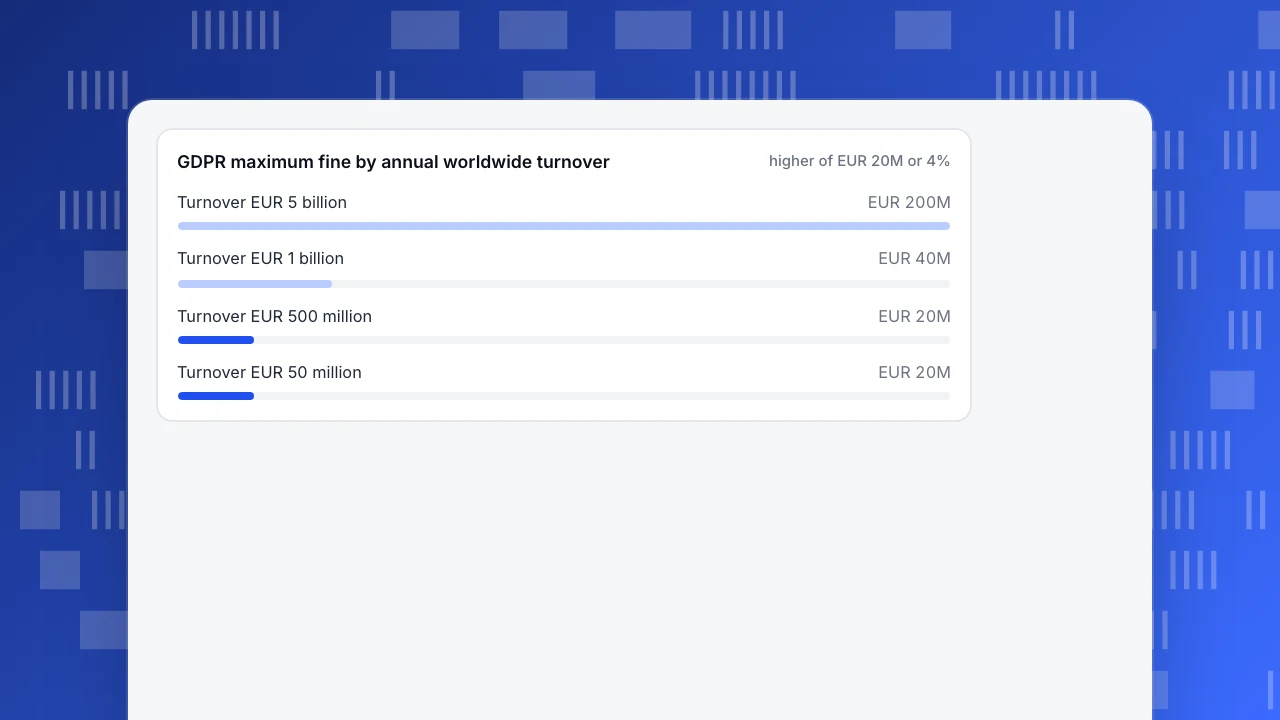
Regulatory fines. GDPR Article 83 sets two tiers. For some infringements, fines can reach EUR 10 million or 2% of worldwide annual turnover of the previous year, whichever is higher. For others, including the basic principles for processing, consent, data subjects' rights and transfers to third countries, they can reach EUR 20 million or 4%, whichever is higher. The arithmetic matters for planning:
| Annual worldwide turnover | 4% of turnover | Cap (higher of EUR 20M and 4%) |
|---|---|---|
| EUR 50 million | EUR 2 million | EUR 20 million |
| EUR 500 million | EUR 20 million | EUR 20 million |
| EUR 1 billion | EUR 40 million | EUR 40 million |
| EUR 5 billion | EUR 200 million | EUR 200 million |
For a small company the cap is the flat EUR 20 million; 4% only takes over above EUR 500 million of turnover (20 ÷ 0.04). Fines are rarely set at the cap, but the cap tells you how seriously the law ranks consent, rights and transfers.
Transfers. On 22 May 2023 the European Data Protection Board announced a EUR 1.2 billion fine on Meta Platforms Ireland, issued by the Irish data protection authority after the Board's binding decision. It covered transfers of EU users' data to the United States under standard contractual clauses from 16 July 2020, which the Board called very serious because the transfers were systematic, repetitive and continuous. Analytics is exactly this kind of continuous flow: every pageview is a transfer if the processor sits in another region.
Breaches. IBM's 2026 Cost of a Data Breach report puts the global average cost of a breach at USD 4.99 million, a record high and 12% more than the year before. The cheapest breach to handle is the one where the data was never collected, or was already deleted.
GDPR maximum fine by annual worldwide turnover
higher of EUR 20M or 4%How to rank the risks for your site
Score each risk from 0 to 3 on two questions and multiply:
- Exposure: how much data is involved (0 = none, 3 = all visitors).
- Sensitivity: how harmful would a leak be (0 = harmless, 3 = could identify or harm a person).
Sample data: a store with a checkout and a newsletter form scores session replay of the checkout at 3 × 3 = 9, an unused 18-month raw event store at 3 × 2 = 6, and tags nobody owns at 2 × 2 = 4. Start with 9. A risk that scores 6 or more gets a named owner and a date; below 3, note and move on.
Decision rules
- If you cannot name the purpose of a property, stop collecting it.
- If a field accepts free text, record that it was used, not what was typed.
- If your visitors are in the EEA or the UK, assume consent logic is needed and check with your lawyer for the details.
- If data crosses a border, document where it goes and the mechanism you rely on.
- If a tag has no owner, remove it and see whether anyone notices.
- If a shared report has no password or expiry, add them or delete the link.
- Review all of this quarterly, on the same day as a tag audit.
Run a one-hour tag audit
Most of the risks above are visible in a list of what your site loads. Open your tag manager or view the page's network requests and list every tag with four columns: what it sends, where it sends it, who owns it and why it exists.
Sample data: an audit of 12 tags on a store.
| Result | Tags | Share | Action |
|---|---|---|---|
| Owner and purpose clear | 6 | 50.0% | Keep; note the review date |
| No owner, purpose unknown | 3 | 25.0% | Remove, then watch for complaints for two weeks |
| Sends to another region or fires before a consent choice | 2 | 16.7% | Review the transfer mechanism and the consent gate |
| Captures typed text | 1 | 8.3% | Fix now: stop capturing field contents |
| Total | 12 | 100.0% |
Three of twelve tags (25.0%) had no owner, so removing them costs nothing but attention. The single tag that captures typed text is the one to handle today, because a leak there can include names, emails or worse. The two review items need a decision, not a deletion: a different region can be acceptable with a documented mechanism.
Repeat the audit every quarter and after every redesign. A new campaign page is usually where an unreviewed tag arrives.
What to do when a data subject asks for their data
A request to export or delete one person's data is a test of whether you know where identifiers live. Prepare before the first request arrives:
- List the identifiers: cookie or device ID, login ID, email, and any custom user properties.
- Decide which system holds what: analytics, chat, CRM, email, support.
- Name an owner and write the steps so a request can be answered without a meeting.
- Keep a log of requests and the date each was completed.
If your analytics tool stores no persistent ID and no raw IP, there may be little to find; that is the benefit of collecting less. If it identifies logged-in users, you need to know the user ID so the export and deletion match the person.
Mistakes that turn small issues into large ones
- Treating the banner as the whole program. A consent banner records a choice; it does not limit what a tag sends, where it goes or how long it stays. Test that tags really wait for the choice by loading the page with a fresh browser and watching the network requests.
- Keeping data "just in case". Every extra month of raw events adds exposure in a breach and work in a data request. If you cannot name a report that needs it, shorten the retention period.
- Copying a policy without checking the tags. A privacy policy that says you do not share data with third parties is a problem if the audit above finds a tag that does.
- Giving everyone access. Exports, API keys and shared links are the usual exit routes. Limit who can create them and set expiry dates.
- Never rehearsing a request. Run one test export and one test deletion on a colleague's record a year before you need it.
Each mistake has the same remedy: make the default smaller. Collect less, keep it for less time, share it with fewer parties, and let fewer people open it.
How privacy controls work in TapCub
Take the store above and set it up in TapCub.
- Open Configuration › Privacy center and choose a collection tier. Tier 1 records anonymous aggregates: no persistent ID and no automatic collection or identity features. Tier 2 is the default. Rules for the EEA and the UK default to tier 2 with consent required, and without analytics consent the project falls back to tier 1; pageviews and custom events are still recorded. In China mode nothing is collected before consent.
- Check the same page for IP truncation, retention periods and data subject requests (export and delete). Set retention before you need it, because details past the retention period are deleted.
- Leave form capture alone unless you need it: it is off by default, and when you turn on
data-forms="true", only the form id, name and action are recorded, never what a visitor typed. - Keep Session replay off unless a question needs it. It is off by default.
- In Configuration › Settings › Public sharing, set a password and a limit on how many days of data can be seen; visitor lists and sessions cannot be shared publicly at all.
TapCub does not decide whether you need consent; that depends on your configuration and the law where your visitors live. It gives you the switches, and the default is to record less.
FAQ
What are the biggest data privacy issues for websites?
Collecting data without a valid basis or consent, moving it to another region without a mechanism, capturing sensitive text in forms and replays, keeping it too long, sharing it with unknown third parties and breaches. The first and last have the largest financial penalties.
How much can a GDPR fine be?
Up to EUR 20 million or 4% of worldwide annual turnover, whichever is higher, for infringements such as breaking the processing principles or data subjects' rights. A lower tier is EUR 10 million or 2%. Fines are set case by case and are usually below the cap.
Does analytics create privacy risk?
Yes, because it records behaviour, often with identifiers, and sends it to a processor. The risk shrinks when you collect less, truncate IPs, avoid capturing typed text and set a retention period.
What should I do first?
List every tag and what it collects, remove the ones without an owner, and turn off capture of typed text. Those three steps cut the most exposure for the least work.
Sources
Was this article helpful?
We use your answers to fix and expand this page.
Couldn’t send. Please try again in a minute.
Thanks for the feedback. We’ll use it to improve this page.You’ve already sent feedback on this page. Thanks.

Data Analyst
Explores traffic sources, conversion funnels, and retention, using clear metric definitions and concrete examples to explain what the numbers mean.