Try it on your own data
Every report in this article is in the free plan. One snippet for web and apps, up to 10 sites.
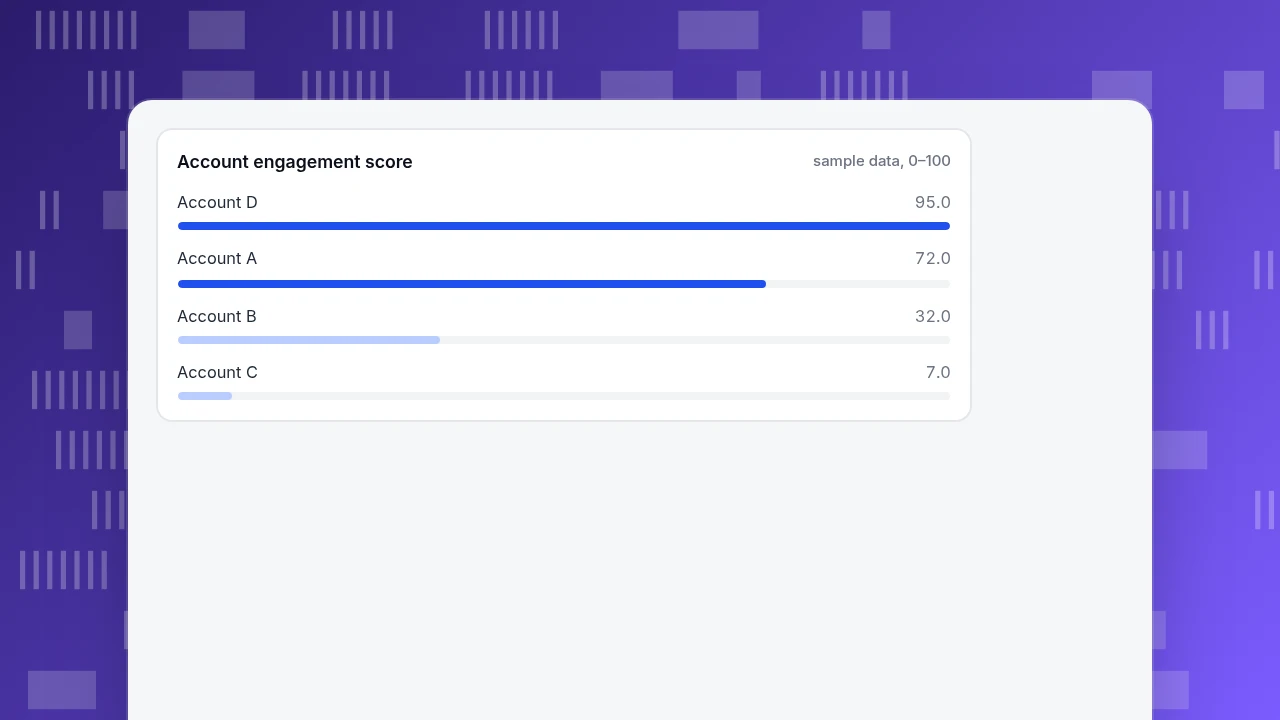
Start freeCustomer engagement management (CEM) is deciding how and when you interact with each customer across channels, and measuring whether those interactions strengthen the relationship. A CEM stack is a loop of capture, identify, decide, act and measure, and the layer most teams under-build is measurement. Below: the layers, metrics by level and a worked 0–100 score, where four sample accounts score 72, 32, 7 and 95.
What you will learn
- Treat CEM as a loop of five layers; capture without identify and act without measure are the common gaps
- Define each metric exactly, such as an engaged session as over 10 seconds, a key event or 2+ views
- Check that low engagement scores actually predict churn before acting on bands, and keep a comparison group
What is customer engagement management?
Customer engagement management (CEM) is the practice of deciding, across every channel you use, how and when you interact with each customer, and measuring whether those interactions strengthen the relationship. The word is used two ways, which causes confusion: as a management practice (the process and the metrics) and as a software category (platforms that bundle messaging, support and data). This guide is about the first and shows where software fits in.
The research definition is useful because it is wider than "marketing messages". In a 2010 paper in the Journal of Service Research, van Doorn and colleagues define customer engagement behaviors as customers' behavioral manifestations toward a brand or firm that go beyond purchase, such as recommending, reviewing and helping other customers. So engagement is what customers do, not what you send. The working claim of this guide follows from that: a CEM stack is a loop of capture, identify, decide, act and measure, and the part most teams under-build is measurement. Most teams have an email tool and a support tool; few can say which interactions changed behavior. For the metric catalogue, see customer engagement metrics; for automation of the "act" layer, see customer engagement automation; for a product-category view, see customer engagement software.
What are the layers of a CEM stack?
Five layers, each answering a different question. You can buy one product that covers several, but you cannot skip a layer.
| Layer | Question it answers | Example data or tool | Typical owner |
|---|---|---|---|
| Capture | What did the customer do, on which channel? | Page and event tracking, chat transcripts, orders | Analytics or data team |
| Identify | Which events belong to the same person or account? | Login id, account id, customer id | Product and data |
| Decide | Who should hear what, and when? | Segments, scores, rules | Marketing or lifecycle team |
| Act | Deliver the interaction | Email, push, in-app message, support reply, a call | Marketing, support, sales |
| Measure | Did behavior change compared with not acting? | Conversion, retention, resolution, comparison groups | Analytics |
Two gaps are common. Capture without identify means you know that 8,000 visits happened but not that three of them were the same account; the result is over-contacting some customers and ignoring others. Act without measure means a lot of messages go out and nobody can say what they changed. The loop only works when the measure layer feeds back into decide.
| Layer | Question it answers | Example data or tool |
|---|---|---|
| Capture | What did the customer do, on which channel? | Event tracking, chat transcripts, orders |
| Identify | Which events belong to one person or account? | Login id, account id |
| Decide | Who should hear what, and when? | Segments, scores, rules |
| Act | Deliver the interaction | Email, in-app, support reply, a call |
| Measure | Did behavior change compared with not acting? | Conversion, retention, comparison groups |
You can buy one product that covers several layers, but you cannot skip a layer.
Which metrics belong at each level?
Pick a small set at three levels, and define each exactly.
| Level | Metric | Definition | Watch out for |
|---|---|---|---|
| Activity | Engagement rate | Engaged sessions ÷ sessions. A session is engaged if it lasts longer than 10 seconds, has a key event, or has 2 or more page or screen views | Rewards long sessions on slow pages |
| Activity | Active days | Days with any qualifying event in the last 30 | Counts bots if not filtered |
| Relationship | Returning rate | Customers active this period who were also active last period ÷ customers active last period | Needs identity to be reliable |
| Relationship | Account health | Share of members active, share of active days, recency | Weights are a judgment, so validate them |
| Outcome | Conversion or retention | Goal completions or renewal among those engaged vs not | Engaged people were more likely to convert anyway |
| Outcome | Resolution and satisfaction | Resolved ÷ conversations; a 1–5 rating after resolution | Small samples |
The engaged-session definition is Google's, from its Analytics help on engagement: any one of more than 10 seconds, a key event, or two or more page or screen views. It is a good example of a definition made of three precise thresholds rather than a feeling. Notice the last column: every metric has a way of fooling you, and the last two outcome metrics have a selection problem: customers who engage are different from those who do not, so a raw gap overstates what your interaction did. If you can, hold out a comparison group.
How do you build an engagement score?
A score compresses several signals into a number you can sort and band. Keep it simple enough to explain in one sentence.
Sample data: a score from 0 to 100 for an account, with three components:
- Breadth, 40 points: share of the account's members active in the last 30 days × 40.
- Depth, 30 points: share of the last 30 days with activity × 30.
- Recency, 30 points: 30 if last seen within 7 days, 15 if within 30 days, 0 after that.
| Account | Members active | Active days of 30 | Last seen | Score |
|---|---|---|---|---|
| A | 12 of 20 | 18 | 1 day ago | 40×0.60 + 30×0.60 + 30 = 72.0 |
| B | 5 of 25 | 9 | 10 days ago | 40×0.20 + 30×0.30 + 15 = 32.0 |
| C | 1 of 8 | 2 | 35 days ago | 40×0.125 + 30×0.067 + 0 = 7.0 |
| D | 7 of 7 | 25 | today | 40×1.00 + 30×0.833 + 30 = 95.0 |
Bands you might use: 70 and above is healthy, 30 to 69 is worth watching, below 30 is at risk. A and D are healthy, B is on watch and C is at risk. The action differs by band: D needs nothing and might be asked for a testimonial; A gets a normal cadence; B gets a human check-in before the next renewal conversation; C gets a direct call, because mass email is unlikely to bring back a three-person dormant team.
Three cautions about scores. The weights are judgments, not facts: check them by seeing whether last quarter's low scores churned more than last quarter's high scores, and adjust. An account with one very active member can look healthy on depth while breadth is thin, which is why breadth is its own component. And do not show a score for an account you have no data on; a blank is more honest than zero.
Account engagement score
sample data, 0–100What does the process look like?
- Define what engagement means for this product. Choose two or three events that indicate real use (not logins alone), and write them with windows.
- Instrument and identify. Make sure those events are captured, and that a logged-in user is linked to an account.
- Set bands and owners. Decide the score or segment thresholds, and who acts on each band.
- Act, with a comparison group when possible. Hold out 5–10% of an eligible segment from a new campaign so you can see what it changed.
- Review monthly. Check whether low bands are actually churning more, retire interactions that did not move behavior, and re-set thresholds.
A rule that saves most CEM programs from noise: no customer gets more than one proactive message per week from the whole company unless they asked for it. Without one owner of contact frequency, each team's reasonable cadence adds up to spam.
What mistakes make CEM programs fail?
- Counting activity as engagement. Email opens and clicks measure messages, not relationship. Prefer events that show product use or purchase.
- Treating channels as separate programs. Support, marketing and product each see a part of the customer; without shared identity, each makes decisions on a fragment.
- No control group. Customers you message are chosen because they looked promising, so their later behavior overstates the message's effect.
- Over-fitting the score. A 12-input score nobody can explain will not be trusted or maintained.
- Ignoring the human channel. A support conversation is a high-intent engagement signal and also a place to act. Connect it to the rest of the data.
How does TapCub fit into a CEM stack?
TapCub covers the capture, identify and measure layers, plus one acting channel, live chat. It does not send email or push messages, run campaigns, score leads or act as a CRM.
- Capture. The website script, app SDKs and server events record behavior, and Web analytics › Events lists them.
- Identify. After login, call
tapcub.loginto link a person, andtapcub.group('company', 'acme', {...})to link a person to an account. In All-platform analytics › Users › Accounts you see accounts, 30-day active accounts, members and a 0–100 health score built the same way as the example above: 40 points for the share of members active in 30 days, 30 for the share of active days, and 30 for recency (30 if last seen within 7 days, 15 within 30 days). The health score is blank when the account has no last-seen time. - Decide. All-platform analytics › Users › Segments & tags builds rule segments that refresh daily, plus RFM buckets and a lifecycle report (New, Returning, Resurrecting, Dormant). See create user segments and read the lifecycle report.
- Act through chat. In Live chat › Inbox, agents see the visitor's source, current page and recent browsing, so a conversation starts with context. Proactive invites in Live chat › Chat settings › Proactive invites trigger on page plus seconds on the page.
- Measure. Live chat › Reports › Conversion attribution compares visitors who chatted with those who did not, with relative lift = chatted rate ÷ no-chat rate − 1, and warns when fewer than 30 people chatted. Treat it as the raw gap discussed above, not as proof of cause.
For email and push, use your own sending tool; if a webhook is configured, TapCub emits segment membership changes you can use to trigger it.
FAQ
What is customer engagement management?
It is the practice of deciding how and when you interact with each customer across channels, and measuring whether those interactions strengthen the relationship. It covers the process and metrics, and the software that supports them, but the measurement loop matters most.
What are the main parts of a customer engagement management stack?
Five layers: capture (what customers did), identify (which events belong to one person or account), decide (segments, scores, rules), act (messages, support, calls) and measure (whether behavior changed). Many products cover several layers, but none of the layers can be skipped.
What metrics measure customer engagement?
Use a few at three levels: activity (engagement rate, active days), relationship (returning rate, account health) and outcome (conversion, retention, resolution and satisfaction). In the sample, a 0–100 score mixed breadth, depth and recency into bands of healthy, watch and at risk.
What is the difference between customer engagement and customer relationship management?
CRM stores and manages customer records, deals and contact history. Customer engagement management is broader on the interaction side: it uses behavioral data across channels to decide what to send and measure whether it worked. Many teams use both, with CRM as the record.
How do you measure customer engagement without a CRM?
Use behavior you already collect: engaged sessions, active days, returning customers and account activity. Link events to a login or account id so that scores are per customer, not per visit. A CRM is not required to measure engagement, only to store deals.
Sources
- Jenny van Doorn et al., Customer Engagement Behavior: Theoretical Foundations and Research Directions, Journal of Service Research 13(3), 253–266, 2010 — customer engagement behaviors as behavioral manifestations toward a brand or firm beyond purchase.
- Google, Analytics Help: Engagement rate and engaged sessions — an engaged session lasts longer than 10 seconds, has a key event, or has 2 or more page or screen views.
Was this article helpful?
We use your answers to fix and expand this page.
Couldn’t send. Please try again in a minute.
Thanks for the feedback. We’ll use it to improve this page.You’ve already sent feedback on this page. Thanks.

Product Experience Specialist
Explores usability, user journeys, and feature adoption through practical examples of onboarding and everyday product use.