Try it on your own data
Every report in this article is in the free plan. One snippet for web and apps, up to 10 sites.
Start freeThe benefits of a customer data platform come down to three jobs: one profile per person, every source in the same shape, and segments sent to the tools that act on them. In the sample below, merging IDs shrinks 12,400 profiles to 8,900 people, lifts the reported conversion rate from 3.31% to 4.61% and moves 70 orders out of direct. It is worth buying only when many sources and tools must agree on who a person is.
What you will learn
- The measurable gain is accurate counts and attribution, not extra revenue: the same 410 orders just stop being mis-credited
- Budget for integration, identity rules, data quality and privacy, not only the licence
- Skip a CDP when you have one or two sources, one destination, small data and nobody to own it
What are the benefits of a customer data platform?
A customer data platform (CDP) is software that collects customer data from your sources, matches records that belong to the same person, and keeps one profile per customer that other tools can read (see customer data platform for the definition). Its benefits come from three jobs: identity resolution (one person, one profile), unified data (every source in the same place and the same shape) and activation (sending segments to the tools that act on them).
| Benefit | What changes in practice | Who feels it |
|---|---|---|
| One profile per person | Web visits, app sessions, orders and chats stop being separate rows | Analysts, support |
| Correct counts | "Customers" and "conversion rate" stop being inflated by duplicate IDs | Finance, marketing |
| Better attribution | Orders on a new device are credited to the earlier campaign, not to "direct" | Marketing |
| Reusable segments | One audience definition used by email, ads and support | Marketing, CRM |
| Faster answers | No export-and-join for each new question | Everyone |
| Privacy control in one place | Deletion and consent changes applied to one profile, not ten systems | Legal, security |
Each row is real only if the data underneath is good enough to match people, and each has a cost. The sections below put numbers on the benefit that is easiest to verify, identity merge, and then weigh it against costs.
| Benefit | What changes | Who feels it |
|---|---|---|
| One profile per person | Web, app, orders and chats in one record | Analysts, support |
| Correct counts | Duplicate IDs stop inflating customers | Finance, marketing |
| Better attribution | New-device orders credited to the earlier campaign | Marketing |
| Reusable segments | One audience for email, ads and support | Marketing, CRM |
| Privacy in one place | One profile to delete from | Legal, security |
Each benefit is real only if records can be matched accurately.
What does an identity merge actually change?
Sample data: one month at an online store. Before any merging, the data holds 12,400 profiles: 8,200 web browser IDs, 2,700 app device IDs and 1,500 email addresses from orders and the chat widget. Many of these are the same people on different devices. A merge rule links records that share a login or an email. After the rule runs, those 12,400 profiles collapse to 8,900 people.
| Measure | Before merge | After merge |
|---|---|---|
| Profiles counted as "customers" | 12,400 | 8,900 |
| Orders | 410 | 410 |
| Orders ÷ profiles | 3.31% | 4.61% |
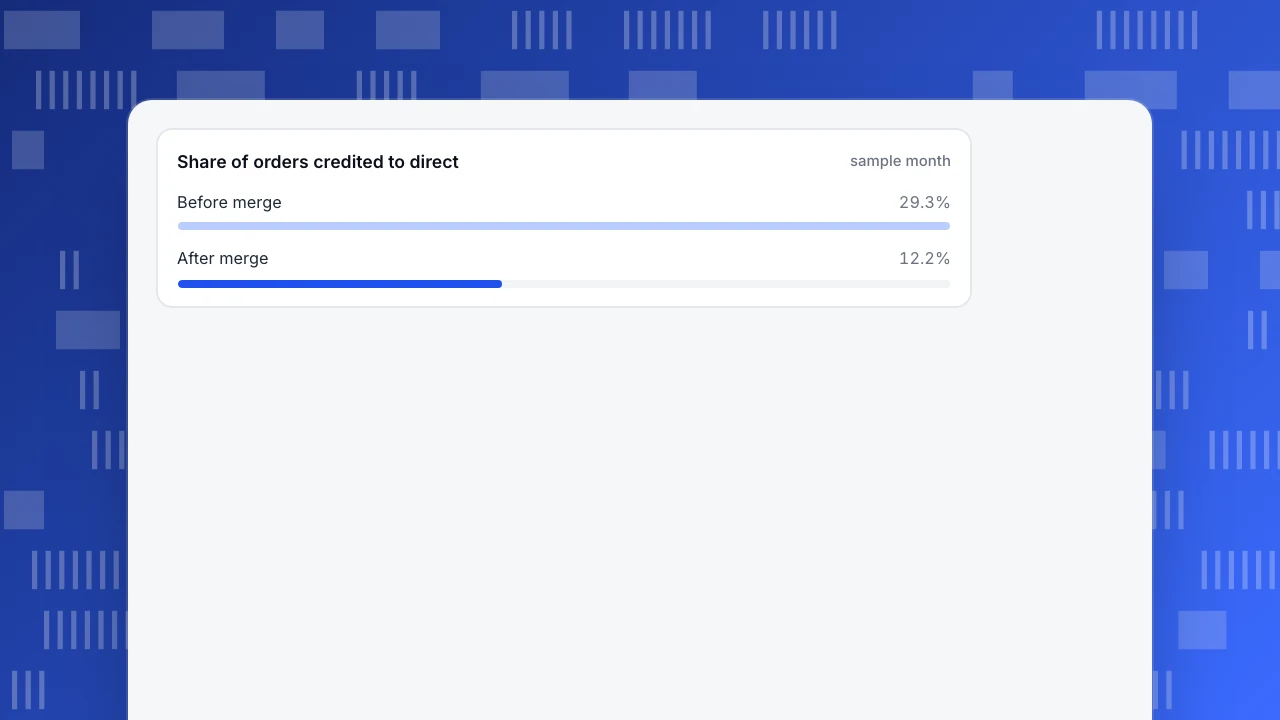
| Orders credited to "direct" | 120 (29.3%) | 50 (12.2%) |
| Orders credited to paid social | 40 | 70 |
| Orders credited to email | 35 | 60 |
| Orders credited to organic search | 85 | 100 |
| Orders from all other sources | 130 | 130 |
How to recompute: 410 ÷ 12,400 = 3.31% and 410 ÷ 8,900 = 4.61%; direct share is 120 ÷ 410 = 29.3% and 50 ÷ 410 = 12.2%. The 70 orders that left "direct" went to paid social (+30), email (+25) and organic search (+15), and 30 + 25 + 15 = 70. The other sources (130 orders) are unchanged, so each column still adds to 410.
What the merge changed is not revenue. The same 410 orders happened either way. It changed how many customers you think you have (28% fewer), the conversion rate you would report (39% higher, 4.61 ÷ 3.31 = 1.39), and which channels get credit. Before the merge, a marketer would have underinvested in paid social and email, because the people they influenced bought later on another device and showed up as direct.
The honest caveat is that the match is a rule, and rules can be wrong. Linking on a shared email is safe. Linking on a shared IP address is not: households and offices contain many people. Record which rule created each link so a bad rule can be undone.
Share of orders credited to direct
sample monthHow much does personalisation depend on this?
The usual business case for a CDP is personalisation: showing each person offers and messages based on what they have done across channels. McKinsey's research reports that 71% of consumers expect companies to deliver personalised interactions and 76% get frustrated when this does not happen, and that companies that excel at personalisation generate 40% more revenue from those activities than average players (McKinsey, "The value of getting personalization right, or wrong, is multiplying", 2021, checked 2026-11-21).
Treat those figures carefully. They are survey and modelling results from 2021, they describe companies that already had the data and the organisation to act on it, and they do not say that buying a platform produces the 40%. The platform supplies the profile. The lift comes from using it: segments that are defined well, messages that are written for them and a test that shows the difference. A CDP with no campaigns behind it is a database.
What does a CDP cost beyond the licence?
| Cost | What it is | How to estimate it |
|---|---|---|
| Licence | Usually priced by profiles, events or connected sources | Quote at your profile count after merge, not before |
| Integration | Sending each source's data in, and each destination's data out | Engineer days per source; add upkeep when an API changes |
| Identity rules | Deciding which IDs link people and testing them | Analyst time to define, sample and audit matches |
| Data quality | Naming, consent flags, de-duplication, schema drift | Ongoing; budget a few hours a week for the first quarter |
| Privacy and legal | Data processing agreement, deletion workflow, retention | See below |
| Change management | Teams must switch from their own lists to the shared profile | Training and a rule that new campaigns use shared segments |
Privacy deserves a plain note. Under the GDPR, personal data must be limited to what is necessary for the stated purposes (Article 5(1)(c)) and kept in identifiable form no longer than necessary (Article 5(1)(e)), and a controller may use only processors that offer sufficient guarantees, under a binding contract that covers things such as acting on documented instructions and deleting or returning data when the service ends (Article 28; text checked 2026-11-21). A unified profile makes deletion easier, because there is one place to delete from, but it also concentrates risk. A CDP that holds everything is a bigger target than ten systems that each hold a slice. Collect less, set retention by purpose and make sure deletion actually reaches every destination the profile was sent to.
When do you not need a CDP?
A CDP solves the problem of many sources and many destinations that must agree on who a person is. If you do not have that problem, it is overhead. Work through these questions:
- How many sources hold customer data with different IDs? One or two (say a web store and a support tool) usually need a good integration, not a platform. Four or more, especially including app, offline and a CRM, is the CDP case.
- How many tools must act on the same segments? If only your email tool does, build the segment in that tool. If email, ads, support and in-app messages must share audiences, a shared profile saves duplication.
- How many people are in the data? Under a few tens of thousands of profiles, a spreadsheet join or a warehouse query run weekly is often enough.
- Do you have someone to own identity rules and data quality? A CDP without an owner degrades. If nobody has the time, do not buy one.
- Is the real problem analytics, not activation? If you mainly need to understand behaviour and conversion across web and app, a product analytics tool with login-based identity may cover it.
If you answered "one or two sources, one destination, small data, nobody to own it", you do not need a CDP yet. If you answered the opposite on three or more, you probably do.
How does this work in TapCub?
TapCub is an analytics and live chat product, not a full CDP: it does not do email marketing or CRM, so the activation half of the CDP story happens in other tools. What it does cover is the identity and segment half, using the same sample.
- One project, one code. Web, app and mini-program data go into the same project and use the same event and user model, so the web store and the app in the sample sit in one place.
- Identify on login. Call
tapcub.loginwhen the person signs in. The first time a device binds to a login ID, that session and the device's earlier anonymous events receive the user ID. That is the merge rule: safe, because it needs a real login. Identified mode must be turned on for the project; the documentation says it needs a plan that includes it. - See the person. Open All-platform analytics › Users › People to see the profile and a day-by-day timeline of behaviour across devices that logged in. Visitors who never log in stay in aggregates and have no profile, so the count of people is only logged-in people.
- Reuse the segment. Define a segment once in All-platform analytics › Users › Segments & tags (rule, static or real-time) and use it in funnels, retention and other analysis.
- Look at orders by source. Compare channels in All-platform analytics › Behavior › Behavior analysis with the attribution model of your choice, so the "direct" share moves the way it did in the example.
Chat helps with the same problem: the live chat uses the same visitor ID, so an agent sees the visitor's source and recent pages without asking.
What mistakes make a CDP business case fall apart?
- Counting benefits that are really the data. Better attribution comes from merging IDs, which a warehouse and a good join also deliver. Be specific about what only the platform provides.
- Buying before choosing the first use case. Pick one concrete use, such as win-back emails to lapsed buyers, and measure it.
- Merging on weak keys. Shared IP address and device type create false matches.
- Ignoring consent. A profile that outlives its consent is a liability.
- Quoting the platform price on pre-merge profile counts. In the example 12,400 profiles become 8,900 people, 28% fewer.
FAQ
What are the benefits of a customer data platform?
The main benefits are one profile per person across web, app and orders, correct customer and conversion counts, better attribution when people switch devices, reusable segments for other tools, and one place to apply privacy requests. Each depends on matching people accurately.
What are the disadvantages of a CDP?
Costs include licence fees, integration work for each source and destination, identity-rule maintenance, data-quality upkeep, privacy and contract obligations, and team change. It also concentrates personal data in one place, which raises the importance of access control and retention.
What is the difference between a CDP and a CRM?
A CRM stores relationships a sales or service team manages by hand, usually after someone becomes a lead. A CDP collects behavioural data automatically from many sources, including anonymous activity, and builds unified profiles for other tools to use. Many companies need both; they answer different questions.
Do small businesses need a CDP?
Usually not. With one or two data sources, a single destination and modest volume, a good integration or a periodic join is enough. Consider a CDP when four or more sources must agree on identity and several tools must act on the same segments.
How does identity resolution work?
The platform links records that share an identifier, such as a login ID or a hashed email, into one profile. Deterministic links, like a shared login, are reliable. Probabilistic links, like similar device and location, can be wrong. Keep a record of which rule created each link.
Sources
- McKinsey: The value of getting personalization right, or wrong, is multiplying, 2021, checked 2026-11-21
- GDPR Article 5: Principles relating to processing of personal data, checked 2026-11-21
- GDPR Article 28: Processor, checked 2026-11-21
Was this article helpful?
We use your answers to fix and expand this page.
Couldn’t send. Please try again in a minute.
Thanks for the feedback. We’ll use it to improve this page.You’ve already sent feedback on this page. Thanks.

Data Engineer
Writes about event design, data quality, and collection workflows, with verifiable implementation methods for reliable analytics.