Try it on your own data
Every report in this article is in the free plan. One snippet for web and apps, up to 10 sites.
Start freeA thank-you note for a purchase thanks the buyer, confirms what happens next with a date, and gives one way to reach you, in two to four sentences. Keep promotions out of order and shipping messages, because under CAN-SPAM they can turn a transactional email into marketing. In the sample here, a note three days after delivery lifted repeat orders from 9.5% to 13.1%.
What you will learn
- Thank, confirm what happens next, give one next step; a promotion inside the note can make it marketing under CAN-SPAM
- Send at the moments the buyer is wondering: order placed, shipped, delivery plus 3 days, delivery plus 10 days
- In the sample, day 3 beat no note (13.1% vs 9.5%, z = 2.54) but not the same-day email (z = 1.87): small groups cannot rank close timings
What must a thank-you note for a purchase do?
A thank-you note for a purchase has three jobs: thank the buyer, confirm what happens next, and leave one easy next step. Anything beyond that, especially a sales pitch, is a different message. A note that does the three jobs in three or four sentences is better than a warm paragraph that leaves the buyer wondering when the parcel arrives.
There is also a legal reason to keep it plain. In the United States, the FTC's CAN-SPAM compliance guide treats an email as transactional or relationship-related only if its content facilitates, completes or confirms a transaction the recipient already agreed to (or covers warranty, safety, account changes or delivery of what was bought). Such messages are exempt from most of the Act's requirements, but the FTC says the categories are read narrowly. Once you add commercial content, such as a discount for the next order, the primary purpose can become commercial and the full rules apply: a working opt-out honoured within 10 business days, and penalties of up to $53,088 for each separate email in violation. If the note is a receipt with a thank-you line, you are fine. If it is a promotion with a thank-you line, treat it as marketing.
When should you send it?
Send one message at each moment the buyer is wondering about something, and let the thank-you ride on the message that is already expected. There are four moments:
| Moment | The buyer is wondering | What to include |
|---|---|---|
| Order placed | Did it go through? | Thanks, order number, what was ordered, when to expect the next message |
| Shipped | Where is it? | Thanks, carrier, tracking link, delivery estimate |
| Delivered, plus about 3 days | Is it what I expected? | A short thanks, how to reach you, how to get help |
| About 10 days after delivery | Do I want more? | A thank-you with one useful tip, and only here a soft mention of the next purchase |
For shipping delays there is a rule, not just etiquette. The FTC's business guide to the Mail, Internet, or Telephone Order Merchandise Rule says that if you make no clear shipment promise you must reasonably believe you can ship within 30 days of receiving the order, and that a delay notice must give a firm new date (or say you cannot), explain the right to cancel for a full refund and offer a way to cancel at your expense; if the new date is more than 30 days away, or unknown, the order is cancelled automatically when the buyer does not respond. A "thank you for your patience" line does not replace that notice.
| Moment | The buyer is wondering | What to include |
|---|---|---|
| Order placed | Did it go through? | Thanks, order number, items, when the next message comes |
| Shipped | Where is it? | Thanks, carrier, tracking link, delivery estimate |
| Delivered plus about 3 days | Is it what I expected? | Short thanks, how to reach you, how to get help |
| About 10 days after delivery | Do I want more? | Thanks with one useful tip; a soft mention of the next purchase only here |
Keep promotions out of order and shipping notes.
Which template fits which situation?
Twelve templates, grouped by moment. Replace the brackets; keep each to two to four sentences.
Around the order
- Order placed. "Thank you for your order, [Name]. Order [#] is confirmed: [items]. We will email you when it ships, usually within [X] days."
- Shipped. "Your order is on its way, thank you. Track it here: [link]. Expected delivery: [date]. Reply to this email if anything looks wrong."
- Delayed. "Thank you for your order. It will ship on [new date], later than we promised. You can keep the order or cancel for a full refund: [link]. We are sorry for the wait."
After delivery
- Delivery check-in. "Your order arrived on [date]. Thank you for choosing us. If something is not right, reply here and a person will help within [X] hours."
- First purchase. "Thank you for your first order, [Name]. If you have questions about setting up [product], [link] is the quickest place to start."
- Repeat customer. "Welcome back, [Name], and thank you for ordering again. If there is anything we can do better than last time, reply and tell us."
- Tip after use. "Thank you for your order. A tip many buyers find useful with [product]: [one concrete tip]. Reply if you would like help."
Special cases
- High-value order. "Thank you for trusting us with [item], [Name]. I have checked the order personally and it ships on [date]. My direct line is [contact]."
- Gift purchase. "Thank you for your order. The gift will arrive with no price on the packing slip, as requested. We have not contacted [recipient name], so the surprise is safe."
- Digital product. "Thank you for your purchase. Your download is ready at [link]; it stays available in your account. Reply if the file does not open."
- Subscription start. "Thank you for subscribing. Your first delivery is [date], then every [period]. You can pause or cancel any time from [link]."
- Handwritten insert. "Thank you for ordering from us. We packed this ourselves. If anything is wrong, write to [contact] and we will fix it."
What should you avoid in the note?
Avoid anything that makes the buyer work, doubt or feel sold to. A short checklist:
- No pitch in a transactional message. Keep discount codes and cross-sells out of the order and shipping notes (see the legal point above). If you want to promote, send a separate message after delivery.
- No vague promises. "Soon" is not a date. Give the day, or the range, as in templates 1 and 2.
- No no-reply address. The buyer should be able to reply to ask about the order.
- No false urgency or guilt. "Don't miss out" does not belong in a thank-you.
- No more than one ask. One link, one reply address, one next step.
For a note in the parcel, write it for the person, not the template: use the name, one specific detail from the order and one sentence. Handwritten beats printed only if it really is handwritten.
Does the timing of the thank-you change repeat purchases?
It might, and you can measure it, but only if you compare like with like. The metric is the repeat purchase rate: the share of first-time buyers who place a second order within a fixed window, here 60 days.
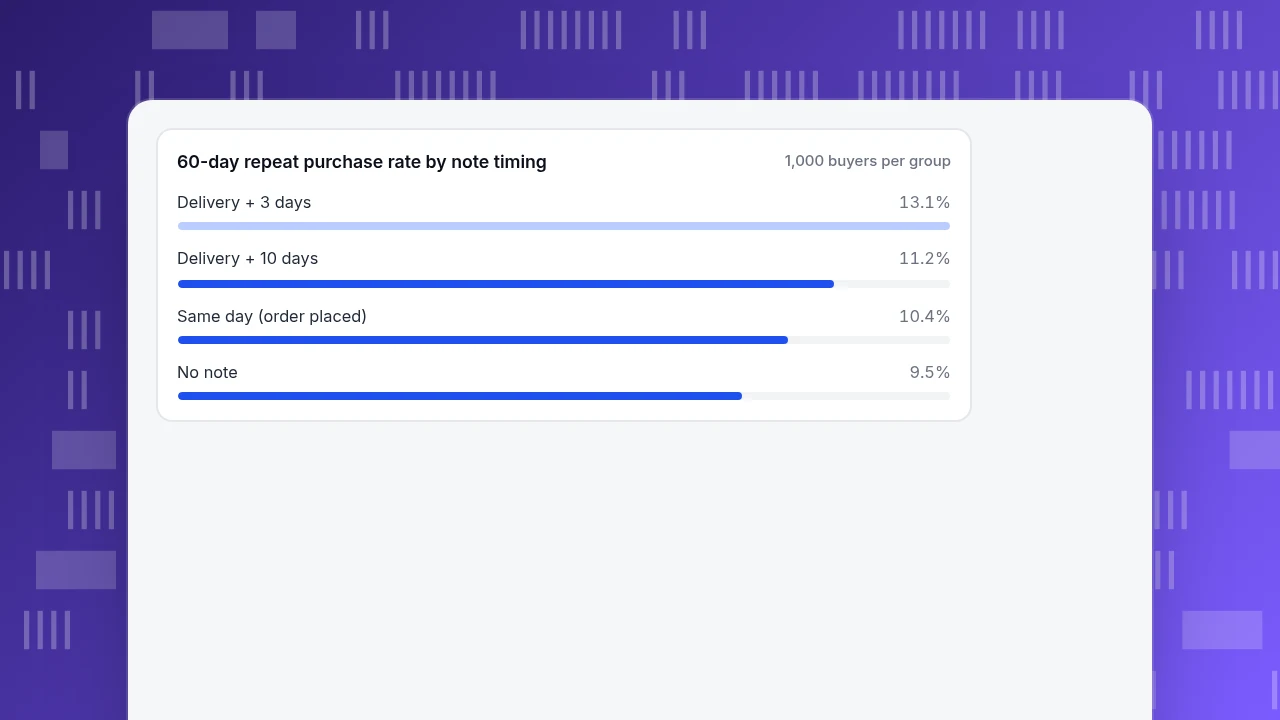
Sample data: 4,000 first-time buyers, split into four groups of 1,000 by when a thank-you note was sent.
| Group | Note timing | Second orders in 60 days | Repeat rate |
|---|---|---|---|
| A | None (receipt only) | 95 | 9.5% |
| B | Order-placed email, same day | 104 | 10.4% |
| C | Delivery plus 3 days | 131 | 13.1% |
| D | Delivery plus 10 days | 112 | 11.2% |
Compare C with A with the two-proportion z-test from the NIST/SEMATECH e-Handbook. The pooled rate is (131 + 95) ÷ 2,000 = 11.3%, the standard error is √(0.113 × 0.887 × (1/1,000 + 1/1,000)) = 0.01416, and z = (0.131 − 0.095) ÷ 0.01416 = 2.54. That is above 1.96, so the 3.6-point gap (a 37.9% relative lift) is unlikely to be chance; the 95% interval for the gap runs from +0.8 to +6.4 points.
Now the honest part. C against B (the same-day email) gives z = 1.87, and D against A gives z = 1.25. Neither reaches 1.96, so with 1,000 buyers per group you cannot say that the day-3 note beats the same-day one, or that the day-10 note beats none. To detect a difference between 10.4% and 13.1% reliably (5% significance, 80% power) you would need about 2,230 buyers per group, using the usual normal approximation. Do not rank all four timings from one small test.
60-day repeat purchase rate by note timing
1,000 buyers per groupHow do you keep a timing test honest?
Three rules. First, assign groups before the message goes out, by order number (odd or even) or at random, not by who opened an earlier email; otherwise your most engaged buyers all land in one group and the lift is selection, not timing. Second, fix the window in advance (60 days from delivery, say) and count only orders after the note. Third, keep a no-note group until you are sure the note itself, not the calendar, drives the difference. If the groups differ in anything else, such as a sale that ran for one of them, write that down before you read the result.
How to measure thank-you timing in TapCub
Use the sample above: first-time buyers, four note timings and a 60-day repeat rate. TapCub does not send the notes, so you send them from your email or shop system and use TapCub to count what happened afterwards.
- Tag the links in each note with campaign parameters, for example
utm_medium=email&utm_campaign=thanks-day3. Visits from each note then show up by campaign in Web analytics › Sources, so you can see which timing brings buyers back to the site. - Make sure buyers are identified. Call
tapcub.loginwhen a customer signs in, so that purchases from one person are connected and appear in All-platform analytics › Users › People, with a time-ordered history in the profile. - Build a group for "bought two or more times in 60 days" in All-platform analytics › Users › Segments & tags, using the rule "did the purchase event, at least twice, in the last 60 days", and review the revenue in All-platform analytics › Business › Commerce & revenue.
- Look at All-platform analytics › Behavior › Behavior analysis retention for the buyers of one week, to see how many return in later weeks, and compare weeks that used different note timings.
- For buyers who write in on chat, save a short thank-you in Live chat › Canned replies: type
/to insert it and edit it before sending.
TapCub measures the effect; it does not run the test split for you, so assign the groups on your side before sending.
FAQ
What do you write in a thank-you note for a purchase?
Thank the buyer by name, confirm what was ordered, say what happens next with a date, and give one way to reach you. Three or four sentences are enough. Leave out discount codes and cross-sells in order and shipping messages; promotional content can turn a transactional email into marketing under CAN-SPAM.
When should you send a thank-you note after a purchase?
Send a short thanks with the order confirmation, another with the shipping notice, and a check-in about three days after delivery. A slower follow-up, around 10 days after delivery, is the place for a useful tip or a soft mention of the next purchase. Measure your own repeat rate by timing before you settle.
Is a thank-you email after purchase a marketing email?
Not if it only confirms or completes the transaction, delivers what was bought, or gives warranty or account information. The FTC says such transactional messages are exempt from most CAN-SPAM provisions but are read narrowly, so adding promotions can make the primary purpose commercial and bring the full requirements, including honouring opt-outs within 10 business days.
Do thank-you notes increase repeat purchases?
They can, but you need a fair test. In the sample here, a note three days after delivery lifted the 60-day repeat rate from 9.5% to 13.1% (z = 2.54). Assign groups before sending, fix the window and keep a no-note group, and use a bigger sample before ranking close timings.
How long should a thank-you note for a purchase be?
Two to four sentences. One for the thanks, one for what happens next, one for how to get help. If it needs a paragraph, it probably contains information that belongs in a different message, such as a shipping update or a how-to.
Sources
- FTC, CAN-SPAM Act: A Compliance Guide for Business (transactional or relationship messages; penalties up to $53,088 per email; opt-out within 10 business days). Checked 2026-11-22.
- FTC, Business Guide to the Mail, Internet, or Telephone Order Merchandise Rule (30-day shipment basis and delay notices). Checked 2026-11-22.
- NIST/SEMATECH, e-Handbook of Statistical Methods: Do two batches have the same proportion of defects? (two-proportion z-test). Checked 2026-11-22.
Was this article helpful?
We use your answers to fix and expand this page.
Couldn’t send. Please try again in a minute.
Thanks for the feedback. We’ll use it to improve this page.You’ve already sent feedback on this page. Thanks.

Product Experience Specialist
Explores usability, user journeys, and feature adoption through practical examples of onboarding and everyday product use.