Try it on your own data
Every report in this article is in the free plan. One snippet for web and apps, up to 10 sites.
Start freeAdvertising appeals are the reasons an ad gives people to act: rational, emotional, fear, humor, social proof, scarcity and authority. Test them one at a time with the same offer and landing page, and judge them by orders and cost per order, not clicks. In the sample here, the fear ad had the highest click rate (1.90%) and the worst order rate (1.69%).
What you will learn
- Seven appeals cover most ads; change one at a time and keep the offer, page and budget equal
- Fear and scarcity claims must be true: the FTC test is whether a reasonable consumer is likely to be misled on a material point
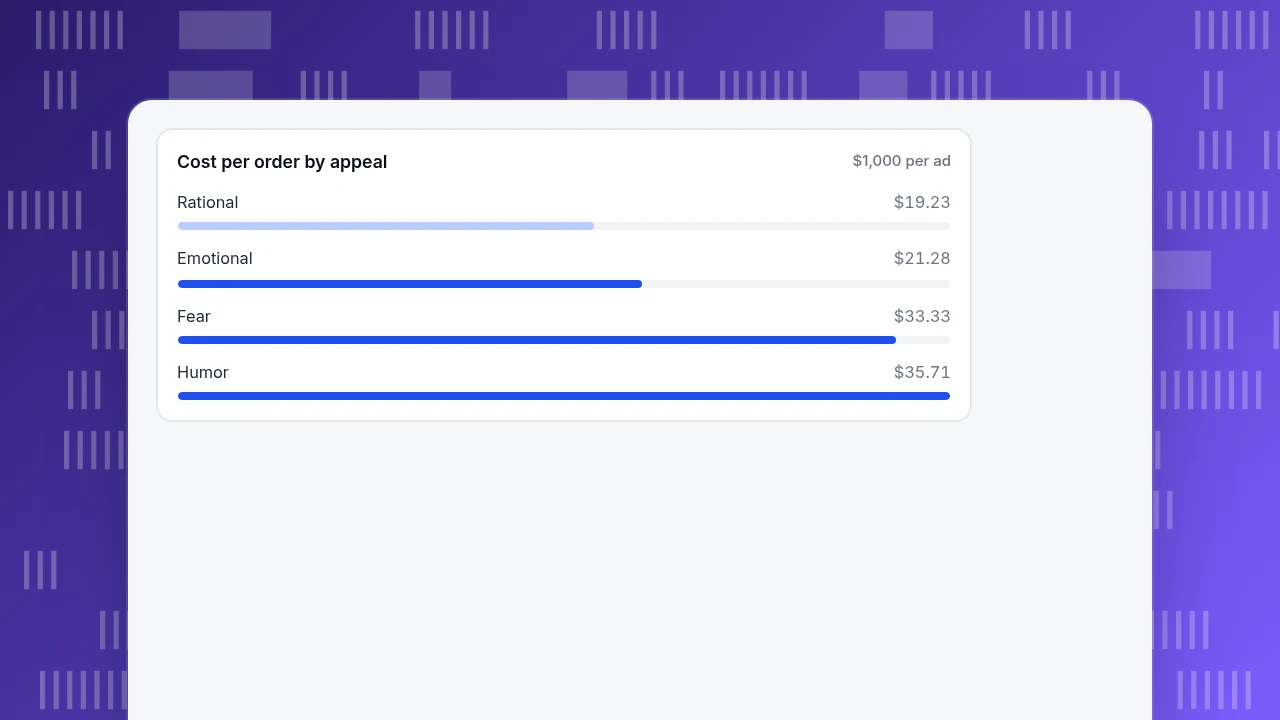
- In the sample, the lowest-CTR ad (rational, 1.10%) had the lowest cost per order ($19.23) against $33.33 for fear
What are advertising appeals?
An advertising appeal is the reason an ad gives the audience to act: the angle it uses to persuade. The oldest classification comes from Aristotle's Rhetoric, which names three modes of persuasion: the character of the speaker (ethos), the emotional state of the hearer (pathos), and the argument itself (logos), as the Stanford Encyclopedia of Philosophy summarises them. Modern lists split these into finer types, but they all trace back to the same three questions: can I trust you, how does this make me feel, and does the case hold up?
The useful way to think about an appeal is as a testable variable. Two ads for the same product with different appeals are two hypotheses about what moves your audience. You do not need a theory to pick the winner; you need clean measurement, which is most of this article.
What are the main types of advertising appeals?
Seven types cover most ads. The examples below are original lines for an imaginary project-management app.
| Appeal | What it asks of the reader | Example line | Works best when | Watch out for |
|---|---|---|---|---|
| Rational (logic) | Compare facts and decide | "Plans start at $12 per user. Cancel any time." | The buyer is comparing options, or the price is the point | Reads as flat if there is no difference to show |
| Emotional | Feel something about the outcome | "Finish Friday with nothing left on your mind." | The product changes how people feel (relief, pride, belonging) | Vague emotion with no product link is forgotten |
| Fear | Avoid a loss or danger | "Every missed deadline is a client you may not get back." | The risk is real and the product reduces it | Clicks without trust; claims must be true and provable |
| Humor | Enjoy it and remember it | "Our inbox has 4,000 unread messages. Yours does not have to." | Awareness stage, low-risk products | The joke is remembered and the product is not |
| Social proof | Follow the crowd | "Used by 3,000 teams." (only if true and dated) | The category is crowded and trust is the barrier | Numbers must be real, specific and current |
| Scarcity and urgency | Act before it ends | "Launch price ends Sunday." | There is a real deadline or limit | A fake countdown destroys trust and can be deceptive |
| Authority and credibility | Trust the source | "Built by a team that has run support for ten years." | New or unfamiliar brands | Unprovable superlatives |
Most strong ads mix two: a rational anchor (what it is, what it costs) with one emotional or credibility angle. For a clean test, change one appeal at a time and hold the product, offer and landing page constant.
| Appeal | Works best when | Watch out for |
|---|---|---|
| Rational | The buyer compares options; price is the point | Flat if there is no difference to show |
| Emotional | The product changes how people feel | Vague emotion with no product link |
| Fear | The risk is real and the product reduces it | Clicks without trust; claims must be provable |
| Humor | Awareness stage, low-risk products | Joke remembered, product not |
| Social proof | Crowded category, trust is the barrier | Numbers must be real, specific and current |
| Scarcity | There is a real deadline or limit | A fake countdown is deceptive |
| Authority | New or unfamiliar brands | Unprovable superlatives |
Original example lines for each appeal are in the article.
What rules limit these appeals?
The FTC's Policy Statement on Deception says a representation, omission or practice is deceptive when it is likely to mislead a reasonable consumer and the misleading part is material to the purchase decision. That does not ban fear, urgency or humor, but it limits how you use them:
- A fear appeal must be about a risk that exists. "Your data may be exposed" needs a basis.
- A scarcity appeal must reflect real scarcity. A countdown that resets for every visitor can be a misleading practice, whatever the creative looks like.
- A social proof appeal must be true, specific and current. "Used by 3,000 teams" needs a count you can show, and a date.
- A comparative claim ("faster than...") needs evidence you hold before running the ad, and naming a competitor adds legal risk. This article does not recommend naming anyone.
If your appeal could not survive the sentence "show me how you know," change the appeal.
Which appeal wins? Test it, and read both CTR and conversion
The appeal that gets the most clicks is often not the one that gets the most orders. Click-through rate (clicks ÷ impressions) measures attention. Conversion rate on the landing page, and cost per order, measure whether the people you attracted were the right ones. Read all three.
Sample data: four ads for the same offer, each shown 100,000 times with $1,000 of spend. Clicks and impressions come from the ad platform, sessions and orders from your analytics.
| Appeal | Clicks | CTR | Sessions | Orders | Order rate (orders ÷ sessions) | Cost per click | Cost per order |
|---|---|---|---|---|---|---|---|
| Rational | 1,100 | 1.10% | 1,034 | 52 | 5.03% | $0.91 | $19.23 |
| Emotional | 1,500 | 1.50% | 1,410 | 47 | 3.33% | $0.67 | $21.28 |
| Fear | 1,900 | 1.90% | 1,770 | 30 | 1.69% | $0.53 | $33.33 |
| Humor | 1,650 | 1.65% | 1,540 | 28 | 1.82% | $0.61 | $35.71 |
On the ad platform, fear looks like the winner: the highest CTR and the cheapest click. In the store it is the opposite. Fear produced 30 orders at $33.33 each, against 52 orders at $19.23 for the rational ad, which had the lowest CTR of the four. The ad that attracted the fewest clicks attracted the people who bought.
Check the differences with the two-proportion z-test from the NIST/SEMATECH e-Handbook, z = (p̂₁ − p̂₂) ÷ √(p̂(1 − p̂)(1/n₁ + 1/n₂)), where a value above 1.96 means a 5% significance level:
- CTR, fear against humor: 1.90% vs 1.65%, z = 4.23. A real difference in attention.
- CTR, fear against emotional: 1.90% vs 1.50%, z = 6.92.
- Order rate, rational against fear: 5.03% vs 1.69%, z = 5.06. A real difference in who converts.
- Order rate, rational against emotional: 5.03% vs 3.33%, z = 2.10. Just over the line; treat it as probably real but not certain with 1,000 to 1,400 sessions each.
The lesson is not that rational beats fear, which is a statement about this sample. It is that the metric you optimise decides the winner, and that the decision metric should be the one closest to money: orders and cost per order.
Cost per order by appeal
$1,000 per adWhat makes an appeal test fail?
Four things spoil most appeal tests. Changing two things at once: a new appeal and a new offer cannot be separated afterwards. Unequal audiences: if the fear ad ran on a colder audience, its low order rate says nothing about the appeal. Stopping early: a lead after two days often disappears by day ten, so set the number of impressions or sessions in advance. Judging by the platform's own conversion count alone: platforms and your analytics count differently, so use the analytics side for orders and keep the platform for impressions and clicks.
How do you set up the measurement?
Give every ad its own tag, and let the analytics side count what the ad platform cannot. Campaign tags are part of the URL. Google's documentation lists five: utm_source for where the traffic comes from, utm_medium for the channel type (cpc, banner, email), utm_campaign for the promotion, utm_content to differentiate creatives, and utm_term for the paid keyword. For an appeal test:
- Same
utm_source,utm_mediumandutm_campaignfor all four ads. - A different
utm_contentper appeal:rational,emotional,fear,humor. - The same landing page, offer and price for all four. Change one thing.
- Equal budgets, equal audience and the same dates, so that differences come from the appeal.
- Stop at a pre-set number, such as 100,000 impressions each or 1,000 sessions each, not when one line looks ahead.
How to measure appeals in TapCub
Use the four-ad example above. TapCub does not buy ads, split traffic or serve variants, so the ad platform runs the test; TapCub's part is what happens after the click.
- Add the
utm_contenttag to each ad URL. In Web analytics › Sources, break visits down by UTM parameters to see sessions per appeal. - Define the order or sign-up as a goal in Web analytics › Goals, so each appeal's conversions are counted from the same place as its sessions.
- Import your ad spend per campaign and day in All-platform analytics › Business › Channel ROI, by CSV or entry by entry. The page then shows cost per click (spend ÷ sessions), cost per acquisition (spend ÷ purchases) and return on ad spend, grouped by campaign.
- Compare the order rate for each
utm_contentin step 1, and run the z-test above on the counts. - If a landing page keeps losing the visitors an appeal attracts, look at where on the page they leave in All-platform analytics › Behavior › Heatmaps.
Real bots can distort ad-driven traffic; TapCub counts recognised crawlers separately from people, so the order rate above is not diluted by them.
FAQ
What are the types of advertising appeals?
The common ones are rational (facts and price), emotional (feelings about the outcome), fear (avoiding a loss), humor, social proof (others use it), scarcity or urgency (limited time or stock) and authority or credibility (trust in the source). They descend from Aristotle's three modes: logos, pathos and ethos.
What is an example of an emotional appeal in advertising?
A line such as "Finish Friday with nothing left on your mind" appeals to relief rather than to features. Emotional appeals work when the emotion is tied to what the product actually does. If the feeling could be attached to any product, it will be remembered without driving sales.
Does fear advertising work?
It can win attention: in the sample here, the fear ad had the highest click rate (1.90%). It did not win orders: 1.69% of its visitors bought, against 5.03% for the rational ad. The FTC also requires that claims be truthful and not misleading, so a fear appeal needs a real risk behind it.
How do you test which advertising appeal works best?
Run versions with one changed variable, equal budgets, the same landing page and different utm_content tags. Compare CTR from the ad platform and order rate and cost per order from your analytics, and test differences with a two-proportion z-test. Stop at a number you set beforehand.
What is the difference between rational and emotional appeals?
A rational appeal gives facts, prices or comparisons to support a decision, such as "plans start at $12 per user". An emotional appeal ties the product to a feeling, such as relief or pride. Many ads use both, with the facts as an anchor and one emotion as the hook.
Sources
- Stanford Encyclopedia of Philosophy, Aristotle's Rhetoric (the three modes of persuasion: ethos, pathos, logos). Checked 2026-11-22.
- FTC, FTC Policy Statement on Deception (October 14, 1983). Checked 2026-11-22.
- Google, Analytics Help: Campaign URL parameters (utm_source, utm_medium, utm_campaign, utm_content, utm_term). Checked 2026-11-22.
- NIST/SEMATECH, e-Handbook of Statistical Methods: Do two batches have the same proportion of defects? (two-proportion z-test). Checked 2026-11-22.
Was this article helpful?
We use your answers to fix and expand this page.
Couldn’t send. Please try again in a minute.
Thanks for the feedback. We’ll use it to improve this page.You’ve already sent feedback on this page. Thanks.

Product Analyst
Focuses on event analysis, conversion funnels, and retention, using clear metric definitions and structured analysis to explain product performance.