Try it on your own data
Every report in this article is in the free plan. One snippet for web and apps, up to 10 sites.
Start freeA restaurant chatbot is a website chat assistant that finishes routine guest questions (hours, address, menu) and hands bookings, allergies and complaints to a person. In a sample month it handled 651 of 1,200 conversations, 54.3%, almost all of them fact questions. Below: which flows to build first, how to handle allergens, how to disclose the bot, and five KPIs you can recompute.
What you will learn
- Automate fact questions first: hours and address finish at 92% in the sample, complaints at 5%
- Never let the bot declare a dish safe: the FDA sets no threshold for any allergen, so quote the menu and route to staff
- Prove value with five numbers, from handled-without-staff rate to chat-to-booking (30.1% in the sample)
What can a restaurant chatbot actually do?
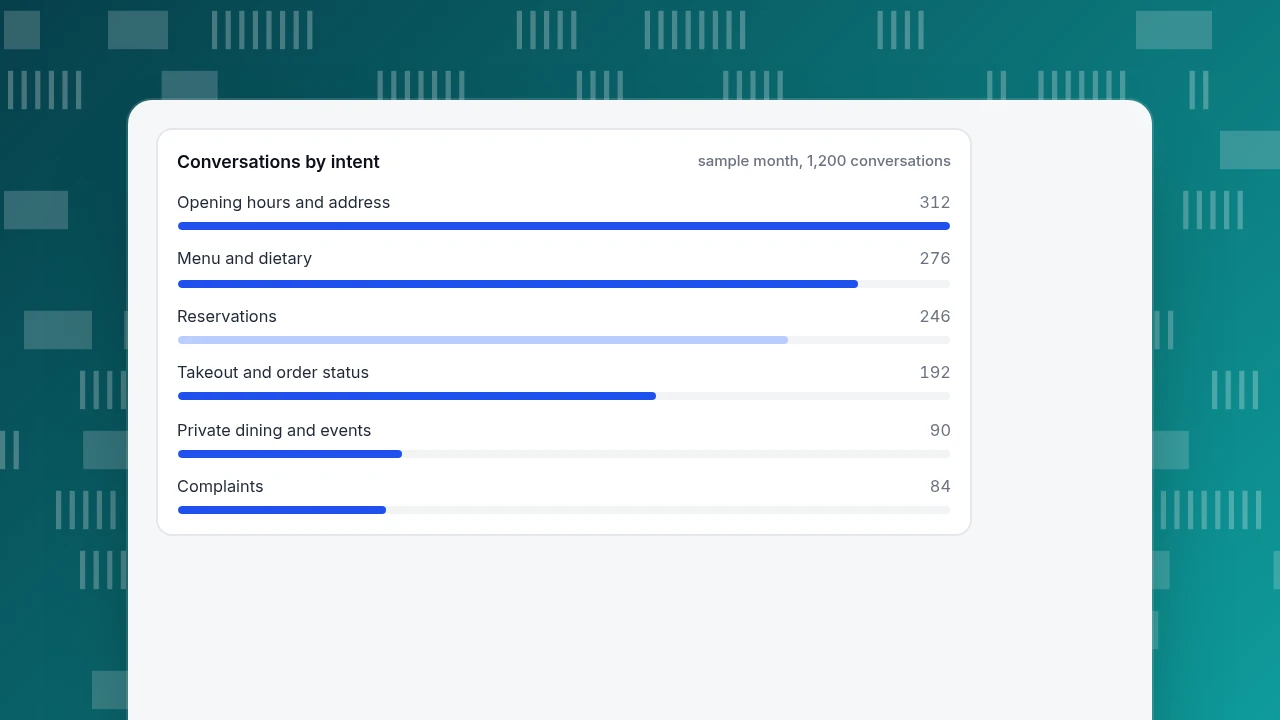
A restaurant chatbot is a chat window on your website that answers the questions guests ask before they come, and hands the rest to a person. In practice there are six jobs, and they are not equally automatable. The table below uses one sample month of 1,200 conversations to show how the questions split and how many a bot can finish without staff.
| Intent | Conversations | Share | Bot finishes alone | Handled without staff |
|---|---|---|---|---|
| Opening hours and address | 312 | 26% | 92% | 287 |
| Menu and dietary questions | 276 | 23% | 75% | 207 |
| Reservations | 246 | 20.5% | 35% | 86 |
| Takeout and order status | 192 | 16% | 30% | 58 |
| Private dining and events | 90 | 7.5% | 10% | 9 |
| Complaints | 84 | 7% | 5% | 4 |
| Total | 1,200 | 100% | 651 (54.3%) |
Sample data: the volumes and completion rates are illustrative, not a benchmark. The pattern is the useful part. Fact questions (hours, address, parking, menu) are cheap to automate because the answer is the same every time. Reservations, orders and complaints are not fact questions: they need a booking system, a kitchen or a person with authority, and a chat window alone cannot supply any of those.
Conversations by intent
sample month, 1,200 conversationsWhich flows should you build first?
Build in order of volume times ease. With the sample above, that gives three stages:
- Facts first. Hours, address, parking, accessibility, dress code, group size limits. These make up 26% of conversations and finish at 92%. Write one short answer per question and test each against how guests actually phrase it ("are you open Sunday", "what time do you close").
- Menu and dietary next. 23% of conversations. Answer only from the published menu: what dishes contain, what is vegetarian, whether a dish can be made without an ingredient if the kitchen has said so in writing. Anything outside the menu text goes to staff.
- Reservations as a handoff to your booking page. A chatbot that links to the booking page, with the party size and date it already heard, is a reservation flow. A chatbot that promises a table without checking availability is a liability. In the sample, 246 reservation conversations produced 118 clicks to the booking page and 74 confirmed bookings.
Leave orders and complaints for later, and keep complaints human from the start. A complaint answered by a bot that cannot refund or apologize with authority is an escalation waiting to happen.
How should the bot handle allergens?
Treat allergen questions as a boundary, not a feature. The U.S. FDA recognises nine major food allergens: milk, eggs, fish, crustacean shellfish, tree nuts, peanuts, wheat, soybeans and sesame. It also states that "may contain" advisory statements are voluntary and that it has not established a threshold level for any allergen. Those two facts mean a bot cannot safely improvise: there is no number it can quote that makes a dish "safe".
A workable rule:
- If the question names an allergen, answer only with the ingredient list or allergen statement you have published for that dish, and say it is from the menu.
- Always add the next step: "Please tell your server about any allergy when you order", plus the phone number or a one-tap handoff to staff.
- Never answer "is it safe for someone with a nut allergy" in the bot. Route to a person every time.
- Log every allergen conversation, so someone reviews them weekly for answers that drifted.
The legal logic is the same as for any business chatbot. A Canadian tribunal held an airline responsible for incorrect information its chatbot gave a customer (Moffatt v. Air Canada, 2024 BCCRT 149). Whatever the bot says is something you said.
How do you disclose that it is a bot?
Say so in the first message: "Hi, I'm the restaurant's virtual assistant. A person can step in anytime." This is good practice everywhere and, for AI systems that talk to people in the EU, a legal duty: Article 50(1) of the EU AI Act requires that people are informed they are interacting with an AI system, unless it is obvious from the context. Check the dates and exemptions that apply to you. The same first message should tell guests how to reach a person fast, because the phone is still how many guests book.
What should the first replies say?
Write four short scripts before you switch the bot on, and test each against five real messages from your inbox or voicemail:
- Greeting. "Hi, I'm the restaurant's virtual assistant. I can help with hours, the menu and booking links. Type 'person' at any time to reach our team." One sentence on what it can do keeps guests from asking for things it cannot do.
- Hours answer. "We are open Tuesday to Sunday, 5 to 10 pm. Last seating is 9:30 pm. Holiday hours are on the Hours page." State the last seating, because "when do you close" usually means "can we still get in".
- Booking handoff. "Tables for 4 on Friday are booked on our reservation page: [link]. For parties of 9 or more, leave your email and we will reply today." The party-size threshold is the rule where the bot stops and a person starts.
- Out-of-scope reply. "I can't answer that one, but our team can. Leave your email and question and we will reply by 11 am." A reply with a deadline gets fewer repeat messages than "someone will get back to you".
Review the transcripts for the first two weeks. Questions the bot missed twice become new knowledge-base entries; questions it answered but guests repeated mean the wording is unclear.
Which numbers show it works?
Five numbers, each with a formula you can recompute from the sample month:
| Metric | Formula | Sample result |
|---|---|---|
| Handled-without-staff rate | handled ÷ conversations | 651 ÷ 1,200 = 54.3% |
| Staff time returned | handled × minutes per conversation | 651 × 3 min = 32.6 hours |
| Booking click-through | clicks ÷ reservation conversations | 118 ÷ 246 = 48.0% |
| Booking completion | confirmed ÷ clicks | 74 ÷ 118 = 62.7% |
| Chat-to-booking | confirmed ÷ reservation conversations | 74 ÷ 246 = 30.1% |
The 3 minutes per conversation is an assumption: time a host or manager would otherwise spend on a short call or message. Measure your own with a week of timing. "Handled" must mean the guest did not need staff afterwards, so count a conversation as handled only if no handoff and no repeat contact within 24 hours followed. And the booking numbers only exist if the confirmation page or booking system sends an event back to your analytics. Without it you know how many guests chatted, not how many came.
| Intent | Conversations | Bot finishes alone | What the bot should do |
|---|---|---|---|
| Opening hours and address | 312 | 92% | Answer from a reviewed fact |
| Menu and dietary questions | 276 | 75% | Quote the published menu only |
| Reservations | 246 | 35% | Link to the booking page with date and party size |
| Takeout and order status | 192 | 30% | Link to ordering or hand off |
| Private dining and events | 90 | 10% | Collect details, hand off |
| Complaints | 84 | 5% | Hand off at once |
Sample data: illustrative volumes and completion rates for one month of 1,200 conversations.
Where does the chatbot fail?
Four failure patterns, each with a fix you can test in a week:
- Stale facts. The holiday hours changed and the bot still says Monday is open. Put a review date on every answer and update the knowledge base the same day you update the website and the Google listing.
- Dead-end reservation replies. The bot says "book on our website" with no link. Always include the link and, when you know them, date and party size.
- After-hours silence. Many questions arrive when nobody is in. Set working hours and a message form, so the guest leaves an email and you see it in the morning.
- Handoff loops. The bot keeps trying after the guest typed "person". Hand off on the first request.
How to measure it in TapCub
Suppose the restaurant site above installs TapCub. The measuring side looks like this. TapCub does not take reservations or orders and does not connect to a POS or booking system: it answers fact questions from your knowledge base, passes everything else to staff, and measures what happens afterwards.
- Turn chat on. If the TapCub script is already on the site, switch on live chat in Live chat › Chat settings › Appearance. No site code changes. Set opening hours in Live chat › Chat settings › Office hours and enable Live chat › Chat settings › Offline messages so after-hours guests can leave an email and a question.
- Load the fact answers. In Live chat › Knowledge base, add the hours, address, parking and menu answers as Q&A entries. A matching Q&A is sent as written and does not use an AI call; a pinned Q&A shows in the visitor's FAQ without opening a conversation, so it does not inflate your conversation count.
- Pick the AI mode. In Live chat › Chat settings › AI assistant, choose whether the AI answers only when all agents are offline or answers first. It only drafts replies from the knowledge base; it does not book, change an order or send email. Keep allergen answers as Q&A entries so they are word-for-word.
- Count the booking. Make the booking confirmation page, or a
reservation_confirmedevent sent from your server, a goal in Web analytics › Goals. - Compare chatted and not chatted. Live chat › Reports › Conversion attribution compares visitors who chatted with those who did not, by day, and shows which pages conversations started on. With fewer than 30 chatted visitors it warns that the sample is small. Treat the gap as an upper bound, because people who choose to chat are often already closer to booking.
FAQ
What is a restaurant chatbot?
A restaurant chatbot is an automated chat assistant on a website, messaging app or phone line that answers guest questions about hours, menu, location and bookings, and passes complex or sensitive requests to staff. Its value is the share of routine questions it finishes alone.
Can a chatbot take restaurant reservations?
Only if it is connected to a booking system that checks availability. Otherwise it should send the guest to the booking page with the date and party size it already heard. Promising a table it cannot confirm creates no-shows and complaints.
Is it safe to let a chatbot answer allergy questions?
Only to quote published menu information and to tell the guest to inform staff. The FDA has set no threshold for any allergen, so a bot cannot declare a dish safe. Route every "is it safe for" question to a person.
How much staff time does a restaurant chatbot save?
In the sample month it handled 651 of 1,200 conversations, about 32.6 hours at 3 minutes each. Your figure depends on your question mix and your own minutes per conversation, so time a week of real messages first.
Do I need to tell guests it is a bot?
Yes, as good practice, and under Article 50(1) of the EU AI Act for AI systems that interact with people, unless it is obvious from context. A one-line first message that also offers a person is enough.
Sources
- U.S. Food and Drug Administration. Food Allergies — nine major allergens including sesame; "may contain" statements voluntary; no threshold level set. Checked 2026-11-22.
- European Union. Regulation (EU) 2024/1689 (AI Act), Article 50 — Article 50(1): persons informed they are interacting with an AI system. Checked 2026-11-22.
- Civil Resolution Tribunal of British Columbia. Moffatt v. Air Canada, 2024 BCCRT 149 — company held responsible for information given by its chatbot.
Was this article helpful?
We use your answers to fix and expand this page.
Couldn’t send. Please try again in a minute.
Thanks for the feedback. We’ll use it to improve this page.You’ve already sent feedback on this page. Thanks.

Product Analyst
Focuses on event analysis, conversion funnels, and retention, using clear metric definitions and structured analysis to explain product performance.